
Moving Beyond the Material: Specifying Insulation Systems, Not Products
Industrial and energy projects are being asked to deliver more than just reliable operations. Owners, operators, and engineering, procurement, and construction (EPC) contractors face increasing pressure to improve energy efficiency, reduce emissions, protect critical assets, minimize maintenance costs, and maximize operational uptime. Insulation is an
important contributor to safety, reliability, asset integrity, and operational performance.
It’s not enough for a specifier to just check a box indicating that a material meets the minimum requirements of a specification. Insulation material is just one part of a larger system. It needs to be evaluated as part of that system to know how, or if, it’s going to
perform as needed in the specific application.
For example, a standard specification of insulation material might list a flame spread rate but not say how to protect your assets in the event of a fire; or it might tell you the minimum and maximum temperatures for the insulation material but not how to prevent reactions at extreme high or low temperatures. To properly qualify an insulation material, the entire insulation system needs to be tested to the specific conditions of the applications in the field.
Engineering Decisions Extend from Materials to Systems
Industry standards for insulation materials, such as ASTM standards, typically include
testing requirements for the insulation itself. While the material properties can provide
a solid foundation, testing the insulation material alone is not sufficient for qualifying
an insulation system, and it cannot fully predict how an installed system will perform
in service.
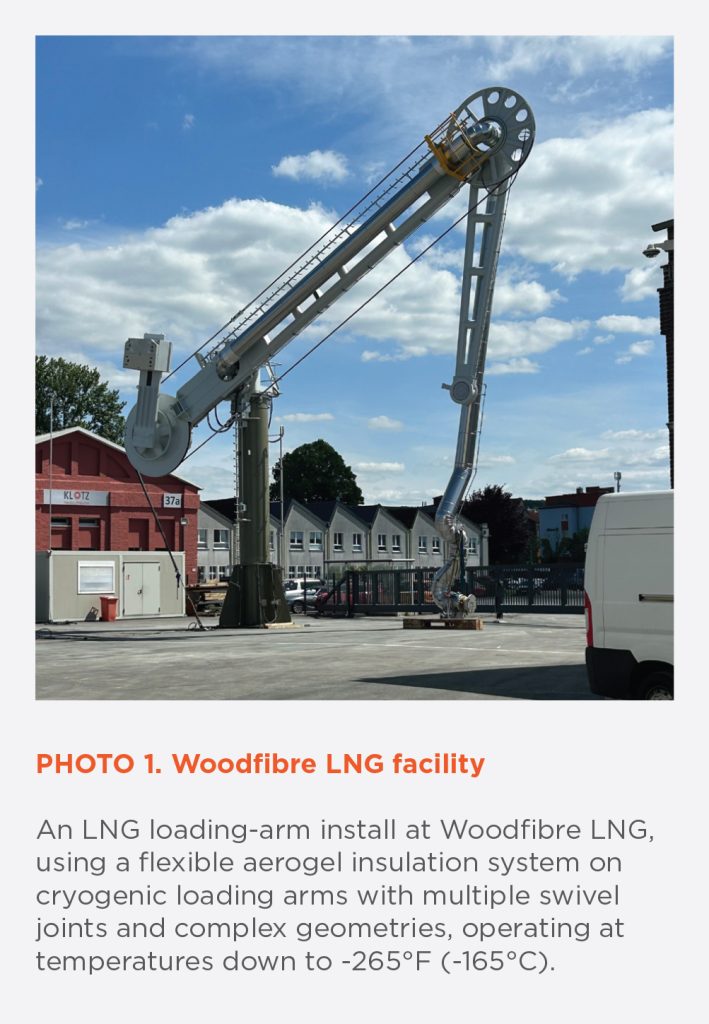
An engineering assessment for application-specific systems should include testing for system performance, not just material performance. Table 1 illustrates the key areas of interest for both the material by itself and for the material when used in a system configuration. It also lists the relevant material properties that can be expanded upon for systems and applications.
There has been a broader industry trend toward application testing and system qualifications, putting additional pressure on insulation manufacturers to provide data on specific systems. Without such data and information, asset owners become responsible for trialing and qualifying an untested system.
Design Driven by Thermal Performance
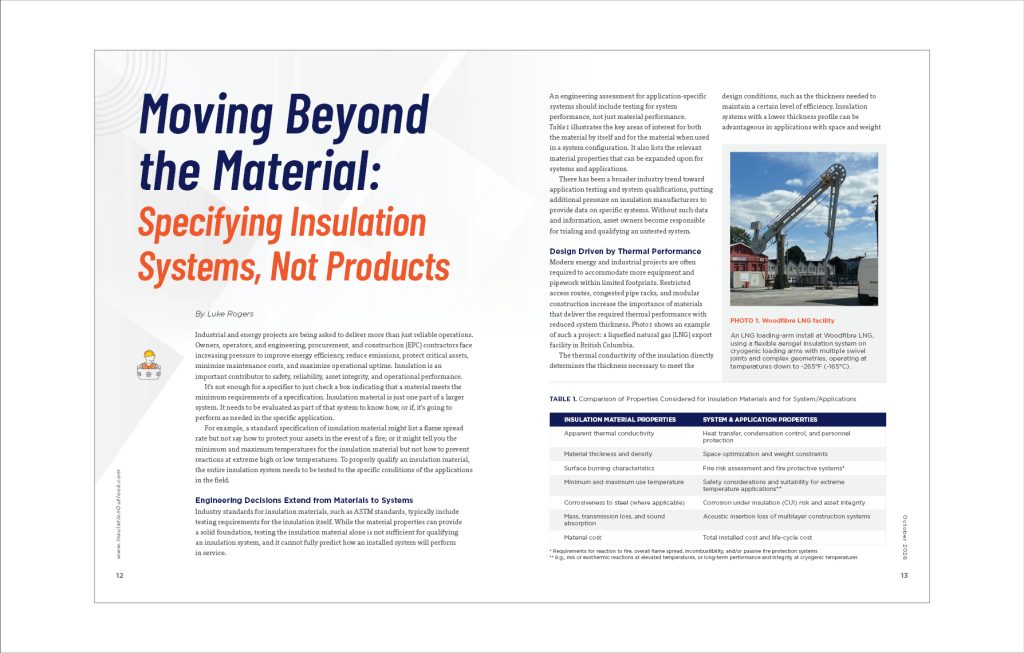
Modern energy and industrial projects are often required to accommodate more equipment and pipework within limited footprints. Restricted access routes, congested pipe racks, and modular construction increase the importance of materials that deliver the required thermal performance with reduced system thickness. Photo 1 shows an example of such a project: a liquefied natural gas (LNG) export facility in British Columbia.
The thermal conductivity of the insulation directly determines the thickness necessary to meet the design conditions, such as the thickness needed to maintain a certain level of efficiency. Insulation systems with a lower thickness profile can be advantageous in applications with space and weight limitations, or with complex piping and equipment configurations. In these environments, fabricating thicker insulation would add volume, labor time, and material costs.
Specification Considerations for Fire Behavior
Specifications for insulation materials typically have a required fire safety test, such as those in ASTM E84 or classifications under EN 13501-1, which provide information about surface burning characteristics and reaction-to-fire behavior.1,2
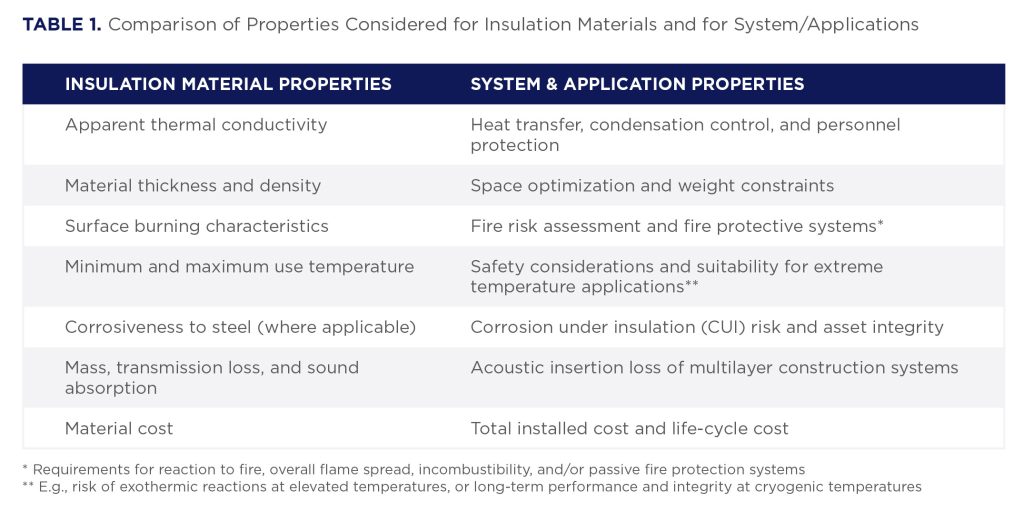
The reaction to fire and flame spread, per ASTM E84 or EN 13501-1, may give a good indication of fire safety for a typical residential or commercial project; however, there is a growing need in the energy and industrial segments for passive fire protection systems, which are assessed using different test methods. Passive fire protection systems may be tested to UL1709 (hydrocarbon pool fires) or ISO 22899-1 (jet fires), with the insulation thicknesses, layering and placement of foils (in the case of sub-ambient applications), jacketing, and installation requirements to achieve the listed Hp/A (massivity).3,4 (See Photo 2.)
For passive fire protection applications outside of standard configurations, insulation manufacturers can offer application-specific design recommendations, insulation thickness calculations, and even finite element modeling.5 For many applications, the focus is shifting from simple fire classifications to proving that insulation systems can effectively protect critical assets when it matters most.
Protection from Corrosion Under Insulation
Asset integrity has become an equally significant driver of insulation system selection. CUI is one of the sector’s most persistent and costly maintenance challenges. Industry publications commonly report that CUI may account for 40 to 60% of piping maintenance expenditures and approximately 10% of annual maintenance costs in affected oil,
gas, and petrochemical facilities.6 The issue of CUI cannot be addressed with insulation alone. It requires a system approach.7,8
Depending on the insulation type and usage, many standard specifications require testing to evaluate the contribution to corrosion when applied to steel. The minimum requirement for ASTM C1617, for example, is that insulation not exceed a specified corrosion rate when applied to a small steel coupon and cycled between wet and dry in a chloride solution at 230°F (110°C) over the course of 96 hours, then extrapolating from that an approximate
corrosion rate per year under normal use.9
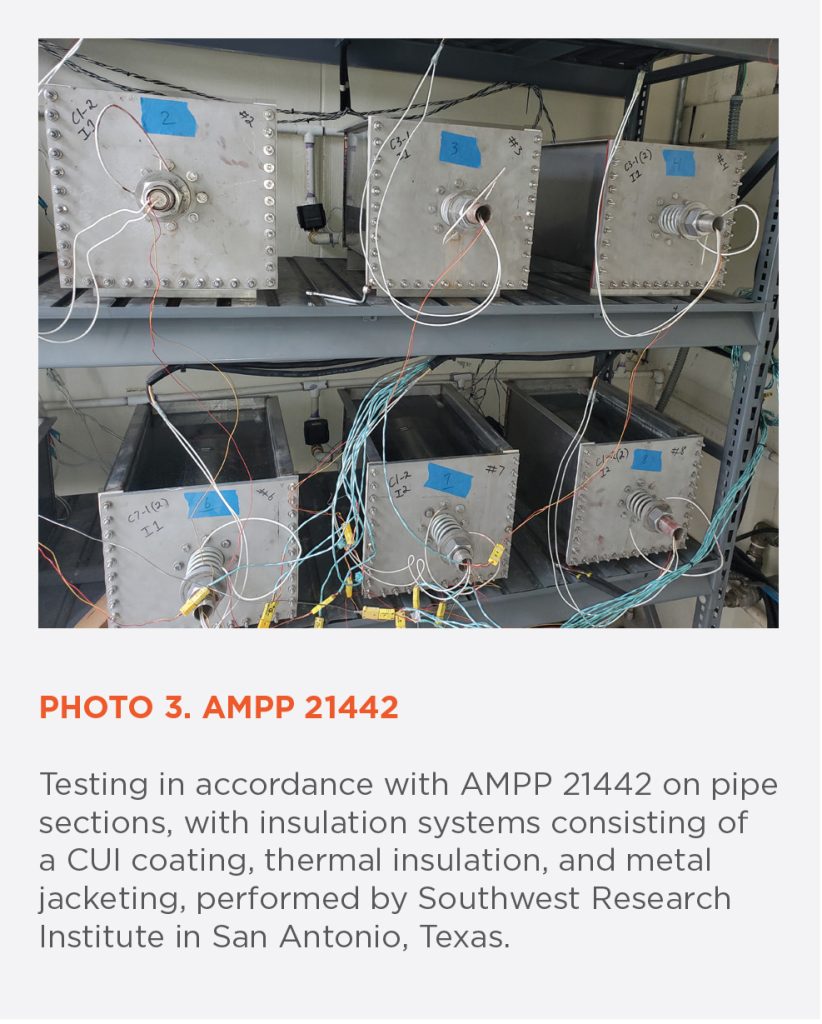
Rather than relying on small-scale, short-term testing in a laboratory environment, many specifiers, engineers, and asset owners prefer testing a system more representative of what will be installed in practice. AMPP 21442 is a test method for evaluating insulation and coating systems on steel pipes. Test conditions involve using a CUI coating, insulation of a specified thickness, and jacketing, subjected to wet/dry cycling at various temperatures over several months10 (see Photo 3).
Safety Considerations for High-Temperature Applications
Even types of insulation materials that are non-combustible per ASTM or EN standards may pose a safety risk if improperly installed. When it comes to assets operating at high temperatures, above 750°F (400°C), with pockets of oxygenated air or organic materials, there can be risk of a fire event. Insulation materials may be listed with a high maximum use temperature, but the user should be cognizant of any special considerations during application.
The ASTM C411 standard test method can be used to evaluate an exothermic temperature rise in an insulation system at its maximum use temperature, with multiple layers of the insulation, at a thickness specified by the insulation manufacturer, and with thermocouples installed between each layer.11
Insulation manufacturers should provide detailed installation instructions based on the testing for extreme-temperature applications to ensure the safety of personnel and the protection of assets. While it’s the asset owner that assumes the risk after installation, insulation manufacturers can reduce safety concerns by fully testing their systems.
System Integrity in Cryogenic Conditions
Cryogenic applications present their own unique set of challenges. LNG infrastructure, for example, operates under extreme temperature differences, with process temperatures reaching down to -265°F (-165°C) and significant thermal contraction as equipment and pipework cool. These conditions create additional demands on insulation systems, including control of moisture and vapor ingress, accommodation of dimensional movement, and maintenance of mechanical integrity.
Under these conditions, insulation systems must do more than provide thermal resistance. They must also manage moisture ingress, accommodate thermal contraction, maintain mechanical integrity, and preserve long-term performance over repeated operating cycles.
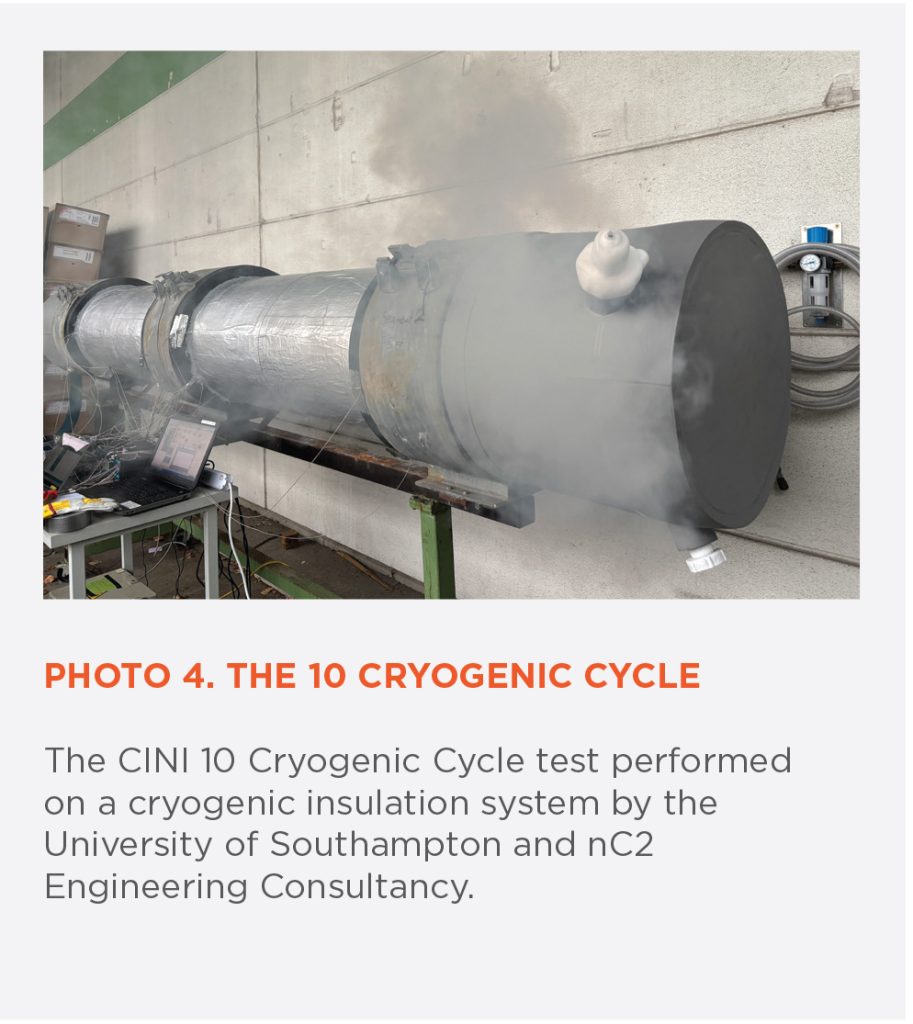
Recognizing these challenges, the industry increasingly relies on application-specific qualification methods that assess how complete insulation systems behave under cryogenic service conditions. Tests such as the “10 Cryogenic Cycle” methodology evaluate thermal performance, moisture resistance, and mechanical durability, while repeatedly cycling systems between ambient and cryogenic temperatures.12 (See Photo 4.)
Technical Expertise Matters
Any insulation products can fail to deliver expected results if improperly installed, or if critical design details are overlooked. Material selection is only one component of insulation system performance. Successful projects also depend on engineering
support, installation quality, and workforce competency. Installation practices, joint detailing, vapor barrier continuity, material handling, and inspection can all influence long-term system performance. Owner-operators and EPC contractors value suppliers that can provide not only high-performance materials, but also technical guidance, application expertise, and practical training.
A growing number of insulation manufacturers are starting to offer services alongside their products, like on-site installation training, contractor qualification, thermal or acoustic consulting, and other benefits. In a global market where generic products may be available from numerous suppliers, the established manufacturing brands recognize the value of local support to help reduce project risk and improve outcomes. These technical services are often viewed as being just as integral as any other components of system performance.
The Future of Insulation Specifications
Going forward, insulation specifiers are less likely to design specifications solely according to material properties and instead are evaluating how effectively the insulation systems can be tailored to their application, and how they address operational and engineering goals, including:
- Improving energy efficiency,
- Optimizing performance in limited space,
- Reducing fire safety risks,
- Managing CUI,
- Ensuring asset integrity at extreme temperatures,
- Reducing downtime and maintenance costs,
- Extending service life, and
- Ensuring technical support over the life of the asset.
As sector investment continues, these considerations are becoming more consequential. It is no longer a matter of just selecting an insulation material, instead it is selecting an insulation system that best meets the needs of the specific application. For a growing number of engineers, operators, and project stakeholders, this way of thinking is shaping insulation decisions.
References
- “ASTM E84 – Standard Test Method for Surface Burning Characteristics of Building Materials,” American Society for Testing and Materials, 2021.
- “Fire Classification of Construction Products and Building Elements – Part 1: Classification Using Data from Reaction to Fire Tests,” EN 13501-1, European Standard, 2019.
- “Rapid Rise Fire Tests of Protection Materials for Structural Steel,” UL 1709, UL Solutions, 2024.
- “Determination of the Resistance to Jet Fires of Passive Fire Protection Materials Part 1: General Requirements,” ISO 22899-1, International Organization for Standardization, 2021.
- “Pressure-Relieving and Depressurizing Systems,” API Standard 521, American Petroleum Institute, 2020.
- NACE Impact Study (Annex D, p. D-10), NACE International, 2016.
- Fitzgerald, B. J., Droz, C., & Winnik, S., “Piping System CUI: Old Problem, Different Approaches [Presentation],” European Federation of Corrosion, 2003.
- “Corrosion Under Insulation and Fireproofing,” American Petroleum Institute (API) Recommended Practice 583, API, 2014.
- “ASTM C1617 – Standard Test Method for Quantitative Accelerated Laboratory Evaluation of Extraction Solutions Containing Ions Leached from Thermal Insulation on
Aqueous Corrosion of Carbon Steel,” American Society for Testing and Materials, 2024.
- “AMPP 21442 – Test Method for Evaluation of Protective Coatings for Use Under Insulation,” Association for Materials Protection and Performance, 2023.
- “ASTM C411 – Standard Test Method for Hot-Surface Performance of High-Temperature Thermal Insulation,” American Society for Testing and Materials, 2019.
- “Manual Insulation for the Industry,” CINI, Committee Industrial Insulation, 2025.