
Gribbins Insulation & Scaffolding Discusses System Design
NIA is proud of the professionalism, creativity, and artistry of our Contractor members. To celebrate the craftsmanship of NIA mechanical and industrial insulation contractors, NIA established the Insulation Project Art Gallery Showcase and Competition in 2023. Last year, we again invited all NIA insulation contractors to submit photographs and a brief description of projects representing their most creative and artistic efforts. At our Fall Summit, we posted all the submissions anonymously and attendees voted for the top three projects in terms of number of parts insulated, aesthetics, difficulty of installation, and well-installed application. We will profile the projects submitted, focusing this month on second-place winner (tie) Gribbins Insulation & Scaffolding (Gribbins). We encourage NIA Contractor members to participate in the next competition and possibly be featured in a future article. The next opportunity to compete will be in 2027, as the Contractor Showcase moves to a biennial schedule.
PROJECT SNAPSHOT
Insulation Contractor: Gribbins Insulation & Scaffolding
Industry Segment: Industrial
Type of Plant/Facility: Distillery
Project Goal: Freeze Protection, Condensation Control, Process Control, Energy Savings
Temperature Range: Below-Ambient System
Region: Midwest
Project Description and Goals
In this new construction project, NIA Contractor member Gribbins installed mechanical insulation on a distillery piping system in Kentucky. The outdoor system included heat-traced cooling tower water and chilled water lines ranging from 6 to 24 inches in diameter. The team installed 2-inch-thick fiber glass pipe covering with aluminum jacketing to ensure durability, energy efficiency, and weather protection. All the work shown in the photos (see page 23 and 26) was completed using scissor and articulating lifts to safely access elevated areas.
Challenges
In an interview, the Gribbins team characterized this project as a standard insulation job for them, but it bears remembering that every insulation project is demanding—when done right. Kyle Forrester, Southern Vice President, says, “There was a lot of highly visible work. Some of it was on larger piping. Some of it was elevated. Your attention to detail and quality’s got to be there. And if you’re adhering to schedule, that [may] increase your manpower.” He adds, “And you’re supposed to do all this while getting home safe to your family.”
“And you’re supposed to do all this while getting home safe to your family.”
The larger piping Forrester references was 20” to 24”, which is a bit larger than in most other systems. Project Manager Todd Siler says of the tower water piping, “The largest size was 24 inches… When you get into those bigger sizes, you need more of a lead time. We did face a few challenges waiting on materials, [but] it was always manageable.” Planning ahead allowed the company to keep to the project schedule.
Then there was the need to perform the work outside, in the elements, at height. Crews used scissor and articulating lifts to get people and materials up to the work areas. While a scissor lift moves a platform up and down, this job required an articulating lift. Also known as a “knuckle boom,” an articulating lift folds (knuckles) on itself, affording flexibility in use and facilitating transport to and from jobsites. Exactly how great a lift are we talking about? The height to the top of the cooling tower was roughly 70 feet, but Siler explains, “That requires about a 120-foot man lift, because you have to extend it, instead of going straight up vertical.” Working at such a height outdoors presents its own challenges. Siler notes, “On sites like this, if you have high winds, you can’t be in an aerial lift [past] a certain height. And, of course, you always have the rain and [other elements] to dodge.”
In addition, keeping everyone safe is vital. Safety is one of the company’s core values, and they set their goal at zero incidents and injuries. The goal is supported by a rigorous, comprehensive safety program. In addition to the company’s full-time safety manager, area safety coordinators cover all the regions where Gribbins has offices. They ensure that everyone on a job is properly trained on all tasks to be performed, and they make regular visits to jobsites to check that safety best practices are being followed and that the site stays in compliance with federal, state, and local requirements, as well as any site-specific rules and regulations the customer sets. Specifically relevant to this project, Siler notes that all of Gribbins’ crew are air lift trained and experienced in working in heights, using appropriate fall protection. Forrester adds, “We’re talking in terms of lifts and stuff like that, but there’s also working with metal: having a safety edge on the metal, making sure we have gloves on that are cut resistant—things like that that.” Gribbins’ safety program consistently earns awards from federal, state, and local agencies, as well as associations and organizations, including several NIA Safety Excellence Awards at the
Platinum level.
Insulation System Walk-Through
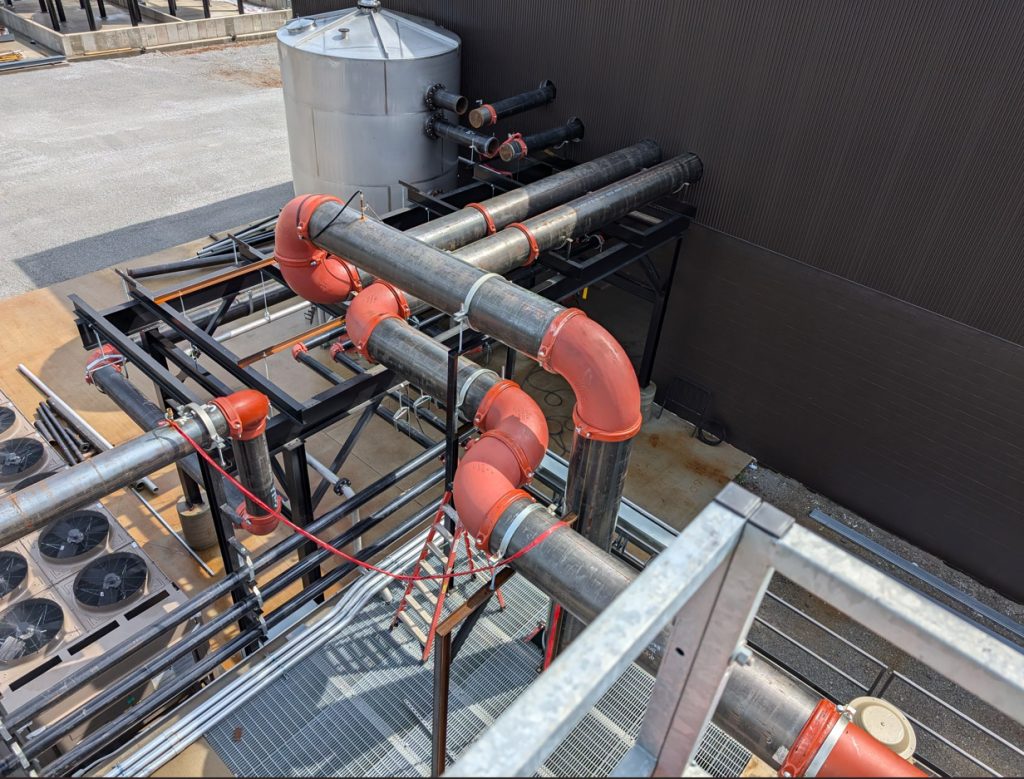
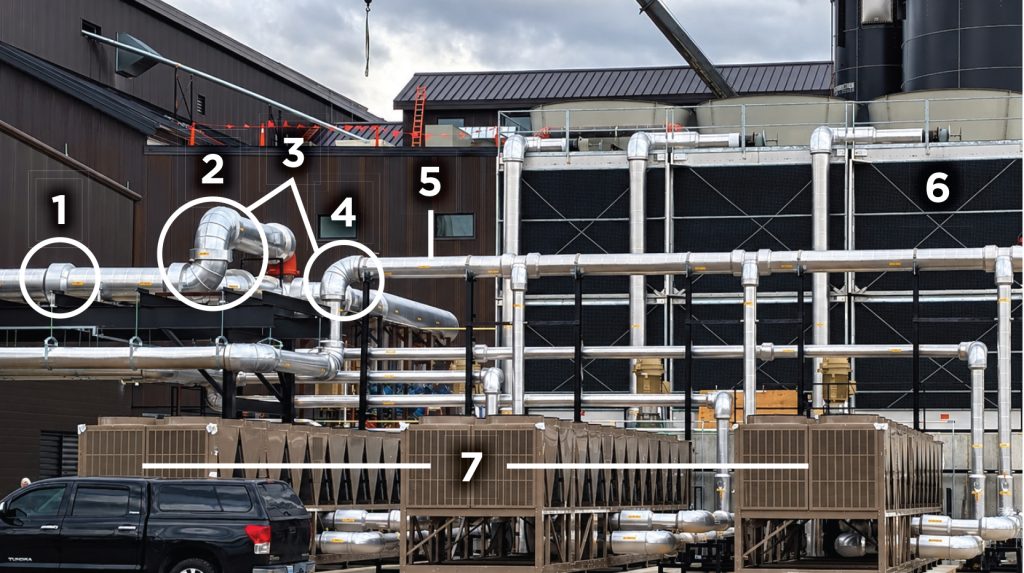
Photo 1 offers a look at parts of the system before insulation application. Photo 2 details different system components for reference.
- Oversizes
- Gored 90s on larger bore piping
- .020 aluminum jacketing
- Pre-molded 90s smaller bore piping
- .016 aluminum jacketing
- Cooling Tower
- Chillers
Table 1 offers an overview of the insulation types and brands used on the system.
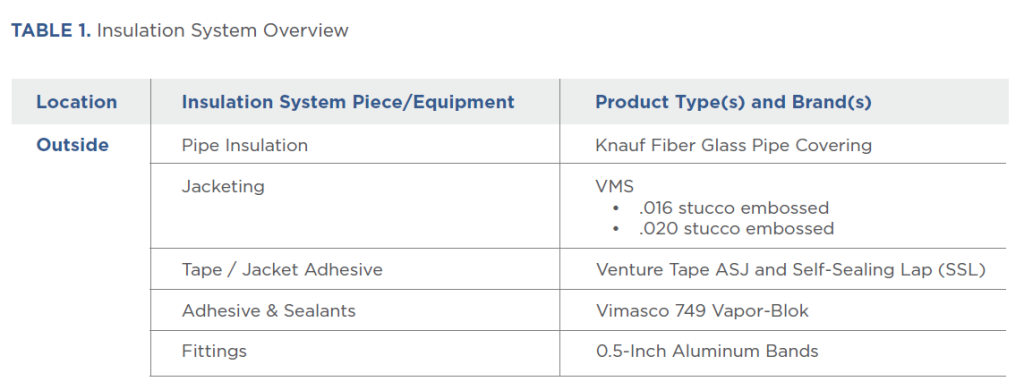
All metal used on project was from Volunteer Megal Systems (VMS). The piping (linear feet) was installed with .016 stucco embossed aluminum, secured with ½” aluminum banding. The fittings (90s and 45s) were .020 on larger bore piping (field fabricated, gores/miters), and pre-molded covers (factory) of .020 on smaller bore piping.
All-Service Jacketing (ASJ) tape was used to vapor seal the ends of the covering on chilled water pipes, butt strips, and raw ends where fiber glass was exposed. Venture Tape ASJ and SSL comes factory installed on Knauf fiber glass pipe covering as a vapor barrier. Bay Insulation supplied the Vimasco Vapor Blok used as a brush-on application on chilled water systems to vapor seal any penetrations or areas where ASJ tape could not be applied—e.g., tees or ends of oversized elements where raw fiber glass was exposed, such as valves and flanges.
To achieve the goal of freeze protection using heat tracing, Gribbins’ crews coordinated with project electricians, who did the actual hook-ups and tie-ins. Siler describes the process: “The [electric] cable is attached to the pipe, and then our insulators—before applying any kind of fiber glass pipe covering—install foil tape over top of the cable and attach it to the pipe… The foil tape over the cable is just for heat transfer, so it covers more of the actual piping. When they turn the heat trace on, instead of just the small area where the cable touches the pipe, when you put a 3-inch foil tape over the cable, it spreads that heat out over the pipe.”
All products listed in Table 1 were used in accordance with project specifications; other NIA members involved directly or indirectly in the project included Knauf (Associate/Manufacturer) and Bay Insulation Supply, Inc. (Distributor).
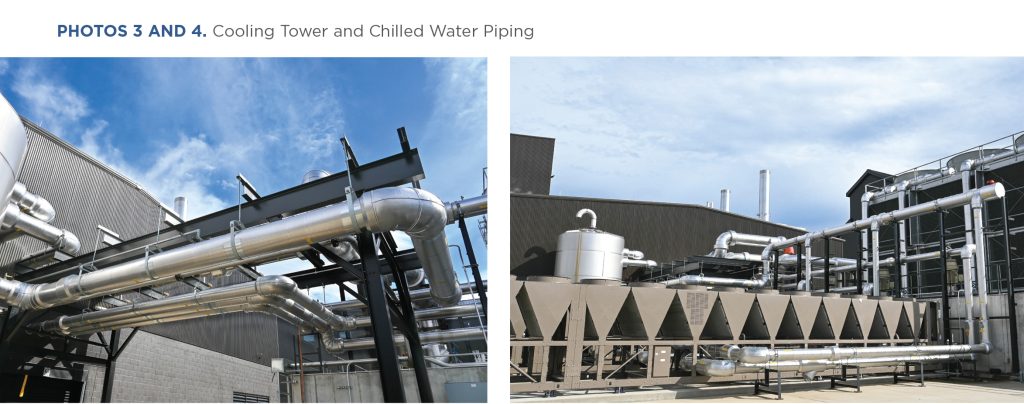
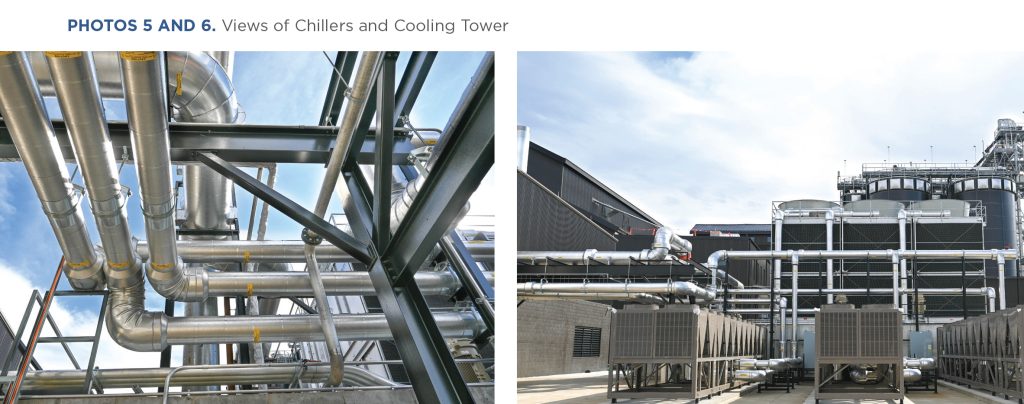
Photos 3–6 show the finished product: fiber glass pipe covering with metal on the tower water and chilled water systems in the back of the plant. This work was all performed using aerial lifts (scissor or articulating). No scaffolding was used on this portion.
What Makes the Project Special
Todd Siler says this project is special to Gribbins “because this is a brand-new plant, built from the ground up. On the industrial side, you don’t get those opportunities very often. Usually, it’s an expansion, or you’re tying into something that’s existing.” The new construction project allowed Gribbins to display company capabilities on a much larger scale than the typical upgrade.
Kyle Forrester adds, “When you start thinking about the challenges that come from working at those elevations… doing that in the elements outdoors… and working as safely as possible [to deliver] a high quality, visually pleasing job,” it’s clear that the crews can take real pride in their work. That type of project execution also helps build customer relationships. With their performance on this job, Gribbins did just that. Louisville Area Manager Jake Gribbins notes, “We’re still working on the site in a maintenance role right now. We’ve helped them out with other issues. They’ve come to rely on us as a resource for insulation on that site. We really shined on this project.”
“They’ve come to rely on us as a resource for insulation on that site.“
With any project, there are stated customer goals, which should be obvious from project specifications,and there are implied goals. Kyle Forrester, observes, “A lot of times, the big picture goals are to insulate—like, for this instance, insulate a heat trace pipe for freeze protection, condensation control, process control, [etc.]. That’s what your goal is. But really, there’s a whole lot more that goes into that.” He explains that what the customer is actually asking for is a high-quality system that meets their specifications, performed within a certain timeframe and schedule, preferably under budget, and completed safely.
For Gribbins, this project highlights the company’s ability to meet both stated and implied goals: deliver high-quality insulation work, under challenging outdoor conditions, while maintaining the craftsmanship and attention to detail so important to the company.
What really resonates with Forrester, though, is how well the project goals aligned with Gribbins’ core values. “Our core values are integrity, safety, quality, and service… In some way, shape, form, or fashion, [the project] touches on all those things that are important to us as a company.” As Steve Jobs observed, “If you are working on something that you really care about, you don’t have to be pushed. The vision pulls you.”
NIA Congratulates 2025 Contractor Showcase Winners
First Place: JT THORPE
Second Place (Tie): Gribbins Insulation & Scaffolding and Insul-Tech, Inc.
We thank all the entrants who helped highlight the diversity and creativity of the mechanical insulation industry, including Jersey Fire Stop, LLC; Performance Contracting, Inc.; and Irex Argus Contracting, LP.
About Gribbins Insulation & Scaffolding
Founded in 1985, Gribbins Insulation & Scaffolding has grown into a leading commercial and industrial mechanical insulation and scaffolding contractor. The company specializes in insulating mechanical and process systems—such as piping, ductwork, and special
equipment—for a wide variety of facilities, including hospitals, schools, power plants, and
manufacturing buildings. To better serve its customers and meet their growing needs, Gribbins launched its scaffolding division in 2021.
Integrity, quality, safety, and service are at the core of everything they do. The company’s mission is to maximize customer satisfaction by providing the highest level of safety, quality, and productivity, leading to optimum employee fulfillment and company profit.
With multiple locations across Indiana, Kentucky, Tennessee, Illinois, and Ohio, Gribbins primarily operates throughout the Midwest, although the company’s extensive project portfolio spans states including Texas, Michigan, Kansas, Missouri, Iowa, Wisconsin,
Pennsylvania, West Virginia, Alabama, Louisiana, North Carolina, Florida, and even the Bahamas.
For more information, please visit www.gribbins.com/about.