
Data Centers Rely on Mission-Critical Outdoor Insulation
When you get right down to it, a data center is simply a building.
Of course, when it comes to mechanical systems—especially insulation—they are anything but simple. While data centers share some infrastructure with other commercial buildings, including piping, ductwork, and chillers, the scale and performance requirements are exponentially larger, particularly outside the building envelope.
As Kent Gapen, Business Development for NIA member company Farwest Insulation Contracting in Arizona, put it, “The needs of a data center compared to, say, a hospital, are 10-fold. Maybe more.” He added, “It’s a building that is pretty basic and straightforward, but the pipe sizes and lengths and footages on a data center are phenomenal, and that’s the challenge.”
For most people, the mention of a data center brings to mind indoor images of the rows and rooms full of machinery. The objective of operating a data center is no small undertaking. Because data centers often house real-time data processing for industries such as telecommunications, finance, and health care, it’s critical to keep things running at an optimal level. There’s a lot that goes into keeping all that technology running efficiently.
System failures can have massive consequences for businesses and consumers around the world, which means data centers need to be well planned and constructed. If machinery overheats or otherwise stops working, the consequences can be catastrophic.
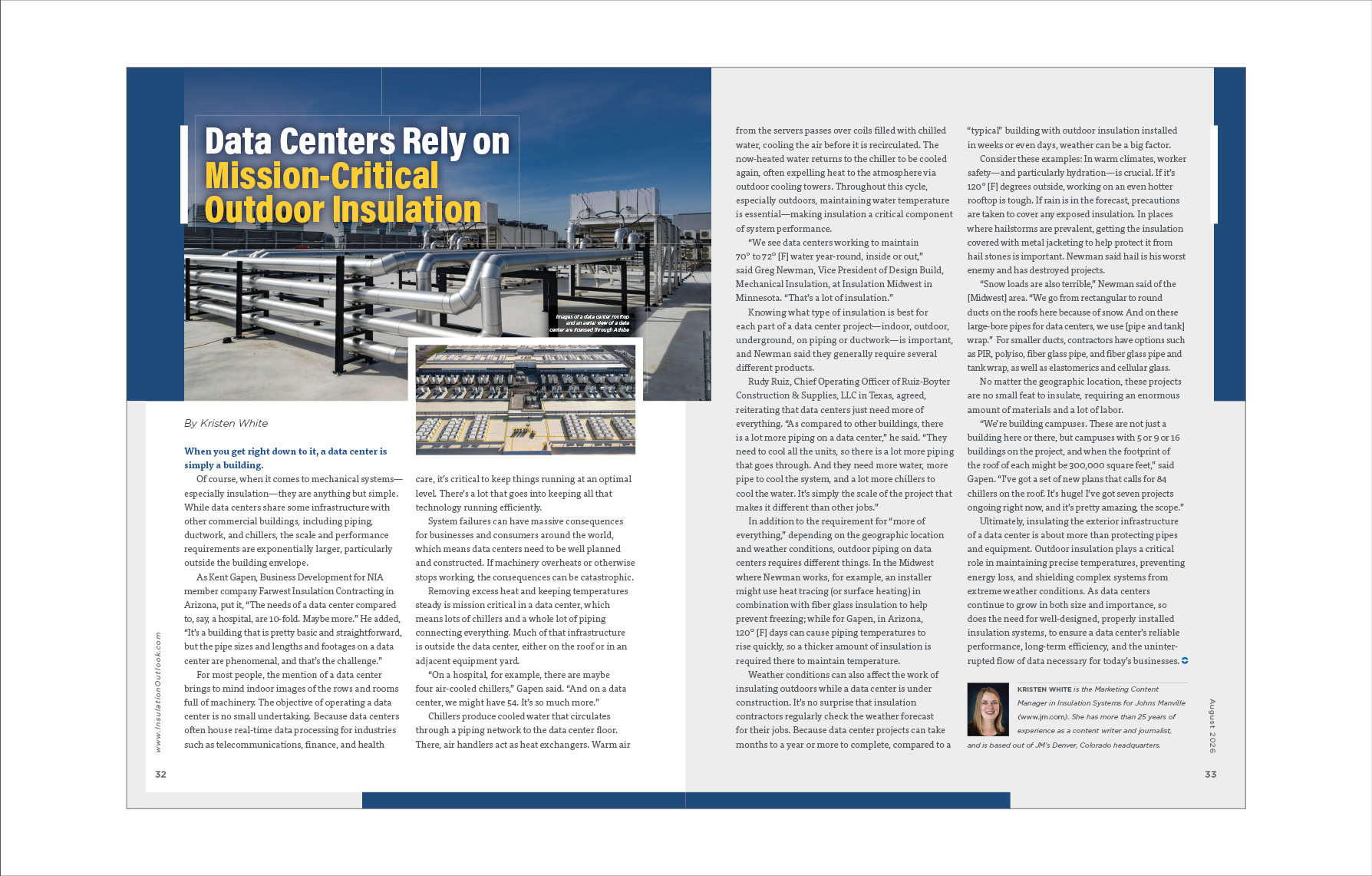
Removing excess heat and keeping temperatures steady is mission critical in a data center, which means lots of chillers and a whole lot of piping connecting everything. Much of that infrastructure is outside the data center, either on the roof or in an adjacent equipment yard.
“On a hospital, for example, there are maybe four air-cooled chillers,” Gapen said. “And on a data center, we might have 54. It’s so much more.”
Chillers produce cooled water that circulates through a piping network to the data center floor. There, air handlers act as heat exchangers. Warm air from the servers passes over coils filled with chilled water, cooling the air before it is recirculated. The now-heated water returns to the chiller to be cooled again, often expelling heat to the atmosphere via outdoor cooling towers. Throughout this cycle, especially outdoors, maintaining water temperature is essential—making insulation a critical component of system performance.
“We see data centers working to maintain 70° to 72° [F] water year-round, inside or out,” said Greg Newman, Vice President of Design Build, Mechanical Insulation, at Insulation Midwest in Minnesota. “That’s a lot of insulation.”
Knowing what type of insulation is best for each part of a data center project—indoor, outdoor, underground, on piping or ductwork—is important, and Newman said they generally require several different products.
Rudy Ruiz, Chief Operating Officer of Ruiz-Boyter Construction & Supplies, LLC in Texas, agreed, reiterating that data centers just need more of everything. “As compared to other buildings, there is a lot more piping on a data center,” he said. “They need to cool all the units, so there is a lot more piping that goes through. And they need more water, more pipe to cool the system, and a lot more chillers to cool the water. It’s simply the scale of the project that makes it different than other jobs.”
In addition to the requirement for “more of everything,” depending on the geographic location and weather conditions, outdoor piping on data centers requires different things. In the Midwest where Newman works, for example, an installer might use heat tracing (or surface heating) in combination with fiber glass insulation to help prevent freezing; while for Gapen, in Arizona, 120° [F] days can cause piping temperatures to rise quickly, so a thicker amount of insulation is required there to maintain temperature.
Weather conditions can also affect the work of insulating outdoors while a data center is under construction. It’s no surprise that insulation contractors regularly check the weather forecast for their jobs. Because data center projects can take months to a year or more to complete, compared to a “typical” building with outdoor insulation installed in weeks or even days, weather can be a big factor.
Consider these examples: In warm climates, worker safety—and particularly hydration—is crucial. If it’s 120° [F] degrees outside, working on an even hotter rooftop is tough. If rain is in the forecast, precautions are taken to cover any exposed insulation. In places where hailstorms are prevalent, getting the insulation covered with metal jacketing to help protect it from hail stones is important. Newman said hail is his worst enemy and has destroyed projects.
“Snow loads are also terrible,” Newman said of the [Midwest] area. “We go from rectangular to round ducts on the roofs here because of snow. And on these large-bore pipes for data centers, we use [pipe and tank] wrap.” For smaller ducts, contractors have options such as PIR, polyiso, fiber glass pipe, and fiber glass pipe and tank wrap, as well as elastomerics and cellular glass.
No matter the geographic location, these projects are no small feat to insulate, requiring an enormous amount of materials and a lot of labor.
“We’re building campuses. These are not just a building here or there, but campuses with 5 or 9 or 16 buildings on the project, and when the footprint of the roof of each might be 300,000 square feet,” said Gapen. “I’ve got a set of new plans that calls for 84 chillers on the roof. It’s huge! I’ve got seven projects ongoing right now, and it’s pretty amazing, the scope.”
Ultimately, insulating the exterior infrastructure of a data center is about more than protecting pipes and equipment. Outdoor insulation plays a critical role in maintaining precise temperatures, preventing energy loss, and shielding complex systems from extreme weather conditions. As data centers continue to grow in both size and importance, so does the need for well-designed, properly installed insulation systems, to ensure a data center’s reliable performance, long-term efficiency, and the uninterrupted flow of data necessary for today’s businesses.