
NIA Contractor Member JT THORPE Discusses System Design
NIA members attending Fall Summit voted a mission-critical facility upgrade at a power generating plant performed by JT Thorpe the first-place winner of 2025’s Insulation Project Art Gallery Showcase and Competition.
Project Description
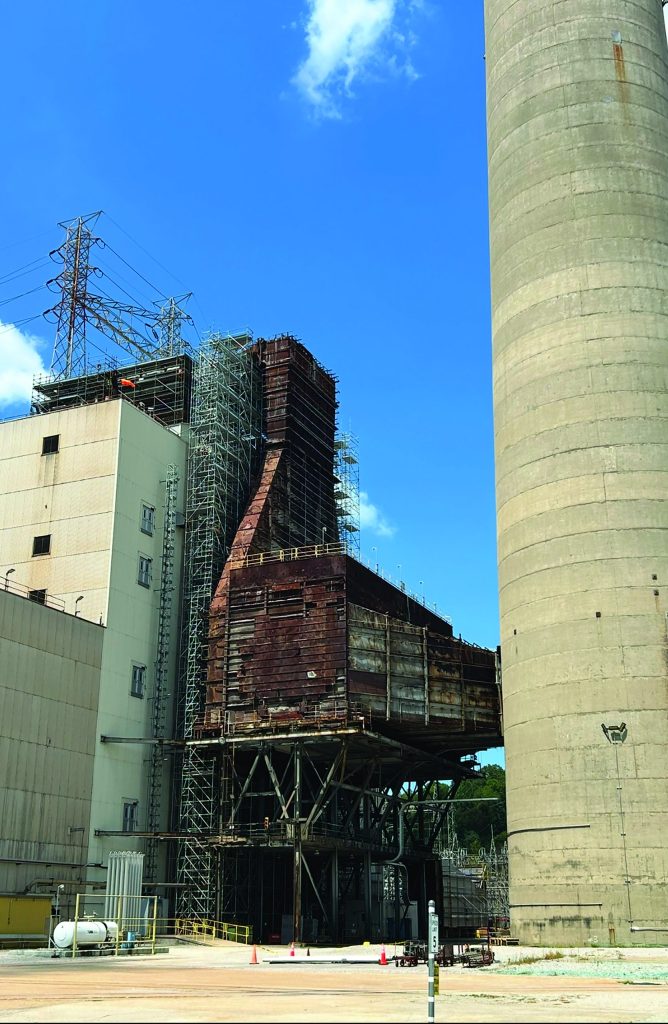
The Pre-Cip (Precipitator) Duct Replacement Project involved meeting a complex series of requirements to accomplish a facility upgrade at the Big Sandy Power Plant in Louisa, Kentucky, owned by American Electric Power (AEP) and operated by AEP subsidiary Kentucky Power. The outlet pre-cip duct, installed in the late 1980s to address environmental concerns, connected to the Unit 1 boiler and was responsible for directing exhaust gases from the boiler to the stack. The current project addressed a significant operational issue: The severely degraded 40-year-old duct had become structurally compromised to the point of requiring replacement. It was allowing cold air infiltration, causing condensation in the stack and reducing system efficiency. Replacing it and properly insulating the new duct would remedy those concerns and provide long-term efficiency for the unit.
Efficiency is critical to the plant’s ability to comply with federal and state regulatory requirements. In 2014, the Kentucky Public Service Commission approved a plan to convert Unit 1 at Big Sandy from coal-fired to gas-fired electricity generation so the plant would comply with 2015 federal environmental standards. The conversion was completed in May 2016, and the upgraded unit went online May 30, 2016. Nearly 10 years later, the Pre-Cip Duct Replacement Project played a critical role in achieving energy and emissions savings into the future. It is also in keeping with one of the core principles described in AEP’s 2025 Corporate Sustainability Report: environmental respect.
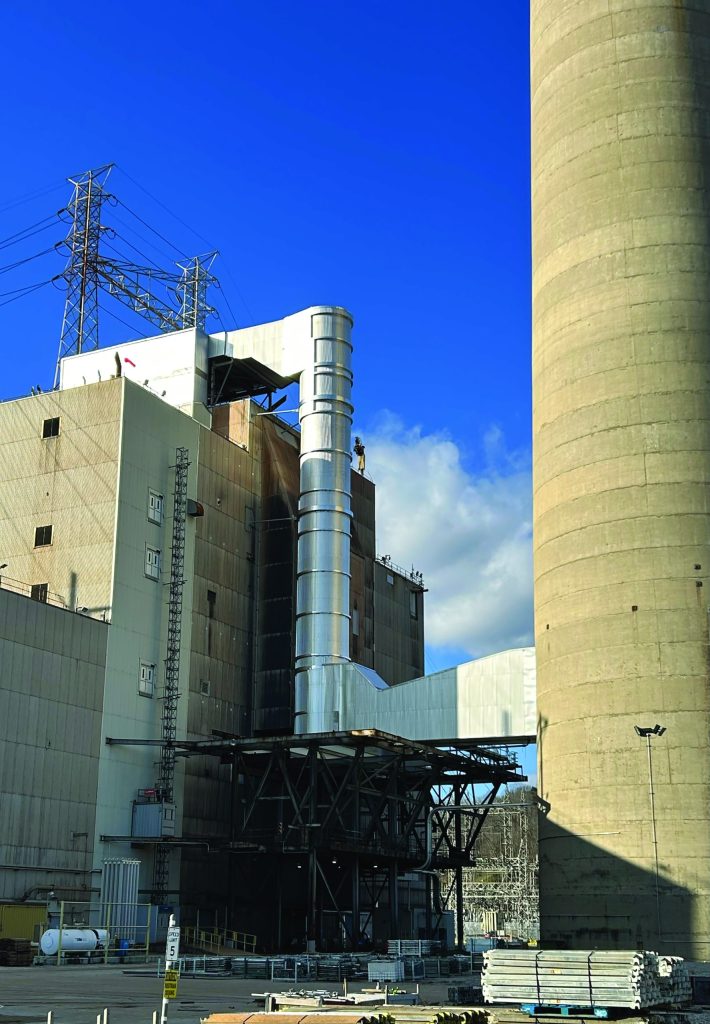
JT Thorpe’s scope of work involved asbestos abatement to prepare for the removal and demolition of the existing duct, removing the structurally compromised ductwork, and installing new, high-performance systems designed for durability and energy efficiency. Specific sections of the new duct system would be insulated before installation, and the remaining components were to be insulated after the new duct was positioned. JT Thorpe personnel constructed and maintained scaffolding to provide safe access for all crafts throughout project performance, painted and coated all structural components and tie-in points, and ensured that all aspects of the work adhered to AEP’s rigorous safety and operational standards.
Photos 1 and 2 offer a comparison of the state of
the pre-cip duct before and after project completion.
Project Planning and Execution
JT Thorpe submitted a comprehensive scope-of-work package covering abatement, painting, scaffolding, and insulation—including a detailed timeline and schedule. To meet the objectives for the upgrade, the following project goals were established.
- Timeline/Schedule and Budget: 12-week turnaround, with project completion on schedule and within budget.
- Quality: All installations to meet strict quality standards for final approval.
- Safety: Zero injuries over the course of the project.
As is common with facility replacement and upgrade jobs, the Pre-Cip Duct Replacement Project presented issues that challenged the contractor’s ability to meet the goals listed. JT Thorpe’s advance planning, risk assessment and mitigation, and deliberate execution enabled the team to overcome each challenge and meet (or better) each objective.
Timeline/Schedule and Budget
Site owner AEP’s power transmission system is one of the largest in the United States, spanning 11 states and supporting 5.6 million customers by providing approximately 29,000 megawatts of generating capacity. As part of that system, the Big Sandy Power Plant uses 2.3 million cubic feet of natural gas each hour to attain generation capacity of 295 megawatts of power.
Maintaining grid reliability and availability is paramount. AEP set the project completion date at 12 weeks to ensure the duct was operational and the plant able to return power to the market within that time frame.
JT Thorpe had to manage and overcome the following challenges, each of which had the potential to impact the schedule:
- Specification review delays,
- Change in installation sequencing, and
- Poor weather conditions.
The delay in specification review meant that the general contractor and project engineers raised multiple issues regarding duct-construction specifications, including weld procedures and inspection requirements, later in the process than usual. Approval delays then pushed the date insulation installation could begin later in the schedule, which altered JT Thorpe’s original work plan. Approximately 40% of the insulation had to be installed after the duct was installed, from scaffold. Asked how the team accommodated the unexpected “in-air installation” requirement without losing any time, Project Superintendent Thomas C. (“Clint”) Hinkle gave credit to JT Thorpe’s carpentry team, led by Josh Bolin, an 18-year Local 650 journeyman carpenter superintendent. Hinkle says, “One of the great things that works for us is the [expertise of our] carpenter, Josh Bolin. As we learned we had to do it, he and his team were quick to get a scaffold just where we needed it… The carpenters really drove us home to get where we needed to, and we just rolled right along with it, so it worked out well.”
That said, Hinkle stresses that working at elevation “is a whole different ball game,” requiring its own planning and execution—and it gets more challenging the higher the elevation. The team worked in increments of 20 feet all the way up to the tie-in point at the top of the pre-cip duct at 200 feet. The secret, Hinkle says, is “good communication… We use three-way communication to make sure we understand what’s going into [each step], and exactly what we are going to do.”
Underscoring the importance of communication, John Stevens, JT Thorpe Vice President, describes the coordination involved in “getting the materials up to the elevated surfaces and making sure all that was being managed safely: the fall protection that had to be in place, and lifts—getting materials lifted up to the work access areas. It was an orchestrated challenge.” (More details on the scaffolding work are described in the section on safety)
Adding to the complexity of working at elevation, uncooperative weather threatened to disrupt the schedule. High winds along the Big Sandy River and an unusually heavy amount of rainfall during the project window had the potential to cause disastrous production delays. Hinkle notes that good planning allowed the team to compensate and avoid slippage in the project’s completion date, explaining, “We looked ahead at the weather forecasts every day and planned it all out… We had a very good general foreman. We were able to plan a lot of the inside work [such as] fabricating our metal for when the bad weather hit.”
When the customer sought to make the unit more visually appealing, asking the team to work on a section of the plant that was not being replaced so that it would match the new construction, JT Thorpe’s team was given access before the rest of the work started. As a result, the expansion of scope had no impact on the 12-week schedule.
In the end, Hinkle notes, “They fired up actually a little faster than 12 weeks.” All the planning and attention to detail got the plant back online a week ahead of schedule.
The same level of planning and communication also helped to manage cost. JT Thorpe was able to stay in budget through collaborative planning and coordination with vendors, the general contractor, and the site owner.
Quality
The team implemented a rigorous quality-control protocol, including daily inspections by the project engineer and site superintendent. All installations had to meet strict quality standards for final approval, as access for changes or repairs would be limited once the scaffolding was removed. Key inspections included:
- Band placement–this had to be done properly to secure the insulation;
- Placement of screws–quantity, spacing, and location were verified to ensure panel stability;
- Quality of caulking–all cuts had to be properly made and thoroughly sealed to ensure they were watertight; and
- Panel integrity–panels were visually inspected for dents or damage prior to approval.
Any areas of concern were tagged and re-inspected after changes were made, although Hinkle notes that because there was good communication between his team and the customer’s engineers, and with material suppliers, “we got our work approved pretty quick because the guys understood what they were asking for.” If there was a question about anything, he adds, “it was quick to get an answer. They were really easy to work with.” The open flow of communication and the well-defined quality assurance process ensured no significant rework by JT Thorpe was needed.
Safety
The project’s numerous challenges—from hazardous conditions surrounding removal of the old system to difficult weather and the need to complete work originally designed to be on the ground in air, on scaffolds at elevations as high as 200 feet—made a focus on safety critical.
A nine-time Platinum-level award winner of NIA’s Safety Excellence Award, as well as numerous other awards, on the Big Sandy project the JT Thorpe team completed 15,052 man-hours with zero injuries. This exceptional safety achievement was the result of a proactive safety culture built on a combination of well-defined processes and practices, training and certification, proprietary technology and tools, and that element recognized as the foundation of the company’s success in other areas: communication. Safety practices strictly followed on the Pre-Cip Duct Replacement Project included the following.
- Comprehensive pre-work planning: Every task, especially high-risk scaffold/in-air installation, was carefully reviewed for hazards.
- Daily safety briefings: Crew members were briefed on potential risks, weather conditions, and proper procedures.
- On-site supervision: The project engineer and site superintendent maintained constant oversight, ensuring compliance with OSHA standards and internal safety protocols.
- Tag-and-inspect system: Any questionable installation areas were tagged and only cleared after proper rework and approval, preventing unsafe conditions from going unnoticed.
- Worker empowerment: Team members were encouraged to stop work if safety concerns arose, creating a culture where everyone felt responsible for the well-being of their peers.
The company was well-positioned to address perhaps the most obvious safety challenge: the scaffolding requirement. JT Thorpe is one of fewer than 100 companies nationwide, and one of the largest, with accreditation from the Scaffold & Access Industry Association (SAIA).
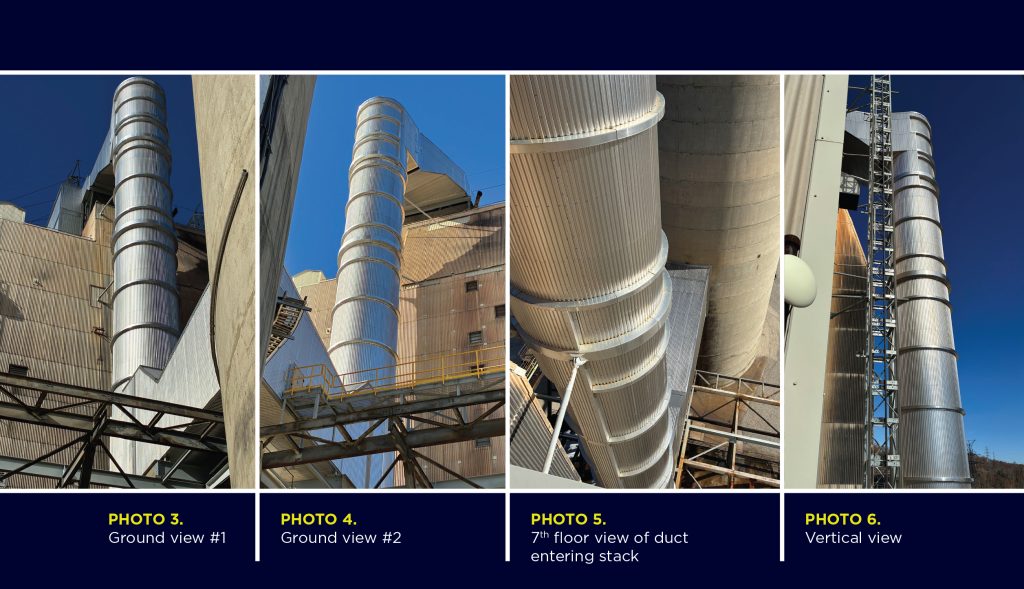
Robert Prinz, JT Thorpe Chief Commercial Officer, describes SAIA as “the NIA of scaffolding” in that they have created an industry-recognized third-party curriculum for providing scaffold user training, including competent person training for supported and suspended scaffolds. Prinz notes that JT Thorpe and its customers have confidence from knowing their team has been through standardized, rigorous training, which translates into predictable, safe performance. And predictable, safe performance is vital when people are performing complex work 200 feet above ground. Photos 3 through 6 offer a range of perspectives to give a true appreciation of the unit’s height.
JT Thorpe uses two proprietary tools to facilitate sharing of safety information and ensure a daily focus on safety is personal for every employee on the jobsite: a proprietary safety app, and FLASH (Field Level Assessment of Safety Hazards) cards.
Prinz explains that the safety app “started out on paper… Then when apps started to come around, we built it. Over the course of time, we’ve built more onto the app as digital information became much more prevalent. It’s a complete repository for our safety data and safety program.” The technology uses algorithms to analyze jobsites for possible hazards each day, and it allows input from crew members in the field to help identify targets for daily safety briefings. For example, says Prinz, “if we’re getting feedback from everybody’s pre task planning plans that there are a lot of crane lifts going on, we can focus our safety talks for that week or the next, saying, ‘hey, when you’re doing crane lifts, here’s what you need to do…’ We’re getting what’s truly happening in the field and figuring out how we can mitigate those risks.
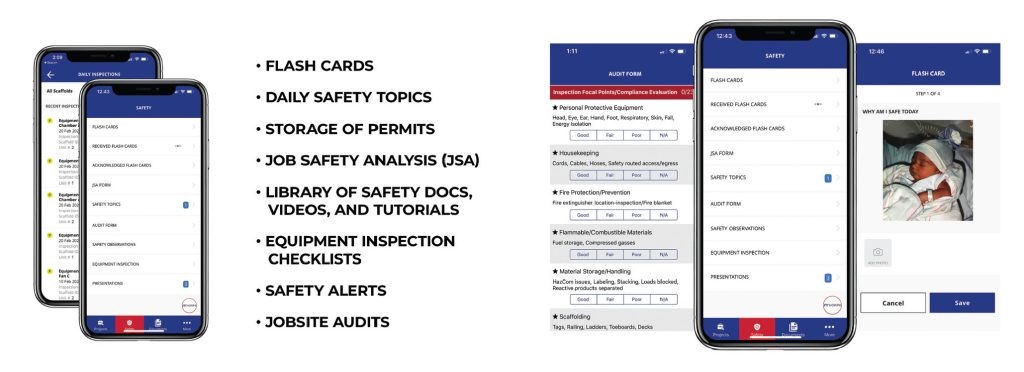
The goal of the FLASH cards is to help each employee start the day thinking about their safety—and not only in the professional terms of conducting a jobsite hazard assessment and pre-task planning, but with a more personal daily reminder of why safety matters. Says Prinz, “The very first question is, why am I working safely today?” He says employees will put a picture of their family, for example, to see first thing. “They’re the why,” he says.
The culture of caring about safety on a personal level is further enhanced by an interesting next step—one not necessarily expected in the corporate world. Prinz explains, “When you complete your daily FLASH card, it goes to a random person in the company. They’ll read your answer and they may say, ‘Hey John, I see it’s your anniversary tonight. Have fun with your wife.’ It creates that interaction and builds a culture.” Hinkle agrees. “Doing those little safety things every day definitely helps to keep your guys in [the right mind frame]. If they see something, they tell you… We always say, ‘You’re your brother’s keeper,’ so you look out for everybody. And it might not even be people that work for our company that our guys look out for.”
Insulation System Specifications and Components
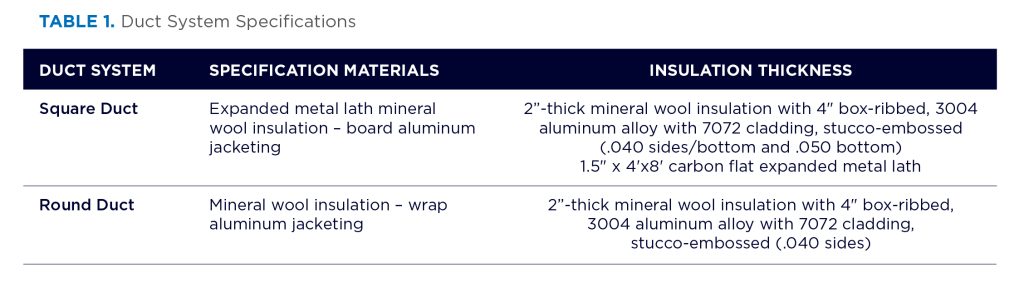
Stevens explains, “The customer here is American Electric Power, and they have, over the years…[developed] a set of standardized, engineered specifications for their different systems.” When the project went out for bid, Stevens says, “they already had the set standards and specifications for the materials… based on data that the customer collects through their processes. And they’re all the time trying to harness energy and make their units more efficient.” Table 1 shows AEP’s specifications for insulation materials and thickness for the pre-cip duct system.
JT Thorpe’s work also needed to comply with AEP-approved specification SES-4005, which addresses the standards (technical and construction) for current transformer enclosures in AEP’s metering installations.
The company collaborated with Mathias Metal to specify and configure structural elements such as stand-offs / stiffeners (see Figure 1).
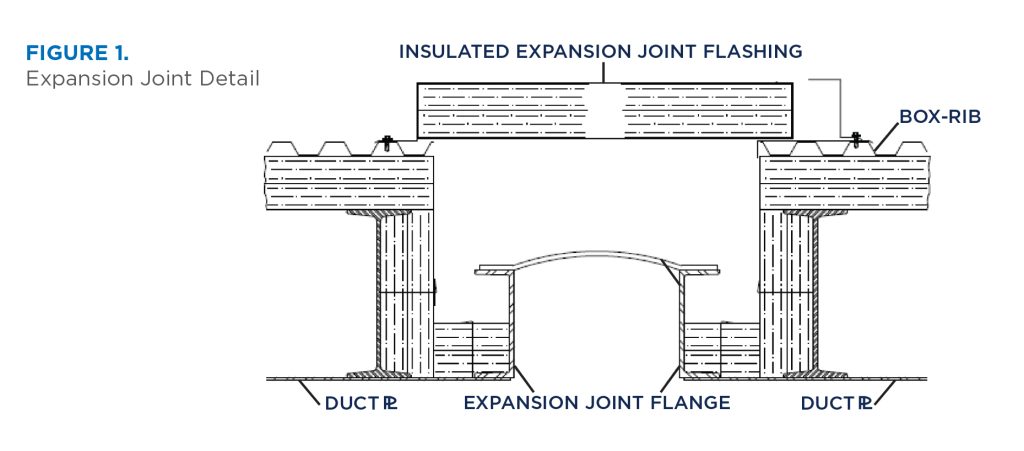
Table 2 offers a summary of material types and products used, as well as the rationale for their selection.
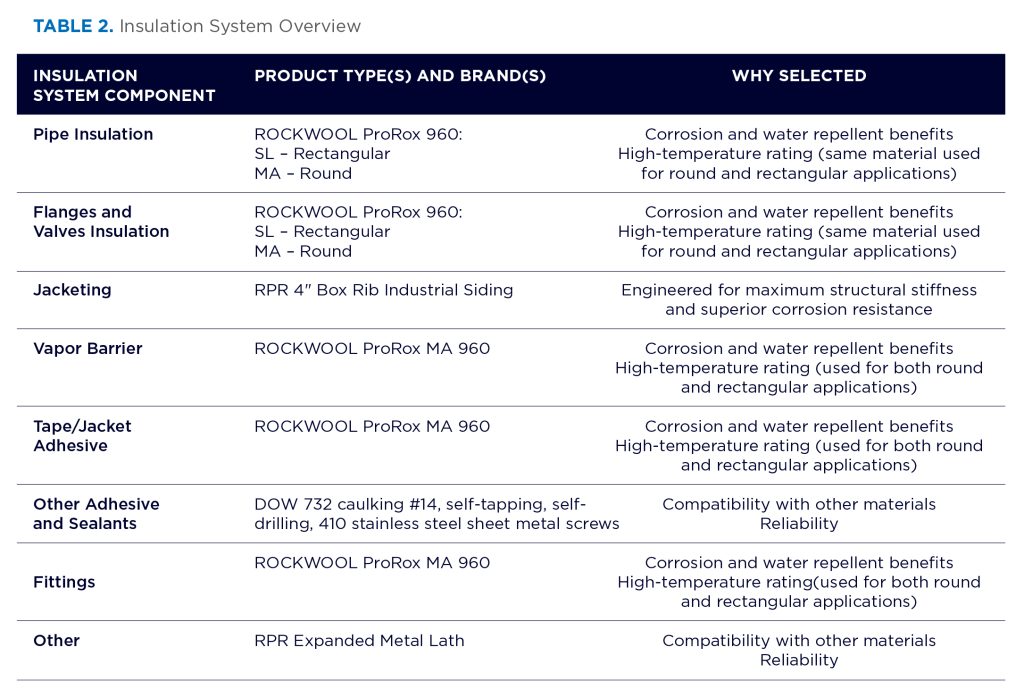
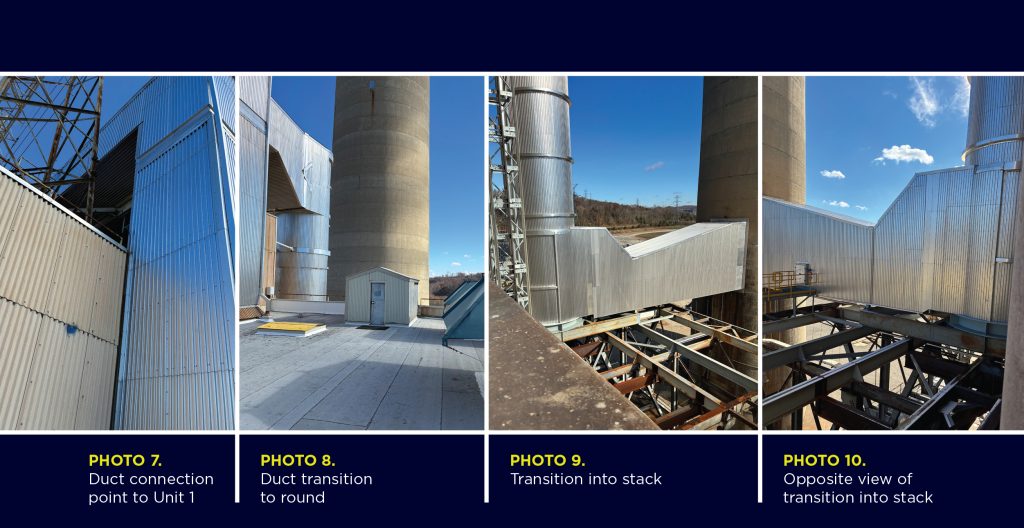
Overall, products used for insulation system components were selected based on thermal rating (up to 1,200°F, per product data sheet) and durability under weather exposure. Metal components and fasteners met project-specific structural and environmental requirements. Component selection prioritized reliability, longevity, and compatibility with existing ductwork. Photos 7 through 10 show various insulated sections.
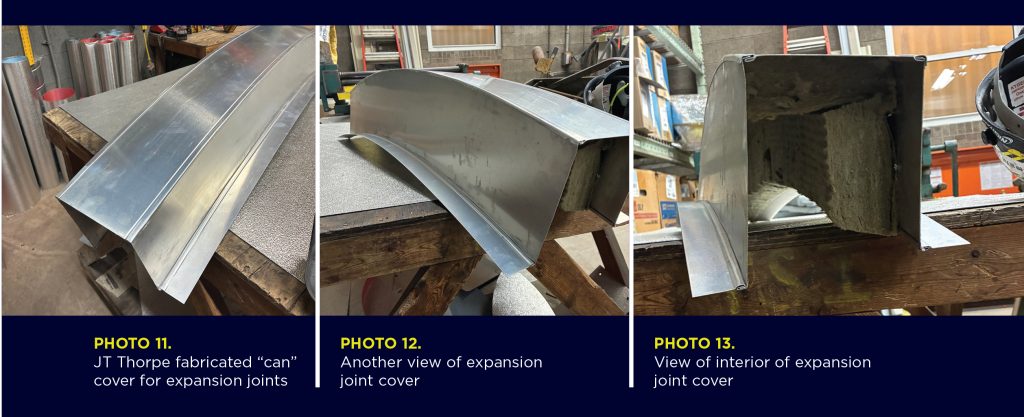
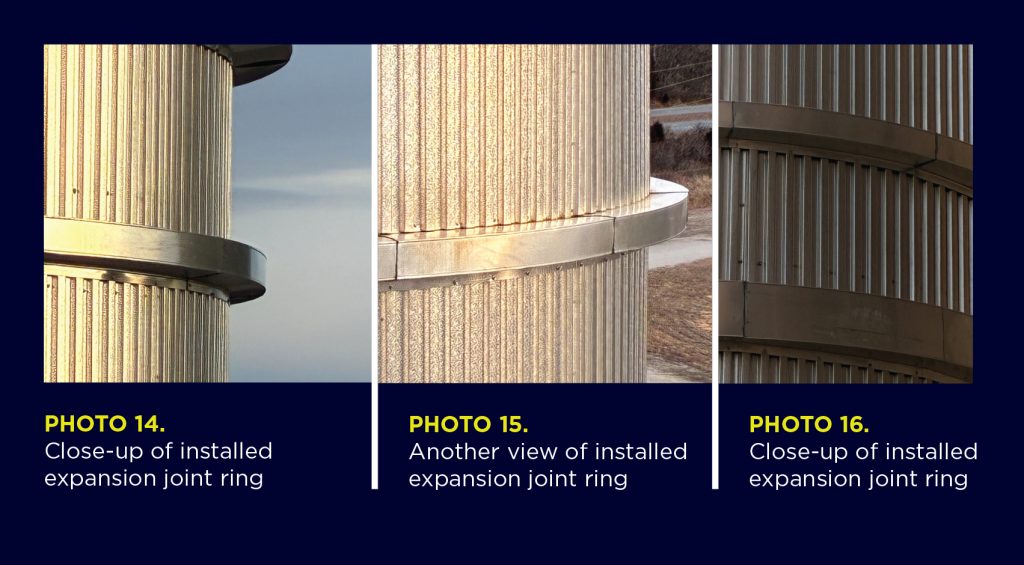
The only area of the system originally left uninsulated were the expansion joints, which were not insulated to keep heat emitting from the duct from compromising the material for the conveyor belt. John Stevens notes that this was an area where the customer’s engineers struggled to find a way to accommodate the natural expansion and contraction. Hinkle explains, “We came up with a solution. We had some cans that we made… Once we got them made, put them on, insulated them and everything, it really helped the project. It looks good and it holds the heat in well.” Photos 11 through 16 show the “cans” fabricated in the shop and then installed in rings around the expansion joints.
Project Takeaways
Stevens and Hinkle shared what they consider useful takeaways for those involved in every phase of a facility life cycle, and they apply to all types of mechanical insulation projects.
For Facility Owners / Managers
- Aging facilities should be proactively inspected and any damaged insulation, piping, and other components replaced before efficiency losses escalate.
- Timely maintenance avoids unexpected downtime and costly system inefficiencies.
- Clear scopes of work and early planning of abatement, insulation, and structural requirements reduce risks of administrative delays, last-minute change orders, and potential environmental impacts or regulatory compliance issues.
For Designers / Engineers
- Ensure design specifications and inspection criteria are clearly defined and approved before fabrication or installation—delays in approval can force suboptimal installation methods (e.g., “in-air” insulation installation).
- Collaborate early with subcontractors and structural suppliers to confirm compatibility and availability of materials (e.g., metal panels, insulation rated for high-temperature applications, structural stand-offs).
- Incorporate access and scaffold removal constraints into the design—once scaffolding is removed, adjustments may not be feasible, so first-pass quality must be guaranteed.
For Insulation Contractors
- Communication is at the heart of project performance, efficient installations, personnel safety, quality results, and customer satisfaction.
- Educate yourself and your teams on the most updated materials, products, applications, and best practices.
- Think creatively and be a problem solver/consultant when solutions are needed on the fly—as when the JT Thorpe team developed the expansion joint rings.
Overall, Stevens emphasizes, “one of the big takeaways is, there’s a lot of companies that have old, outdated specifications that they still have in their engineering department or their procurement department. The owners really need to get involved with today’s insulation contractors and manufacturers to understand that there have been great advancements made and better, more efficient, easier application materials than what we used 40, 30, 20, even 10 years ago… There’s a lot of information to be had. NIA is a great resource with regard to finding the latest and greatest technologies out there.”
A Proud Tradition
The Pre-Cip Duct Replacement Project holds personal significance for the JT Thorpe team. Stevens explains, “The old system we actually installed in the late ’80s/early ’90s. I was the project manager on the job back then.” At that time, his crew included his father, his uncle, and other members of his family. “This project really went full circle from when I ran that job… To come back basically 40 years later and redo the duct system and upgrade it was pretty special.”
And the multigenerational connection doesn’t stop there. Stevens explains, “Then Clint started in the industry. His dad worked with me, and now Clint’s second generation. And for him to run the project, it’s just been a lot of personal attachment.” As many NIA members have observed at association events, the commercial and mechanical insulation industry often seems like one big family. Says Stevens, “Both my sons have been third-generation insulators, Local 80 insulators—as a matter of fact, in the same hall with Clint—and are now JT Thorpe operations managers.” He adds, “It also speaks volumes that all those years later, we’re still working with these same customers. We have built that relationship of trust, service, customer satisfaction, and a quality finished product-driven relationship… It’s pretty cool to see it run generation after generation.”
The company itself spans generations, as this year marks its 120th anniversary. Today, more than 86% of JT Thorpe’s work comes from referrals and repeat customers, expanding and continuing the interconnections.

As for the award-winning project, everyone is extremely pleased with the duct replacement project’s overall success. The customer saw results almost immediately. As Hinkle explains, “The plant talks a lot about how efficient it’s running, as far as the pressures. Before, when the old duct was there, it was very drafty. It had a lot of holes. It was getting a lot of outside air, which was not good. After this project, they’ve been bragging. It’s actually allowed them to get a few more megawatts produced out of the unit.”
For JT Thorpe, the proudest achievement is the safety record: Achieving zero safety incidents over 15,052 man-hours is a major accomplishment, particularly under such challenging working conditions.
“The main goals with every project you do is you want all your guys safe and the customer happy,” Hinkle concludes, “and both of those goals were met.”
JT Thorpe would like to recognize the following individuals for their contributions to the success of the Big Sandy Power Plan Pre-Cip Duct Replacement Project:
Clint Hinkle – 20+ Year Local 80 Journeyman Insulator, Project Superintendent
Josh Bolin – 18-Year Local 650 Journeyman Carpenter Superintendent
Sources
In addition to information obtained in an interview with JT Thorpe Vice President John Stevens, Chief Commercial Officer Robert Prinz, and Project Superintendent Clint Hinkle, as well as in the materials the company submitted with their NIA Insulation Project Art Gallery Showcase and Competition application, the following sources provided background and statistical data used in this article.
- Kentucky Power Fact Sheet, updated 1/5/2026, accessed at www.kentuckypower.com/lib/docs/company/about/KP_Fact_Sheet-2026.pdf.
- American Electric Power, “Powering America’s Future: 2025 Corporate Sustainability Report,” accessed at https://docs.aep.com/docs/sustainability/2025-AEP-Sustainability-Report.pdf.
- Ranie Wohnhas, Kentucky Power, “Kentucky Power Files to Convert Coal-Fired Unit to Natural Gas,” December 9, 2013.
- Ranie Wohnhas, Kentucky Power, “Public Service Commission Approves Big Sandy Unit 1 Conversion to Natural Gas Generation,” August 1, 2014, accessed at www.kentuckypower.com/company/news/view?releaseID=2963.
- Allison Barker, Kentucky Power, “Kentucky Power Completes Big Sandy Power Plant Natural Gas Conversion,” June 27, 2016, accessed at www.kentuckypower.com/company/news/view?releaseID=3326.
- “Big Sandy Natural Gas Conversion Project Completed,” Power Engineering Factor This, June 27, 2016, accessed at www.power-eng.com/coal/big-sandy-natural-gas-conversion-project-completed/.
- “PJM Selects Regional Transmission Projects to be Jointly Developed by American Electric Power, Dominion Energy, FirstEnergy,” American Electric Power News Release, February 27, 2025, accessed at www.aep.com/news/stories/view/10048/
- Scaffold & Access Industry Association University – Training & Education, accessed at https://saia.org/training-education/
About JT Thorpe
For 120 years, JT THORPE has been a trusted name in the industry, consistently delivering exceptional industrial services. Our unwavering commitment to safety, innovation, and superior quality has established us as a premier nationwide company, setting the benchmark for excellence. We specialize in providing top-notch softcraft solutions including fireproofing, refractory, scaffolding, insulation, and coatings—all tailored to meet the unique needs of various industries. With our extensive engineering expertise and professional project management philosophy, we ensure that every project is executed with precision and efficiency. Our work spans maintenance, capital projects, outages, turnarounds, and new construction, supported by a workforce of more than 10,000 skilled craftsmen who are ready to mobilize wherever we are needed. For more information, please visit www.jtthorpe.com/.
NIA congratulates 2025 Contractor Showcase winners:
First Place: JT THORPE
Second Place (Tie): Gribbins Insulation & Scaffolding and Insul-Tech, Inc.
We thank the entrants who helped highlight the diversity and creativity of the mechanical insulation industry: Jersey Fire Stop, LLC, Performance Contracting, Inc., and Irex Argus Contracting, LP. Watch for future articles with details on more projects.