
The Value of Distribution Revisited for a New Era
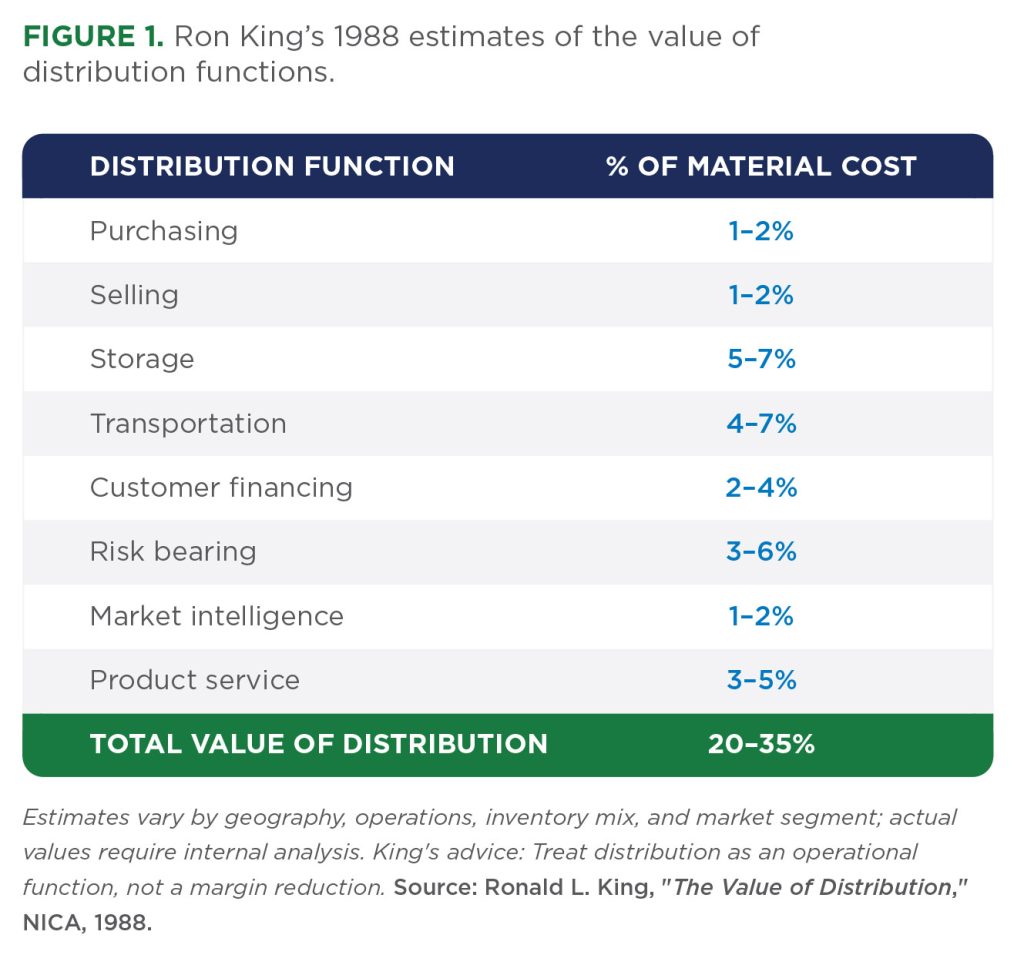
Nearly 4 decades ago, NIA Past President Ron King stood before the National Insulation Contractors Association (NICA, the precursor to the current National Insulation Association) at their 32nd Annual Meeting at Marco Island, Florida, and delivered a presentation that became one of the most enduring contributions to the mechanical insulation industry’s understanding of itself. That 1987 address, later published as the NICA booklet The Value of Distribution, did something deceptively simple: It described, named, and assigned a measurable cost of value to each of the eight core functions distributors perform every day. The Value of Distribution was updated in 2025, and more information on the updated resource can be found on page 28. The functions spanned buying and selling, storing product, transporting materials, extending credit, bearing risk, gathering market intelligence, and providing product service. King estimated that, taken together, these functions represented 20 to 35% of the total value of the materials flowing through the supply chain.
I was introduced to these principles in 1997, at an SPI sales meeting, by Ron King himself. He taught our team what he called the “Distribution Commandments,” the specific functions a distributor performs that a manufacturer or contractor cannot easily replicate.
King revisited his work in a 2012 Insulation Outlook article titled “The Value of Distribution: Revisited.” His conclusion was clear: The core functions had not changed, but the importance of distribution had increased tenfold. Now, nearly 40 years after the NICA Marco Island meeting, it is worth asking the questions again. What has changed? What has endured? The answer is that King’s fundamental thesis remains as sound today as it was in 1987, but the scope, scale, and sophistication of what the modern distributor delivers have expanded far beyond what anyone could have anticipated.
The Thesis that Lives On
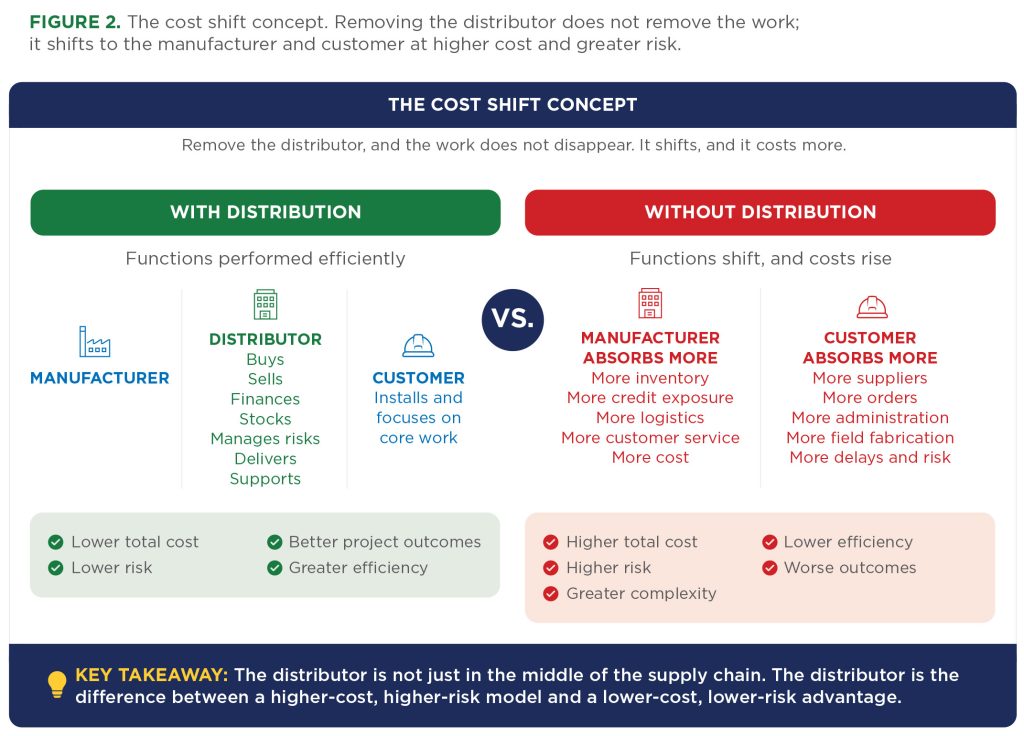
The central argument of King’s original work was elegant in its simplicity: The functions performed by the distributor do not disappear when you remove the distributor. They simply shift to the manufacturer, to the customer, or to both, and almost always at higher total cost and with less efficiency. Someone has to buy the product, store it, transport it, finance it, bear the risk of holding it, and provide technical service around it. The question is not whether these functions will be performed, but by whom, and at what cost (see Figure 2).
King described distributors as “the economy’s shock absorbers,” a phrase that has proven remarkably durable. Distributors absorb fluctuations in demand, supply disruptions, and market volatility so that manufacturers can focus on producing product, and customers can focus on installing it. When pandemic-era supply chains stretched lead times from weeks to months, it was the distributor’s inventory position, supplier relationships, and logistical flexibility that kept projects moving. King’s metaphor was not just clever, it was predictive.
The scale of what distribution absorbs is worth pausing to consider. The National Association of Wholesaler-Distributors estimates that wholesale distribution is an $8+ trillion industry—supporting more than 6 million jobs and powering nearly one-third of the U.S. economy—with industrial distribution alone representing roughly $4 trillion. Distribution has also matured into a formal academic discipline: Texas A&M University’s Industrial Distribution program, housed in its College of Engineering, defines the field in terms King would recognize immediately: moving industrial products from the manufacturer to the end user while maintaining local inventory and providing credit, technical product support, sales, and service. What King sketched for a trade audience in 1987 is now university curriculum.
What the Distributor Delivers to the Customer
For the insulation contractor, facility owner, or engineering, procurement, and construction (EPC) team, the value of working through a distributor is a comprehensive package of services that fundamentally changes the economics and execution risk of insulation work.
Fabrication and prefabrication have become two of the most compelling value-added services in the modern distribution channel, particularly for industrial work. Today’s distributor/fabricator converts raw insulation materials into job-ready, dimensionally precise components that arrive on the project site ready to be installed. Prefabrication reduces installation time, minimizes waste, improves fit-up quality, and lets contractors deploy skilled labor on installation, rather than field fabrication. On large-scale industrial projects, the labor and schedule savings are not marginal; they are material to the project’s overall cost and timeline.
Stocking materials closer to the project remains one of distribution’s most fundamental values. Distributors maintain inventory across warehouse networks, break bulk into job-ready quantities, and provide same-day or next-day delivery. For maintenance and turnaround work, where needs are often unknown until the last minute and downtime overshadows material cost, local inventory is not a convenience but a necessity.
Credit extension and flexible financing allow contractors to acquire materials without tying up working capital, freeing that capital for labor, equipment, and other project costs. The manufacturer benefits as well, dealing with a smaller number of creditworthy distributors, rather than extending credit to thousands of individual contractors.
One-stop-shop consolidation aggregates insulation products, jacketing, vapor barriers, mastics, adhesives, and accessories from many manufacturers under one roof, which means one order, one shipment, one invoice, and dramatically less procurement complexity.
Technical expertise and specification support matter because mechanical insulation is not a commodity. It is a system of materials with specific thermal, mechanical, and chemical properties. Distributors employ staff who understand applications, interpret specifications, and recommend appropriate products and configurations.
Project-scale materials management coordinates takeoffs, fabrication, quality inspection, kitting, staging, and logistics aligned to construction sequencing on projects with thousands of line items, delivering value well beyond the cost of the materials themselves.
Taken together, these services are best understood through the lens of total cost of ownership. Purchasing research consistently shows that purchase price represents only a fraction of what it costs to acquire, handle, and use a product, with hidden costs frequently exceeding visible ones. The value categories above—along with field labor saved, inventory carrying costs avoided, downtime prevented, and administration reduced—are precisely those hidden costs. A buyer who evaluates a distributor on unit price alone is measuring the smallest part of the equation.
What the Distributor Delivers to the Manufacturer
The value of distribution flows in both directions, though the upstream benefits are often less visible (see Figure 3).
Market coverage and geographic reach extend the manufacturer’s sales force into every local market without fixed overhead. As King put it, when a supplier aligns with 2 distributors, and each has 8 salespeople, the supplier just added 16 people to its sales force at no fixed cost until a sale is made.
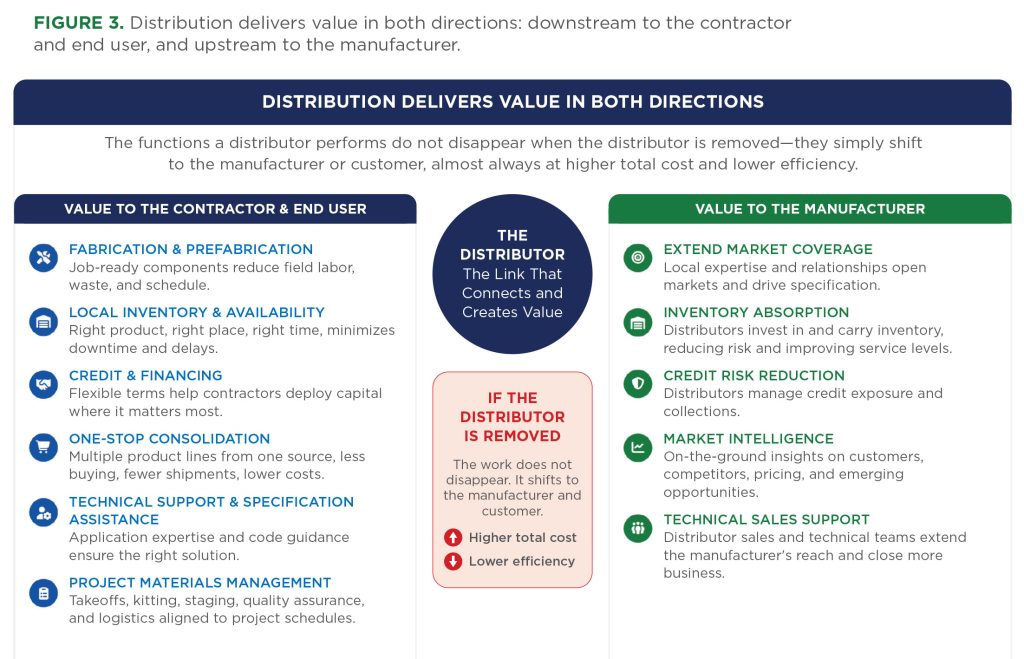
Inventory absorption shifts the carrying cost and risk of finished goods, including falling prices, deterioration, and obsolescence, to the distributor, freeing the manufacturer to focus on production efficiency and bulk shipments, rather than fragmented direct fulfillment.
Credit risk reduction concentrates the manufacturer’s receivables in a small number of established distributors with strong balance sheets, rather than thousands of accounts of variable creditworthiness.
Market intelligence and customer feedback augment the manufacturer’s own capable sales organization. Distributors are in daily contact with the contractors and end users who consume the product, hearing performance feedback, requests for new configurations, and early demand signals. This ground-level insight complements the manufacturer’s own intelligence and informs production planning, capacity allocation, research and development investment, and pricing strategy.
Technical sales support extends the manufacturer’s reach into markets and accounts that may not receive regular direct coverage. Distributor salespeople identify opportunities, offer solutions, and close sales. It should be noted that it is not the role of a distributor to specify products for a given application but to provide technical support via the various manufacturers as a solutions provider.
What Changed
Five key forces have reshaped the distribution function (see Figure 4).
Fabrication has grown from a peripheral offering to a defining capability. For the industrial segment in particular, it distinguishes a full-service distributor/fabricator from a warehouse with a delivery truck. Fabrication represents a larger share of activity in industrial distribution than in commercial work, which still accounts for the bulk of the industry by volume. Even so, modern fabrication operations, with precision equipment and tight quality control, have elevated the distributor/fabricator to a role that is more manufacturing partner than middleman; and on many large industrial projects, prefabrication is now an economic imperative.
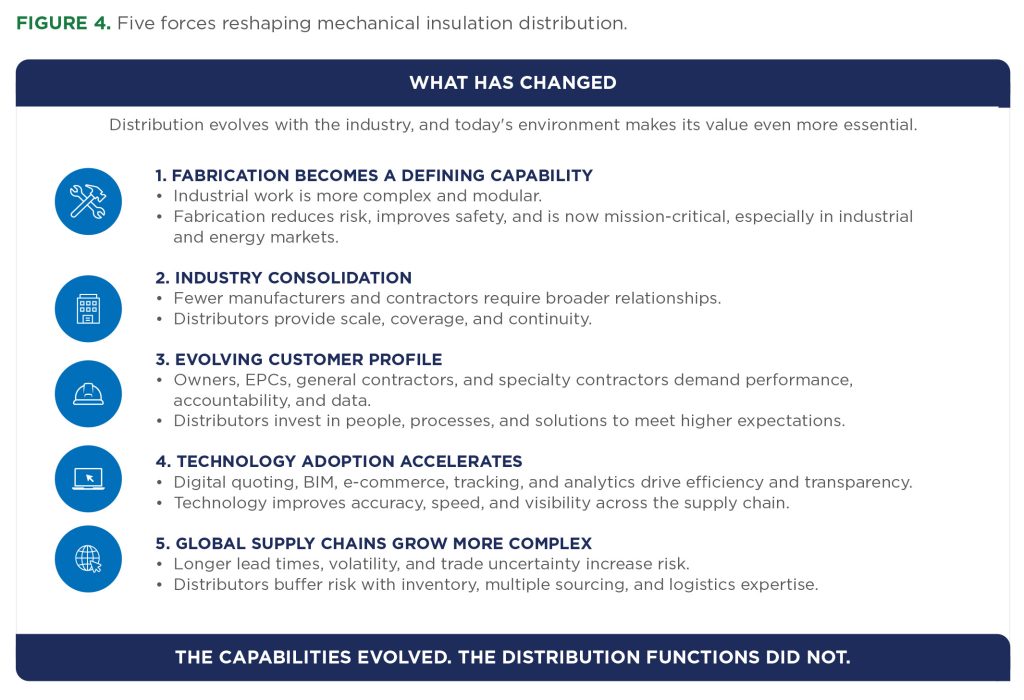
Industry consolidation has reshaped the landscape. Private equity and strategic acquisitions have produced fewer, larger, better-capitalized distributors with broader reach, deeper inventory, and more extensive fabrication capability, bringing scale advantages while challenging organizations to preserve the local knowledge and responsiveness that are distribution’s traditional strengths.
The customer profile has continued to evolve. More EPCs, facility owners, general contractors, and specialty contractors procure directly—each segment with distinct service, credit, delivery, and technical expectations—forcing distributors to become more sophisticated in how they serve each.
Technology has improved operations. Today’s distributors actively use enterprise resource planning systems, demand forecasting, automated replenishment, customer relationship management, and supply chain visibility tools, a marked improvement over the gaps King identified decades ago, though the opportunity to further leverage technology remains a priority across the industry.
The global supply chain has added complexity. Export compliance, international logistics, customs, trade regulation, and currency management now shape projects in ways that barely existed when King wrote. The distributor’s ability to navigate these complexities has become an increasingly important element of the value proposition, particularly for EPCs and owner-operators executing projects worldwide.
The Modern Distributor as Strategic Partner
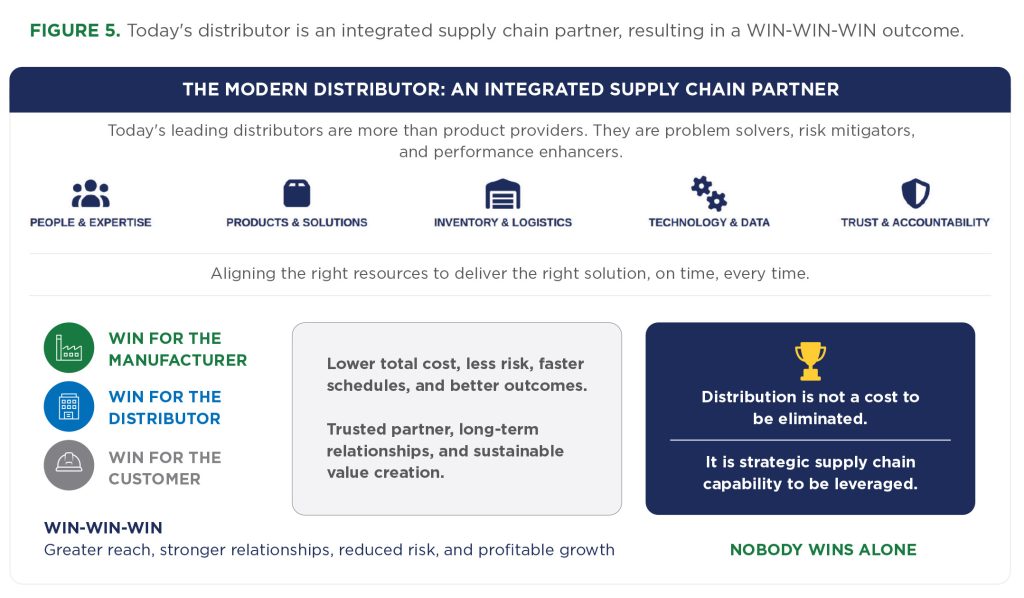
The modern mechanical insulation distributor bears only a passing resemblance to the warehouse and delivery operation of 1987. Today’s distributor/fabricator is an integrated supply chain partner delivering sourcing across multiple manufacturers, inventory and local availability, precision fabrication, project materials management, technical support, logistics, credit, and market intelligence. These are not ancillary functions. They are core capabilities that create measurable value for the manufacturers who produce the product and the customers who install it.
King concluded his original booklet with a statement that has aged remarkably well: The supplier, the distributor, and the customer form a partnership whose defining characteristic is “WIN…WIN…WIN.” This is shown in Figure 5. The manufacturer wins through extended reach, inventory management, and credit risk reduction. The customer wins through availability, fabrication, technical support, and financial flexibility. And the distributor wins by performing these functions efficiently and profitably, earning a return justified by the measurable value created for both partners.
Looking Forward
The mechanical insulation industry is entering a period of significant change. Consolidation will continue, technology adoption will accelerate, skilled labor challenges will make prefabrication and materials management even more critical, and the industry’s global reach will expand. Through it all, one thing will not change: The functions Ron King identified nearly 40 years ago will still need to be performed. The question is, as it has always been, who will perform them most efficiently, most reliably, and at the lowest total cost to the supply chain?
For nearly 4 decades, the answer has been the same. The mechanical insulation distributor—evolved, consolidated, technologically enabled, and more capable than ever—remains the most efficient and effective channel for moving insulation products from the manufacturer to the point of installation. Ron King saw this clearly in 1987. The industry would do well to remember his insight.
Distribution is not a cost to be eliminated. It is a strategic capability to be leveraged. And when suppliers, distributors, and customers work together, everyone wins.
REFERENCES
- King, Ronald L., The Value of Distribution. National Insulation Contractors Association (NICA), 1988.
- King, Ronald L., “The Value of Distribution: Revisited.” Insulation Outlook, November 2012.