
Unlock Material Insights: A Guide to NIA’s Insulation Materials Specification Chart
Choosing the right insulation material for a project can be a complex task. With a vast array
of products on the market, each possessing unique properties, quickly comparing their
attributes to identify the optimal solution can be challenging.
That is where NIA’s Insulation Materials Specification Chart comes in. This invaluable, unbiased tool consolidates the physical and material properties of various insulation
materials—as defined by their relevant ASTM specifications—into a single, easy-to-navigate resource. Think of it as a comprehensive summary of material properties, all grounded in industry standards.
By bringing together the technical specifications for numerous insulation materials
in one place, the Insulation Materials Specification Chart (often simply called the
“Spec Chart”) significantly streamlines the material comparison process. Even when
dealing with extensive data, the tool allows quick and efficient side-by-side analysis.
NIA’s Technical Information Committee (TIC)—an impartial and respected technical authority in the industry—reviews the chart quarterly and oversees any necessary updates.
Who Can Benefit from the Spec Chart?
The answer is simple: everyone involved in the mechanical insulation industry. This includes:
- Contractors,
- Distributors,
- Engineers,
- Fabricators,
- Manufacturers,
- Specifiers, and
- Anyone else involved in the design, installation, inspection, and use of mechanical insulation systems.
How to Use the Spec Chart
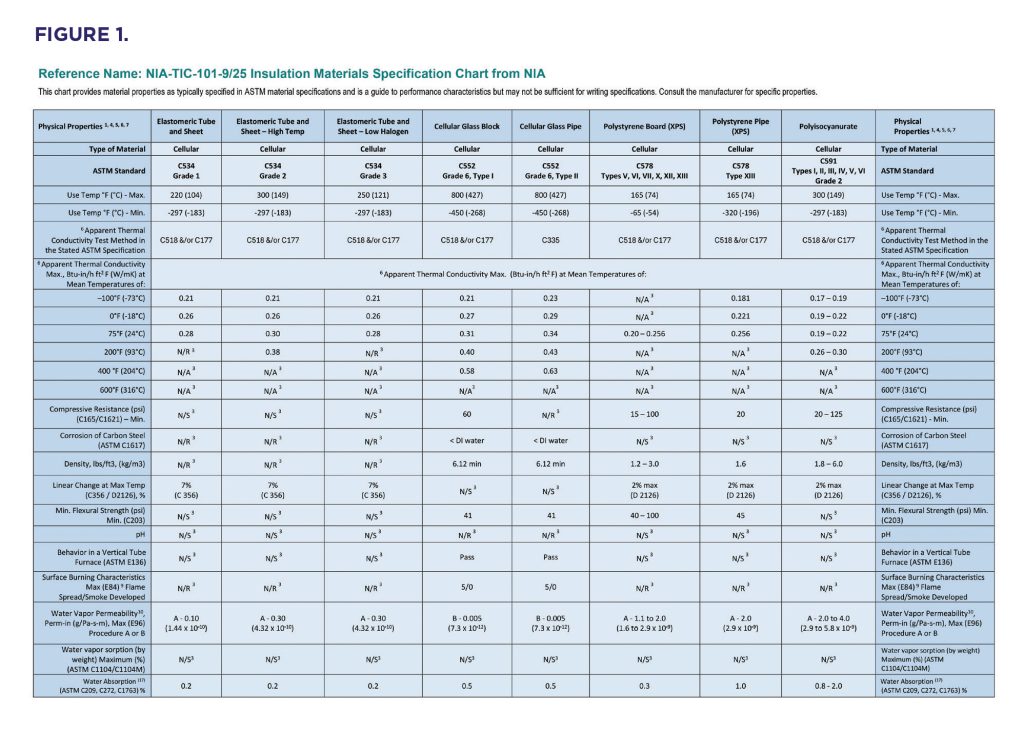
The Spec Chart (see Figure 1) is clear and organized, and includes:
- Different Insulation Material Types: These are listed across the top row, allowing users to easily identify different material categories.
- Relevant ASTM Standards: Directly below the material types, users will find the corresponding ASTM standard that governs the specifications for that material.
- Material Properties: Further down the chart are rows dedicated to different physical and material properties. Users can quickly compare these properties across adjacent insulation materials.
NIA’s TIC has created three more specification charts to serve as additional resources for the mechanical insulation industry. In early 2026, NIA’s Education Center will offer new microlearning modules to guide users through these resources, described below.
- Insulation Coverings Chart: Provides properties of different insulation coverings and includes descriptions and common applications, as well as insulation materials they are commonly used with.
- Mastics and Coatings for Insulation Systems: Provides users with properties of various insulation mastics and coatings, and offers descriptions and common applications, as well as ASTM standards that may be applicable.
- Types of Sealants for Thermal Insulation: Describes properties of various insulation sealants, common applications for each sealant type, and insulation materials they are commonly used with.
Conclusion
NIA’s Insulation Materials Specification Chart is a useful tool designed to simplify the process of comparing insulation material properties. By understanding its purpose, knowing how to use it effectively, and being aware of where to find it on the NIA website, users can work more efficiently and make better informed project decisions.

For further information about NIA’s Spec Chart or other resources, please visit www.insulation.org or www.niaeducationcenter.org, or reach out to training@insulation.org.