
What the Latest Safety Management in the Construction Industry SmartMarket Report Reveals about the Evolution of Safety in the United States
The latest research by Dodge Construction Network (Dodge), conducted in partnership with The Center for Construction Research and Training, captures how safety management continues to evolve. In addition to an ongoing examination of training and communication about safety, which the study has explored since 2013, the findings now reveal how contractors are managing challenges such as improving the mental health and well-being of the workforce, managing the risks of heat exposure, bringing safety more prominently into the preconstruction process, and utilizing digital and new emerging technologies to support their efforts to enhance safety.
To explore these topics, Dodge conducted an online survey of general and specialty trade contractors in the United States in the fall of 2025. The respondents were drawn from the Dodge Contractor Panel and database of contractors, but they were also recruited by participating associations, including the National Insulation Association, the Association of Union Contractors, the Mechanical Contractors Association of America, and the National Electrical Contractors Association. Ultimately, 323 contractors from a diverse range of U.S. company types, sizes, and geographies participated in the survey, including 16 insulation contractors. While this article focuses on overall findings and what they reveal about the evolution of safety in the construction industry, it also addresses where insulation contractors’ inputs differ from the main results in their responses. Although 16 responses are not sufficient for a quantitative analysis, they are sufficient for a qualitative examination of the unique challenges and opportunities to improve safety management.
Helping to Improve Workforce Mental Health and Well-Being
The study examined several areas related to improving the mental health and well-being of the workforce, and the findings reveal that the industry is seeking to engage with this issue. Notably, insulation contractors are also more affected by and more frequently trying to address the challenges that impact their workers’ well-being.
Extended worker travel is widespread. The study benchmarked extended worker travel, which has often been cited as a factor impacting the mental health and well-being of the construction workforce. It reveals that this is a common challenge, with 52% on average reporting that their workers have long commutes of more than 100 miles, are required to do extended stays of at least 3 nights, and/or are required to travel out of state.
Strikingly, 81% of the insulation contractors who participated in the study report that their workers experience this challenge.
Training on mental health or substance abuse is offered by more than half of contractors, but more resources are needed. On average, 57% of contractors offer jobsite programs or training that address mental health or substance use. Insulation contractors trend slightly higher, with 63% offering these resources to their workers.
However, both contractors in general and insulation contractors in particular are also seeking resources to support their efforts to address mental health and substance use issues. Fifty percent of contractors overall and 75% of insulation contractors indicate that they need more training materials and resources—such as webinars, fact sheets, infographics, or toolbox talks—on the topics of mental health, suicide, and opioid overdose. Interest in more materials covering these topics has topped the list of desired resources since first introduced in 2023. Strikingly, the share of insulation contractors seeking more resources is nearly double that for any other subject area, with the next two most important topics, ladder safety and heat exposure, only selected by 38%.
There is significant opportunity for contractors to increase the programs and training they offer to support mental health and well-being. The study reveals several opportunities to provide more support to workers to help improve mental health and well-being.
- More companies could provide anti-harassment training. Only 62% of contractors overall offer this, and slightly fewer insulation contractors (50%) do.
- More companies could provide an employee assistance plan (EAP). Currently, just under half of contractors overall (46%) have an EAP at their organization. Again, slightly fewer insulation contractors (31%) report that their company provides an EAP.
- More companies could offer other programs to support worker mental health and well-being. Insulation contractors use other programs to support mental health and well-being at higher rates than the industry averages, including peer support (38% versus 23% overall), return-to-work programs (44% versus 39%), second chance agreements (31% versus 19%), and awareness training (63% versus 43%). While the number of insulation contractors responding to the survey prevents any of these individual differences from being statistically significant, they reveal an overall trend that suggests heightened efforts on the part of insulation companies that have these programs to support the well-being of their staff.
Dealing with Heat Exposure
While the number of contractors who report heat-related illnesses or injuries on their jobsites in the last 3 years has remained relatively steady since the previous survey in 2023, small contractors (those with fewer than 20 employees) experienced a noticeable drop, from 11% to 5%. They also increased their use of several means to assess heat risk,
including weather forecasts, mobile heat safety apps, and the types of clothing/personal protective equipment (PPE) they use, which may have contributed to this decline (see Figure 1).
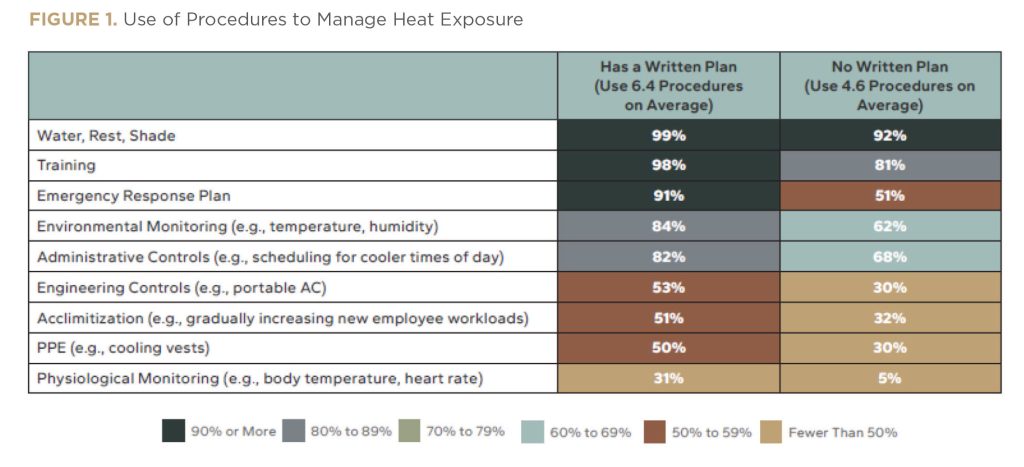
The survey also asked contractors whether they use eight procedures to manage heat exposure. Over half are widely adopted: 80% or more report using water/rest/shade, training, an emergency response plan, administrative controls such as scheduling work for cooler hours, and monitoring for factors like temperature and humidity. However, only 50% or less use engineering controls such as portable AC units, acclimatization, PPE such as cooling vests, or physiological monitoring. Insulation contractors largely report similar measures of use of all of these approaches. These findings suggest that there are some as yet untapped possibilities to decrease the risks posed by extreme heat for workers. One factor that seems to encourage wider use of all of these procedures is adoption of a written heat-illness prevention plan. Contractors use more of each of these practices when they have a written plan in place.
One of the most promising findings is the impact of state-mandated heat illness prevention standards. While only a few states have them now, and fewer than half (41%) of contractors report working in a state with a standard in place, those who do frequently report fewer heat-related illnesses. Tellingly, most of them also find that those improvements occur on all their projects, not just those in the state with the standard.
Addressing Safety in Preconstruction
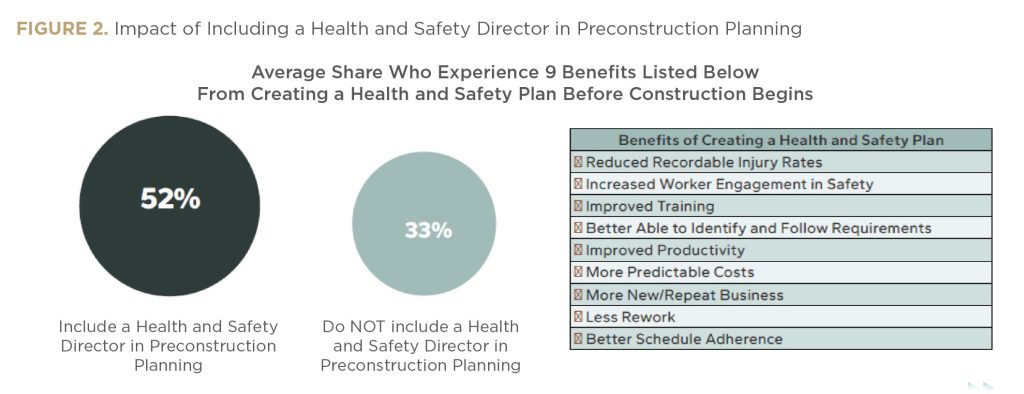
The current study also reinforces the importance of including a health and safety director in the preconstruction planning process. Recognition of the importance of preconstruction planning is on the rise in the construction industry, and fortunately, that includes addressing safety. Nearly half (43%) of contractors now include a health and safety director in this process, up from 26% in 2023. Insulation contractors report this practice at a similar rate (44%).
However, this means that over half of contractors do not include their health and safety director in the process, and the findings suggest that they are missing out on an opportunity to see significant improvements from the health and safety plans they create. The study looked at nine benefits, which range from reduced recordable injury rates and increased worker engagement in safety, to improved productivity and less rework. Across all nine of these benefits, 52% of contractors on average at companies where the health and safety director is included in preconstruction planning experience these benefits, compared with just 33% of those who do not (see Figure 2).
Using of Online Training
Online training has become an established way to deliver safety and health courses in construction. Seventy-five percent of contractors now report using it, up from 64% in 2023. The insulation contractors in the survey lead the industry in its engagement, as 94% offer online safety training to their workers.
However, even with that level of engagement among insulation contractors, the study suggests the potential for wider implementation. More than one-quarter (27%) of the insulation contractors currently using online training expect to increase its use in the next 3 years.
Notably, across contractors overall, use has grown considerably, especially among smaller contractors.
- Small companies increased their use of online training most dramatically in the last 2 years, with a 20-point increase from 45% in 2023 to 65% in 2025.
- Use at midsize companies (those with 20 to 99 employees) grew substantially as well, from 57% to 71%.
- Seventy-seven percent of large companies were already using online safety training in 2023; but even though it was clearly a well-established practice at most of these organizations, the share using it still grew to 82% in 2025.
These findings suggest that large companies paved the way, but smaller companies are now filling in the gaps.
Leveraging Digital and Emerging Technologies and Safety
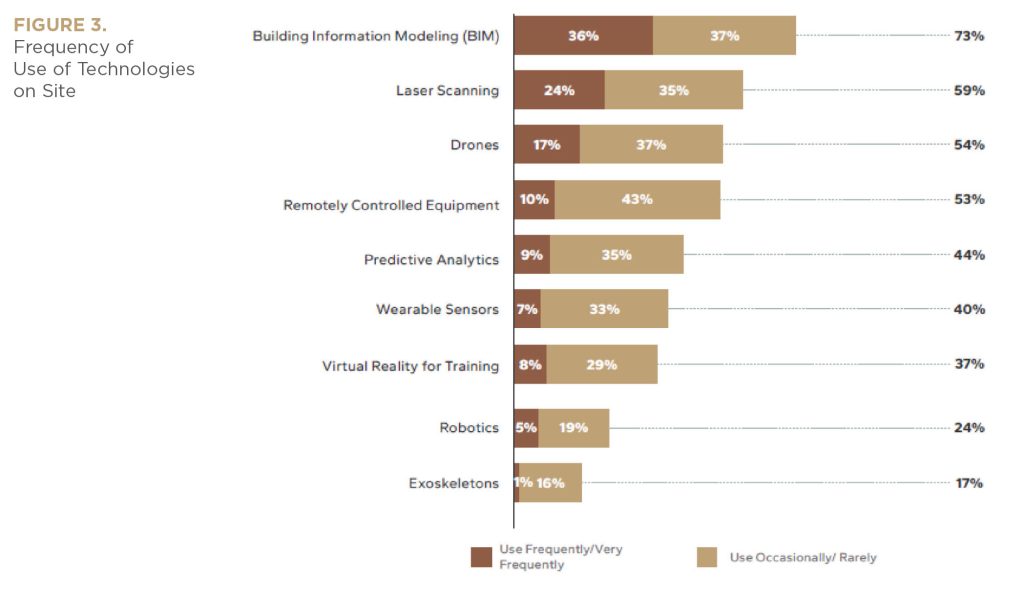
Some technologies are already widely adopted in the construction industry, including building information modeling (BIM), laser scanning, and drones and remotely controlled equipment. BIM is used by nearly three-quarters (73%) of contractors, and the other three are used by over half. However, of these four, only BIM is frequently put to use by around half, and most contractors who use the other technologies say they do so only occasionally or rarely.
The majority of users only deploy technologies that are moderately adopted in the industry
occasionally or rarely as well, including predictive analytics, wearable sensors, and virtual reality for training. These are also the three technologies most widely used to help companies improve safety (see Figure 3). Other technologies that would have a clear impact on safety are rarely used, including robotics and exoskeletons.
Taken together, all these findings suggest that the construction industry has yet to see the full impact on safety that using these technologies may offer. It will be interesting to see as both adoption and implementation increase how effectively these digital and emerging technologies can improve safety on site.
To download the full report, visit www.construction.com/resource/safety-management-
in-the-construction-industry-2026.