
Fire Resistance Rated Air Duct Systems—The Vital Role Insulation Plays
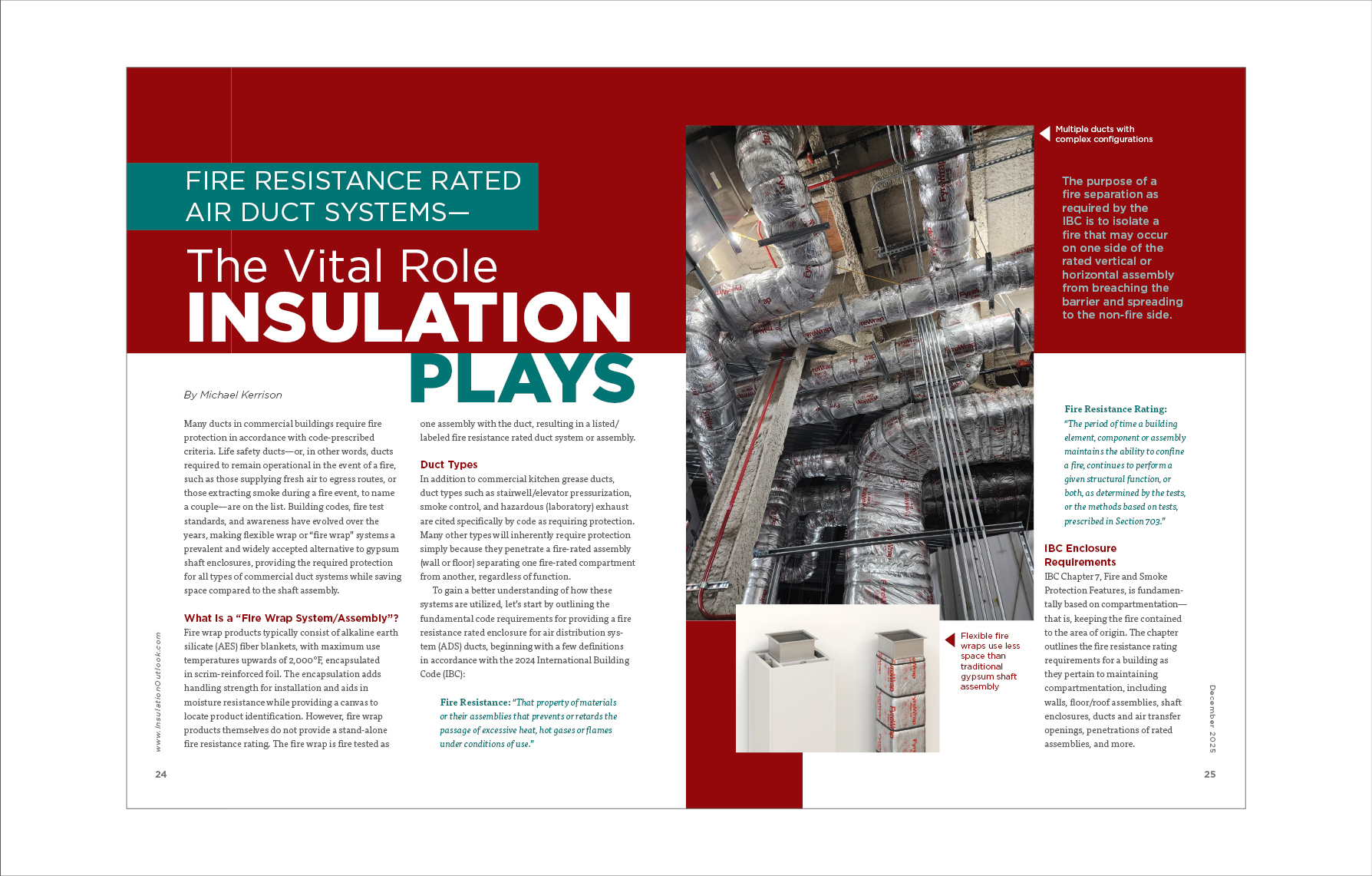
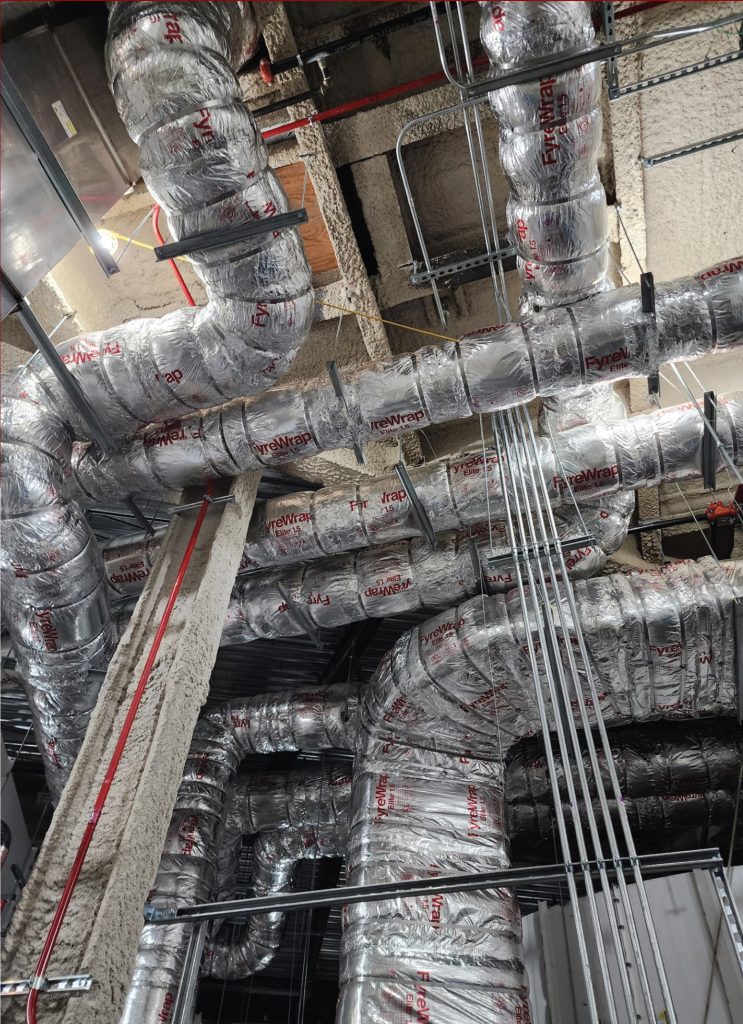
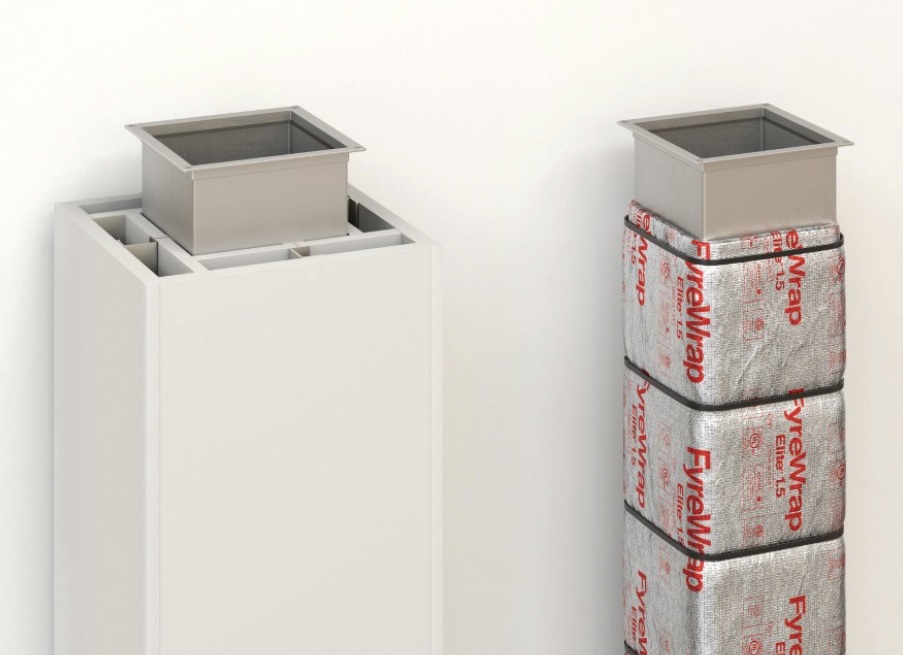
Many ducts in commercial buildings require fire protection in accordance with code prescribed criteria. Life safety ducts—or, in other words, ducts required to remain operational in the event of a fire, such as those supplying fresh air to egress routes, or those extracting smoke during a fire event, to name a couple—are on the list. Building codes, fire test standards, and awareness have evolved over the years, making flexible wrap or “fire wrap” systems a prevalent and widely accepted alternative to gypsum shaft enclosures, providing the required protection for all types of commercial duct systems while saving space compared to the shaft assembly.
What Is a “Fire Wrap System/Assembly”?
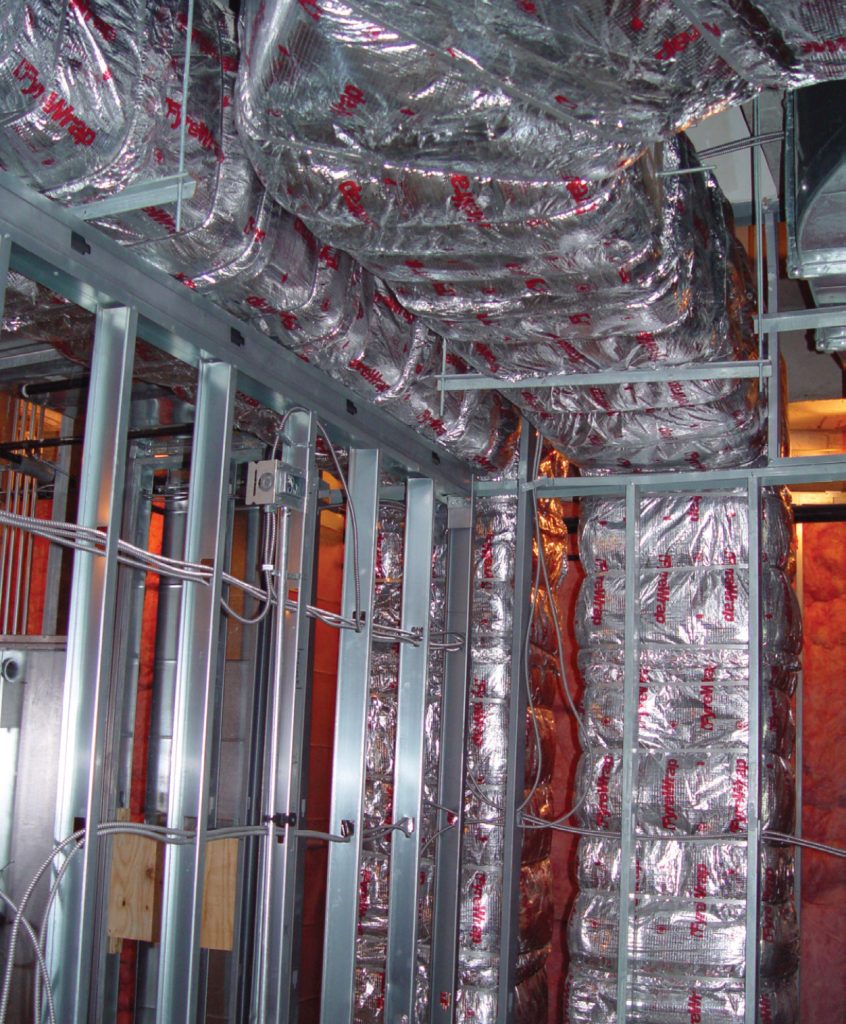
Fire wrap products typically consist of alkaline earth silicate (AES) fiber blankets, with maximum use temperatures upwards of 2,000°F, encapsulated in scrim-reinforced foil. The encapsulation adds handling strength for installation and aids in moisture resistance while providing a canvas to locate product identification. However, fire wrap products themselves do not provide a stand-alone fire resistance rating. The fire wrap is fire tested as one assembly with the duct, resulting in a listed/labeled fire resistance rated duct system or assembly.
Duct Types
In addition to commercial kitchen grease ducts, duct types such as stairwell/elevator pressurization, smoke control, and hazardous (laboratory) exhaust are cited specifically by code as requiring protection. Many other types will inherently require protection simply because they penetrate a fire-rated assembly (wall or floor) separating one fire-rated compartment from another, regardless of function.
To gain a better understanding of how these systems are utilized, let’s start by outlining the fundamental code requirements for providing a fire resistance rated enclosure for air distribution system (ADS) ducts, beginning with a few definitions in accordance with the 2024 International Building Code (IBC):
Fire Resistance: “That property of materials or their assemblies that prevents or retards the passage of excessive heat,
hot gases or flames under conditions of use.”
Fire Resistance Rating: “The period of time a building element, component or assembly maintains the ability to confine a fire, continues to perform a given structural function, or both, as determined by the tests, or the methods based on tests, prescribed in Section 703.”
IBC Enclosure Requirements
IBC Chapter 7, Fire and Smoke Protection Features, is fundamentally based on compartmentation—that is, keeping the fire contained to the area of origin. The chapter outlines the fire resistance rating requirements for a building as they pertain to maintaining compartmentation, including walls, floor/roof assemblies, shaft enclosures, ducts and air transfer openings, penetrations of rated assemblies, and more.
Regarding the requirements for shaft enclosures, Section 703.2.1, Tested Assemblies, states: “A fire-resistance rating of building elements, components or assemblies shall be determined by the test procedures set forth in ASTM E119 or UL 263.” Fire resistance rated shaft enclosures are constructed as fire barriers (vertical) and floor/roof assemblies (horizontal), as tested/listed to ASTM E119, Standard Test Methods for Fire Tests of Building Construction and Materials, and are required to have a fire resistance rating of at least 2 hours when connecting four stories or more, and at least 1 hour if fewer than four stories. ASTM E119, Standard Test Methods for Fire Tests of Building Construction and Materials, and UL 263, Fire Tests of Building Construction and Materials, are nearly identical test methods for evaluating building construction and materials to achieve a fire resistance rating. For conciseness, we’ll focus on ASTM E119.
Achieving a Fire Rating in Accordance with ASTM E119
For a wall or floor/roof assembly to be assigned a fire resistance rating in accordance with ASTM E119, the assembly must comply with all of conditions 1-4 listed below. The fire resistance rating is based upon the time in minutes (or hours) at which the first occurrence of any of these failure criteria pertaining to structural stability, temperature rise resistance on the unexposed surface of the test assembly (insulation), and prevention of the passage of flame or hot gases and subsequent passage of hose stream (integrity). The specific language defining the pass/fail criteria are as follows:
- The wall or partition withstands the fire endurance test without passage of flames or gases hot enough to ignite cotton waste, for a period equal to that for which classification is desired,
- The assembly limits temperature rise to a maximum average temperature rise above ambient of 250°F by making measurements during the conduct of the fire exposure test,
- The assembly limits the maximum temperature rise over ambient at any individual location to a maximum of 325ºF by making measurements during the conduct of the fire exposure test, and
- The wall or partition withstands the impact of the hose stream test. The assembly is considered to have failed the hose stream test if an opening develops that permits a projection of water from the stream beyond the unexposed surface during the application of the hose stream test.
It is critical (and explicitly required by E119 test method) that all four of these criteria are satisfied, as omission of any one of them could allow fire to spread to another compartment.
Unfortunately, code-prescribed ASTM E119 does not have provisions for testing duct enclosure assemblies. However, IBC Section 703.2.3, Approved Alternate Method, permits the establishment of alternative protection methods in accordance with Section 104.2.3, Alternative Materials, Design and Methods of Construction and Equipment. This alternative proposed method complies with the intent of the code and is not less than the equivalent of that required by the code in several categories, including Fire Safety (outlined in IBC Sections 104.2.3.3 and 104.2.3.4).
The purpose of a fire separation as required by the IBC is to isolate a fire that may occur on one side of the rated vertical or horizontal assembly from breaching the barrier and spreading to the non-fire side. While the fire separation (tested assembly) is a wall or floor/roof when tested to ASTM E119, when we introduce a duct penetrating the assembly going from one fire-rated compartment to another, the purpose of the fire separation does not change; it simply becomes a wall or floor with a duct penetrating it and, as such, requires testing as one assembly.
Purpose-Built Fire Test Methods
Since a duct system can’t be tested to ASTM E119, we turn to purpose-built duct testing methods. These duct testing methods are specifically designed to apply the basic principles and pass/fail criteria of ASTM E119 to a duct system to demonstrate equivalent performance to code-required protection while evaluating the duct system’s ability to remain functional. We’ll consider two test methods: ISO 6944, Fire Resistance Tests – Ventilation Ducts, and ASTM E2816, Standard Test Methods for Fire Resistive Metallic HVAC Duct Systems.
ISO 6944
Originally published in 1985 in response to the need for a method of evaluating fire resistance of duct assemblies, the original document scope stated:
“The general purpose of this test is to measure the ability of a representative duct or duct assembly to resist the spread of fire from one fire compartment to another without the aid of fire dampers.”
This was the first fire test method of its kind, and it has evolved through several editions since the original 1985 edition, with the most recent being 2024.
While the title has changed slightly (Fire Containment – Elements of Building Construction – Part 1: Ventilation Ducts), and the method has improved over the years for usability, the fire exposure and pass/fail criteria have remained fundamentally unchanged and continue to align with that of ASTM E119. Although the time-temperature fire exposure is not exactly that of ASTM E119, ISO 6944 utilizes the ISO 834, Fire Resistance Tests – Elements of Building Construction, time-temperature exposure. To compare the ISO 834 and ASTM E119 fire exposure conditions, the American Society for Testing and Materials (ASTM) and the National Research Council Canada (NRCC) conducted a study. The results showed that for tests under 1½ hours, the ASTM exposure was “slightly more severe,” while during longer tests, the differences between the two were negligible, thus providing technical justification for acceptance of ISO 6944 tested systems.
ISO 6944 tests the ducts in both the vertical and horizontal orientations, penetrating fire-rated floor/roof and/or wall assemblies, respectively, for both fire outside the duct (Duct A) and fire inside the duct (Duct B), utilizing three pass/fail criteria that align directly with those of ASTM E119:
- Stability – When the duct collapses in such a manner that it no longer fulfills its intended function.
- Insulation – Temperature rise limit on the duct surface outside the fire environment exceeds pass/fail.
- Integrity – Passage of flames or hot gases sufficient to create flaming outside the fire environment.
By design, these three criteria match directly with criteria 1 through 3 of ASTM E119, lacking only the hose stream requirement. That requirement is not omitted, however, as the IBC requires duct systems penetrating fire-rated walls and floor/roof assemblies be tested in accordance with ASTM E814, Standard Test Method for Fire Tests of Penetration Firestop Systems. Testing to E814 (or UL 1479) demonstrates that for locations where the duct system passes through fire resistance rated walls or floor/roof assemblies, test results maintain the fire resistance rating of the assembly penetrated. It also includes the same hose stream as ASTM E119. Two hourly ratings are established/reported:
- F Rating – No flaming on the unexposed surface, and
- T Rating – Temperature rise criteria on the surface of the penetrating item and assembly penetrated remains below pass/fail temperatures.
To be considered as a shaft alternative, and to comply with the intent of the IBC, the hourly duration for all three—stability, insulation, and integrity—as well as F and T ratings, must be at least that of the required shaft enclosure. None can be reduced or omitted.
ASTM E2816
Originally published in 2011, ASTM E2816 utilized the foundation created by ISO 6944 and built upon it to create an all-inclusive method for evaluating fire resistance rated ADS duct systems, evolving through 14 editions over 13 years to improve usability, clarity, and function. The scope states:
“These test methods evaluate the ability of a HVAC duct system to resist the spread of fire from one compartment to other compartments separated by a fire resistance rated construction when the HVAC duct system is exposed to fire…”
While we have outlined how ISO 6944 provides a capable and widely utilized method for providing equivalency to code-prescribed shaft enclosure requirements, ASTM E2816 takes it to another level.
ASTM E2816 tests the duct essentially the same as ISO 6944, including both vertical and horizontal orientations, fire both inside and outside the duct, and the ASTM E119 pass/fail criteria translated to a duct system. However, it includes a few specific enhancements to more directly align with that of code-prescribed ASTM E119:
- It utilizes the ASTM E119 time-temperature fire exposure, as opposed to ISO 834.
- It incorporates the ASTM E814 through penetration firestop test (including hose stream) directly into the method, and it requires equal F and T ratings to the assembly penetrated.
- It uses mandatory compliance language.
The mandatory compliance language ensures that all equivalent ASTM E119 pass/fail criteria applied to the duct system are met, and the fire resistance rating reported is clear. In contrast, ISO 6944 leaves room for testing/listing agencies to report compliance broken into the three individual parts (stability, insulation, and integrity). The most common issue with the individual parts seen in the marketplace is systems lacking the insulation rating, resulting in some being utilized that (unknown to the user) do not limit the temperature rise on the duct surface on the non-fire side of the assembly, creating the potential for fire to spread from one fire-rated compartment to another.
It is important to note that limiting the temperature rise on the non-fire side of the assembly is not a requirement specific to duct systems that use insulation. Rather, be it a fire wrap, prefabricated (double wall), spray applied, or any other duct system used as an alternative to shaft construction, insulation is used to satisfy this temperature rise limitation requirement—recall that it stems from the ASTM E119 criteria and is translated to duct systems via ISO 6944 and ASTM E2816.
In closing, would a building have a shaft wall that only limited the temperature rise on the non-fire side for 15 minutes? Obviously not. The same should hold true for fire resistance rated duct systems being utilized as alternatives to the code-prescribed shaft protection.
Sources
- International Building Code 2024, International Code Council Inc.
- ISO 6944, Fire Resistance Tests – Ventilation Ducts, International Organization for Standardization (ISO)
- Harmathy, T.Z., Sultan, M.A., and MacLaurin, J.W., “Comparison of Severity of Exposure in ASTM E 119 and ISO 834 Fire Resistance Tests,” Journal of Testing and Evaluation, JTEVA, Vol. 15, No. 6, Nov. 1987, pp. 371–375.
- ASTM E2816-24, “Standard Test Methods for Fire Resistive Metallic HVAC Duct Systems,” ASTM International
- ASTM E119-25, “Standard Test Methods for Fire Tests of Building Construction and Materials,” ASTM International
- ASTM E814-24, “Standard Test Method for Fire Tests of Penetration Firestop Systems,” ASTM International
- UL 263, “Fire Tests of Building Construction and Materials,” www.icc-es.org