
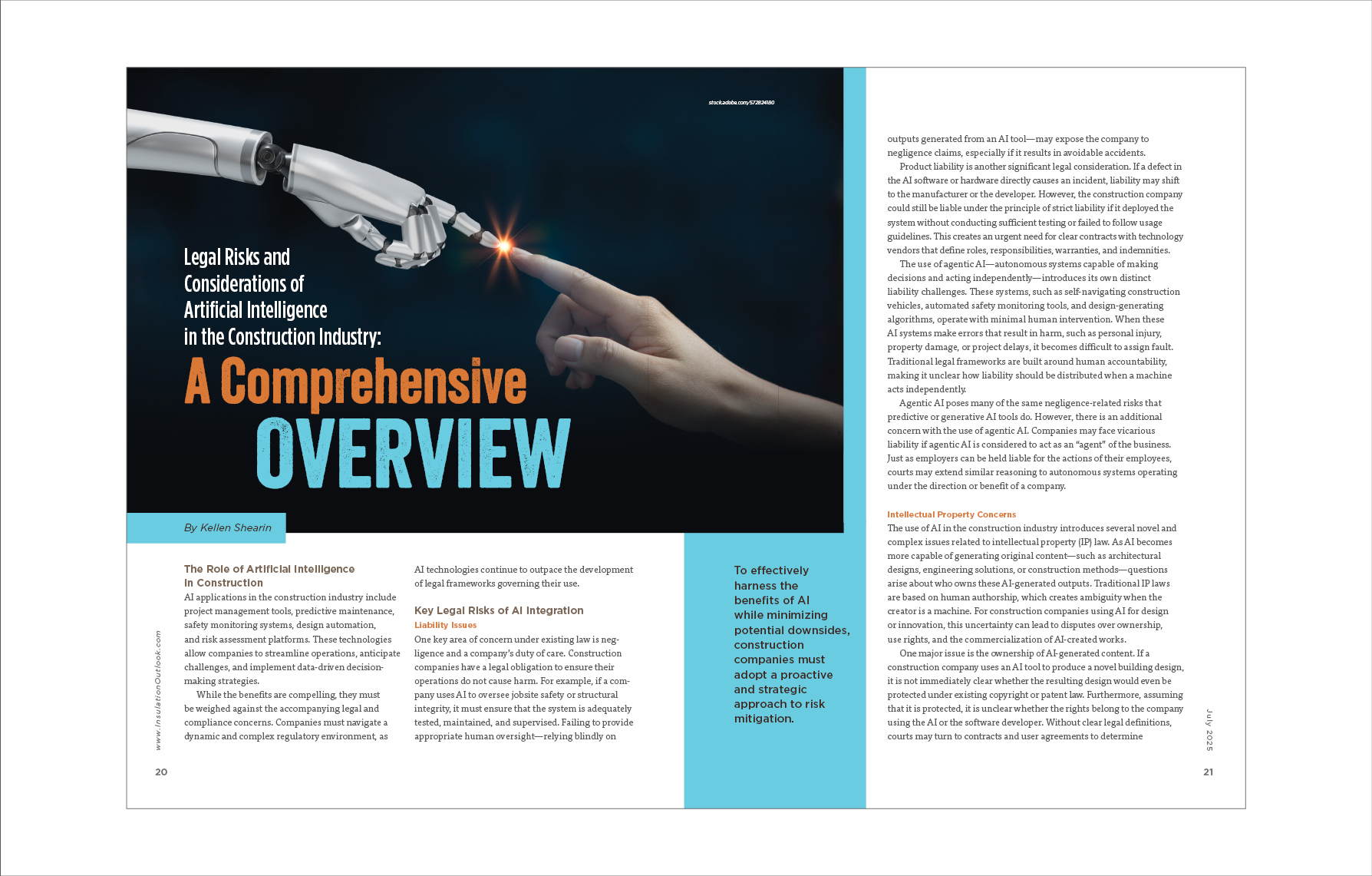
Legal Risks and Considerations of Artificial Intelligence in the Construction Industry: A Comprehensive Overview
The Role of Artificial Intelligence in Construction
AI applications in the construction industry include project management tools, predictive maintenance, safety monitoring systems, design automation, and risk assessment platforms. These technologies allow companies to streamline operations, anticipate challenges, and implement data-driven decision-making strategies.
While the benefits are compelling, they must be weighed against the accompanying legal and compliance concerns. Companies must navigate a dynamic and complex regulatory environment, as AI technologies continue to outpace the development of legal frameworks governing their use.
Key Legal Risks of AI Integration
Liability Issues
One key area of concern under existing law is negligence and a company’s duty of care. Construction companies have a legal obligation to ensure their operations do not cause harm. For example, if a company uses AI to oversee jobsite safety or structural integrity, it must ensure that the system is adequately tested, maintained, and supervised. Failing to provide appropriate human oversight—relying blindly on outputs generated from an AI too —may expose the company to negligence claims, especially if it results in avoidable accidents.
Product liability is another significant legal consideration. If a defect in the AI software or hardware directly causes an incident, liability may shift to the manufacturer or the developer. However, the construction company could still be liable under the principle of strict liability if it deployed the system without conducting sufficient testing or failed to follow usage guidelines. This creates an urgent need for clear contracts with technology vendors that define roles, responsibilities, warranties, and indemnities.
The use of agentic AI—autonomous systems capable of making decisions and acting independently—introduces its own distinct liability challenges. These systems, such as self-navigating construction vehicles, automated safety monitoring tools, and design-generating algorithms, operate with minimal human intervention. When these AI systems make errors that result in harm, such as personal injury, property damage, or project delays, it becomes difficult to assign fault. Traditional legal frameworks are built around human accountability, making it unclear how liability should be distributed when a machine acts independently.
Agentic AI poses many of the same negligence-related risks that predictive or generative AI tools do. However, there is an additional concern with the use of agentic AI. Companies may face vicarious liability if agentic AI is considered to act as an “agent” of the business. Just as employers can be held liable for the actions of their employees, courts may extend similar reasoning to autonomous systems operating under the direction or benefit of a company.
Intellectual Property Concerns
The use of AI in the construction industry introduces several novel and complex issues related to intellectual property (IP) law. As AI becomes more capable of generating original content—such as architectural designs, engineering solutions, or construction methods—questions arise about who owns these AI-generated outputs. Traditional IP laws are based on human authorship, which creates ambiguity when the creator is a machine. For construction companies using AI for design or innovation, this uncertainty can lead to disputes over ownership, use rights, and the commercialization of AI-created works.
One major issue is the ownership of AI-generated content. If a construction company uses an AI tool to produce a novel building design, it is not immediately clear whether the resulting design would even be protected under existing copyright or patent law. Furthermore, assuming that it is protected, it is unclear whether the rights belong to the company using the AI or the software developer. Without clear legal definitions, courts may turn to contracts and user agreements to determine ownership. This makes it critical for construction companies to establish explicit terms in contracts with AI vendors, addressing who retains rights to AI-generated works and under what conditions they can be used, licensed, or sold.
Another challenge is the patentability of AI-assisted inventions. AI tools can identify efficiencies in construction techniques or generate new building materials and methods. If these innovations meet the criteria for patent protection—novelty, non-obviousness, and utility—a company may be able to secure exclusive rights. However, questions about inventorship can complicate the application process, especially if the invention stems primarily from the AI system rather than human input. The U.S. Patent and Trademark Office currently requires that a human inventor be named, which could disqualify some AI-derived inventions or lead to disputes over who contributed the inventive step.
Additionally, construction companies must be mindful of copyright infringement and trade secret protection. AI systems trained on vast datasets may inadvertently reproduce elements of copyrighted works, leading to infringement claims. Similarly, if proprietary algorithms, data models, or AI-driven methodologies give a construction company a competitive advantage, the company must take steps to protect these trade secrets through non-disclosure agreements and cybersecurity protocols. Failure to do so could result in the loss of valuable IP or exposure to litigation.
Data Privacy and Security Concerns
The implementation of AI in the construction industry brings significant data privacy and security challenges, particularly given the vast amount of sensitive information these systems collect, process, and store. AI tools used for project management, workforce monitoring, and predictive maintenance often rely on data from employees, clients, and
jobsites—including biometric data from wearable safety devices, GPS tracking, financial details, and proprietary blueprints. Without robust data governance practices, construction companies risk violating privacy laws, compromising sensitive information, and exposing themselves to regulatory penalties and litigation.
One of the most pressing concerns is compliance with data protection laws. Regulations such as the General Data Protection Regulation (GDPR) in Europe and the California Consumer Privacy Act (CCPA) in the United States impose strict requirements for the collection, use, and sharing of personal data. Construction companies using AI must ensure that they obtain proper consent from individuals, disclose how data will be used, and provide mechanisms for individuals to access or delete their information. Failure to comply may result in substantial fines and reputational harm, especially in jurisdictions that prioritize consumer data rights.
Another major risk involves data breaches and cybersecurity threats. AI systems integrated with cloud platforms, internet of things (IoT) devices, and remote access capabilities present new vulnerabilities. A successful cyberattack could lead to unauthorized access to construction plans, personnel records, or site conditions, causing not only operational disruptions but also legal exposure. Additionally, data shared with third-party vendors—such as AI developers or cloud service providers—introduces further risks if those partners lack strong security standards or breach contractual obligations.
Regulatory Compliance
Regulatory compliance is a critical concern for construction companies adopting AI technologies. The construction industry is subject to a variety of local, state, and federal regulations covering safety, labor practices, environmental standards, and data protection. As AI tools increasingly influence decision-making in these areas—for example, determining jobsite safety protocols, automating employee performance tracking, or managing environmental impacts—companies must ensure that their use of AI aligns with existing legal obligations. Failure to do so could result in fines, project delays, or even legal action.
Compounding the challenge is the rapidly evolving regulatory landscape surrounding AI itself. While comprehensive federal legislation on AI is still in development in the United States, several states have enacted laws addressing AI transparency, accountability, and data privacy. For example, California and Colorado have introduced detailed statutes governing high-risk AI systems and algorithmic decision-making. Construction companies operating in multiple jurisdictions must stay informed of these regulatory differences to remain compliant. In addition, new rules may require companies to document how AI systems make decisions and conduct risk assessments, and require that they disclose AI usage to affected stakeholders. Proactive compliance strategies—including legal consultations, internal audits, and regulatory monitoring—are essential to navigate this dynamic environment responsibly and effectively.
Finally, the use of AI in hiring processes presents several employment-related concerns for construction companies, particularly in terms of fairness, transparency, and compliance with labor and antidiscrimination laws. AI-driven tools that screen resumes, assess video interviews, or predict candidate success may unintentionally perpetuate bias if they are trained on historical data that reflects past discriminatory practices. This could result in unfair exclusion of qualified candidates based on race, gender, age, or other protected characteristics, exposing companies to legal liability under equal employment opportunity laws. Additionally, under statutes like the Illinois Artificial Intelligence Video Interview Act, employers must obtain informed consent when using AI to analyze interview footage, further emphasizing the need for transparency.
National Labor Relations Act Concerns
Construction companies incorporating AI into their operations must consider the implications of the National Labor Relations Act (NLRA), which protects employees’ rights to organize, unionize, and engage in collective bargaining. One of the primary concerns under the NLRA is job displacement. As AI automates tasks such as scheduling, project oversight, and equipment operation, workers may face reduced hours or even layoffs. If these changes are implemented without consulting employees or their unions, companies could be accused of undermining collective bargaining rights or engaging in unfair labor practices.
Another significant issue involves the use of AI for employee surveillance and performance monitoring. AI-powered tools that track productivity, location, or behavior on jobsites may infringe on workers’ rights to privacy and can create a chilling effect on organizing efforts. Under the NLRA, employees have the right to discuss working conditions and advocate for improvements without fear of retaliation or intrusive monitoring. If AI systems are used to monitor or penalize union activity—intentionally or not—it could lead to legal challenges.
Ethical Considerations
As construction companies increasingly adopt AI, ethical considerations must play a central role in guiding how these technologies are implemented and used. One of the primary concerns is the potential for algorithmic bias in AI systems. If the data used to train the systems contains historical biases—such as underrepresentation of certain demographics, or skewed performance metrics—AI could inadvertently perpetuate discrimination in areas like hiring, task assignments, or performance evaluations. This not only raises moral questions but also exposes companies to reputational and legal risks.
Another key ethical issue is transparency and accountability. Many AI systems operate as “black boxes,” making decisions based on complex algorithms that even their developers may struggle to fully explain. This opacity can be problematic in safety-critical environments like construction, where lives may depend on understanding why a particular decision was made—such as approving a structural design or halting a project due to risk assessments.
To maintain trust among employees, clients, and regulators, construction companies must strive for explainability in their AI systems. Establishing clear policies on how decisions are made, who is responsible for overseeing AI outputs, and how errors are addressed is essential for building a culture of ethical AI use.
Mitigation Strategies
To effectively harness the benefits of AI while minimizing potential downsides, construction
companies must adopt a proactive and strategic approach to risk mitigation. One of the most important steps is developing clear and comprehensive contracts with AI vendors and technology partners. These agreements should explicitly outline ownership of AI-generated outputs, liability in the event of system failures, data usage permissions, and indemnification clauses. Well-drafted contracts can help avoid disputes and provide legal clarity on responsibilities and rights related to AI systems.
Another essential mitigation strategy is conducting regular audits and testing of AI tools. These audits should assess the accuracy, fairness, and safety of AI systems, especially those used for critical tasks like structural design, project management, and safety monitoring. Regular evaluations can identify potential flaws or biases in the algorithms before they cause harm. Construction companies also should ensure that AI tools are updated frequently and tested under real-world conditions to confirm reliability and compliance with evolving regulatory standards.
Employee training and engagement are equally crucial. Workers need to understand how AI systems function, their limitations, and how to use them effectively and ethically. Offering workshops, onboarding sessions, and open forums for feedback can help reduce resistance to AI adoption while ensuring that staff are aware of legal and operational implications. Moreover, involving employees in the implementation process helps foster trust and encourages responsible use of new technologies.
Construction companies should invest in robust data security and compliance programs. This includes establishing internal policies for data collection, storage, and sharing; implementing cybersecurity measures such as encryption and access controls; and monitoring compliance with privacy regulations like the GDPR or CCPA. By embedding these risk mitigation strategies into company culture and workflows, construction companies can responsibly innovate while minimizing legal, ethical, and operational risks.
Finally, maintaining human oversight over AI tools is essential for construction companies to ensure accountability, accuracy, and compliance with legal and ethical standards. While AI can significantly enhance decision-making in areas such as safety monitoring, project planning, and hiring, it is not infallible. Errors, biases, or misinterpretations by AI systems can have serious consequences, including legal liability, safety hazards, and reputational damage. Human oversight allows companies to catch mistakes, interpret AI outputs within the appropriate context, and make judgment calls that machines cannot. Additionally, given the rapidly evolving regulatory landscape surrounding AI, consulting an attorney is crucial. Legal counsel can help construction firms navigate complex issues such as data privacy compliance, IP ownership, labor law implications, and liability concerns, ensuring that AI adoption is both legally sound and strategically managed. Legal counsel also can help a company keep up with regulatory changes, thereby further safeguarding operations.
Conclusion
AI is poised to revolutionize the construction industry, offering substantial improvements in efficiency, safety, and innovation. However, its integration brings multifaceted legal, ethical, and operational challenges. From liability and IP ownership to data privacy and labor relations, each risk demands careful attention and proactive management.
Construction companies must embrace a strategic approach—grounded in legal compliance, transparent policies, and stakeholder engagement—to fully realize the benefits of AI while minimizing its pitfalls. Through informed planning, continuous education, and legal due diligence, the industry can build a future where AI enhances, rather than endangers, construction outcomes.