Category Archives: Material Selection

Polyurethane

Polyurethane
insulation, commonly called PUR, is a closed-cell foam insulation material. It
is typically either spray applied or poured in place. Spray Applied
Polyurethane Foam (SPF) requires specialized equipment to apply the material
and proper technical training to get the best results. SPF is used in a wide
variety of applications, including industrial applications such as pipes,
tanks, cold storage facilities, freezers, and walk-in coolers.

ASTM
C 1029 Standard Specification for Spray-Applied Rigid Cellular Polyurethane
Thermal Insulation covers the types and physical properties for using thermal
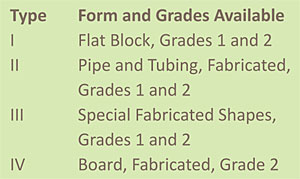
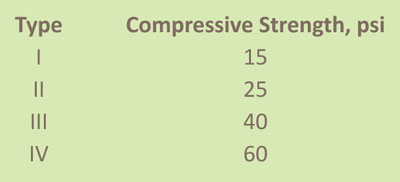
insulation between -22°F and 225°F. The standard classifies materials into four
types by compressive strength, as follows in the chart below.

The
standard covers requirements for thermal resistance of 1.0 inch thickness,
compressive strength, water vapor permeability, water absorption, tensile
strength, response to thermal and humid aging, and closed-cell
content. For comparison purposes, the maximum thermal conductivity for all
types is 0.16 Btu-in/(h ft²°F).

ASTM
C 945 Standard Practice for Design Considerations and Spray Application of a Rigid
Cellular Polyurethane Insulation System on Outdoor Service Vessels covers
substrate preparation, priming, selection of the polyurethane system, and
selection of the protective covering for outdoor service. The Spray
Polyurethane Foam Alliance (www.sprayfoam.org) is a trade organization
of SPF producers and contractors who can provide additional assistance on SPF.

Polyurethane
foam is also available as one- or two-component poured-in-place systems in
disposable containers.

Figure 1

Many executives have wondered how they will ever be able to develop this murky concept, called social media, into a viable strategy that will help grow their businesses. Social media is not as complicated as you might think. Essentially, the term means sharing information, such as ideas, personal messages, videos, etc., with an online community, like your friends on Facebook or your peers on LinkedIn.

While social media can be a great asset to any company, it is not necessary (in fact, often it is counterproductive) to use every social media application you can get your hands on. The trick is to be selective. Pick and choose the applications that seem best for your business when you weigh the costs (both monetary and time) with the benefits.

Here is a list of the top five social media applications you should check out, if you haven’t used them already.

  1. Facebook (www.facebook.com)
    and Google+(plus.google.com)

    Both of these free applications allow your company to connect with individuals on a personal level and maintain a dialogue with current and potential customers and partners. These days, nearly everyone, from your 14-year-old son to your 75-year-old mother-in-law, has a Facebook account (and Google+ has also risen in popularity).

    In order to utilize these social networking websites, people need to “like” your company’s page. Just as you would ask people to subscribe to an e-mail list, you would ask people to “like” your Facebook page. While millions of people are on Facebook, you are only communicating with the ones who have found your page and decided to connect with you. Although this may restrict the number of people you can connect to, it also ensures that the people who receive your posts are interested in your message or company. The more people who “like” your page, the more visible your company will be, allowing you to foster relationships with customers and partners, thus generating new business. Facebook is used primarily for personal social interaction and business-to-consumer relationship building, rather than business-to-business interaction.

  2. Twitter (twitter.com)

    When the free Twitter application first gained popularity in 2008-09, many people wondered how one could successfully communicate with a limit of just 140 characters. As users have become more comfortable with the platform, it has become clear that Twitter can be extremely useful for sharing new products and services, upcoming events, and breaking news. Essentially, think of Twitter as a way to communicate headlines, with links to other websites to provide additional information.

    Twitter created a worldwide stir when Iranians used the application to instigate and organize national protests in 2009. Dubbed “Iran’s Twitter Revolution,” traditional media sources relied on Twitter posts to cover news of the national unrest because Iran had banned all traditional media from the country.

    In the marketing arena, many companies are launching Twitter campaigns, including the Emmy-winning “Old Spice Guy” campaign that combined commercials, Twitter, and YouTube. The Old Spice Guy solicited questions from fans on Twitter and then answered them in personal, short, humorous YouTube videos. According to the social media experts at Mashable, the “total upload views for the Old Spice YouTube videos (including both the TV and the social media campaigns) [stands] at almost 135 million.”

  3. LinkedIn (www.linkedin.com)

    This is the only popular social media application that is designed specifically with businesses and professionals in mind. LinkedIn is a free website that helps you to foster relationships with peers, interact directly with clients, and find and recruit talented employees. This program allows you to create a user profile and develop strategic “connections” with other professionals. LinkedIn provides many great resources, including allowing you to create a forum to interact directly with your “linked” customers to create a community, professional groups for problem solving and industry discussion, and recruiting resources. Like Facebook, LinkedIn is more effective the more people you are
    “connected” with; however, it focuses on both business-to-consumer and business-to-business interaction.

  4. YouTube (www.youtube.com)

    Since the mid-2000s, YouTube videos have surged in popularity, as the free service allows anyone to upload a video and share it with the world. YouTube can be a great resource for sharing educational and marketing videos about insulation products and systems; indeed, several insulation manufacturers have posted product and/or installation videos that you can link to on your website or send to your customers.
    In order to use YouTube effectively, it’s important to ensure that you have a high quality and pertinent video. YouTube can be combined with other social media, such as using Facebook and Twitter to advertise your videos.

  5. Google Alerts (www.google.com/alerts)

    This free Google feature is an easy way to help manage your reputation, find out about new industry developments, or get updates on business partners or even competitors. Google Alerts lets you run a continuous web search on any topic. As new results—such as web pages, newspaper articles or blogs—appear that match your initial search query, you will be sent an e-mail alerting you of the news. You can use Google Alerts to monitor anything on the web.

    For example, many insulation professionals use Google Alerts to perform the following:

    • Find out what is being said about
      their company
    • Monitor a developing news story
    • Keep up to date on a competitor
      or industry
    • Find out about new industry
      regulations
    • Monitor codes or pending legislation
      that affects the insulation industry

In case you are worried that this feature has the potential to clog your inbox with e-mails, fear not. With Google Alerts, you can specify the frequency of e-mails to receive updates on a as-it-happens, daily, or weekly basis.

Creating a Plan

As you start to develop your social media strategy, devote some time and energy to
careful planning. Consider your target audience, determine your goals (brand building, marketing products, strengthening customer relationships, etc.) and evaluate the best social media tools to reach them. For instance, if your goal is to stay informed of industry news, Google Alerts might be the right tool. If you want to market your company’s products, Twitter might be a better forum. After you have established your goals, determine the metrics you will use to evaluate progress and how you will define success.
 

Once you have determined this part of your strategy, designate a staff member (or members) to be responsible for implementing and maintaining your social media platforms and invest in a social media training program for those personnel. Choose staff members you trust to speak on your behalf, manage your marketing and branding, and protect your company’s reputation. Additionally, make sure that these staff members are knowledgeable of your company’s policies and have the authority to address the customer complaints or issues that might arise in these public forums. Your designated staff members will be representing your company on a global scale; thus, it is important that
their communications are professional and their responses improve your brand, rather than harm it. Think of your social media applications as a billboard advertisement for your company on the highway. How would it look if your company’s billboard contained a misspelling or grammatical mistake?

The next step is to make your social media strategy a priority. Create a flexible calendar addressing the topics and timeline of posts. Set reasonable and specific goals, e.g., write one Facebook post each morning or week. A social media plan is not something you develop and then forget about; it’s an ongoing effort. Overall, make sure your company supports staff and allows them the time needed to learn about social media and implement your plan successfully.

Social Media Management

You will probably choose to use more than one social media channel in your marketing strategy. Fortunately, there are a few tools that are designed specifically to help you manage your entire social media campaign from just one website. These time-saving tools are a great help to a small marketing team. When selecting a social media application, it’s important to select a program that includes all or most of your social media websites so that you’re not just adding another program to the list of websites you have to monitor.

  1. TweetDeck (www.tweetdeck.com)

    This free website manages Twitter and Facebook accounts.

  2. Hootsuite (hootsuite.com)

    This social media management program allows you to manage your Facebook, Google+, Twitter, LinkedIn, Foursquare, Ping.fm, WordPress, My Space, and Mixi accounts all from one website.  It also allows you to add customized applications, such as YouTube, Flickr, and Tumblr. Hootsuite has various paid levels that are affordable for small businesses.

  3. Hubspot (www.hubspot.com)

    This social media management program is more extensive, as it offers a complete marketing system for small businesses. It includes website management, blogging tools, lead nurturing, e-mail marketing/automation, inbound marketing analytics and other tools. Free trials are available, but it costs $100 a year for the basic program.

Conclusion:

One of the biggest perks of the “digital age” is that marketing your company does not have to cost a fortune. With a savvy and selective media strategy, you can utilize free (or inexpensive) social media applications to brand your company; foster relationships with current and potential clients; recruit talented personnel; and keep tabs on new developments in your field, your competitors’ activities, and your own reputation. Social media can serve as a reasonably inexpensive way to expand your company’s marketing reach, in addition to your existing traditional marketing strategies.

Polystyrene

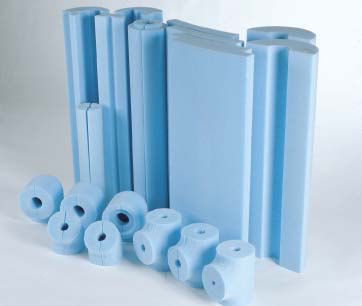
Polystyrene thermal insulation is rigid, cellular foam
insulation. It is commonly classified as either Expanded Polystyrene Foam (EPS)
or Extruded Polystyrene Foam (XPS). XPS is a closed-cell material manufactured
as rectangular billets, typically 20 in wide x 9 ft long x 10 in tall. Prior to
actual installation, billets are fabricated into various shapes including
preformed pipe half-shells 3 ft long designed to fit NPS pipe and tubing.
Complex shapes can also be fabricated to fit valves, fittings, and other
equipment. ASTM material specification C 578 covers several types of
polystyrene insulation, but Type XIII is usually specified for mechanical
applications and covers service temperatures from -297°F to +165°F. The
standard contains requirements for compressive resistance, flexural strength,
thermal conductivity, water absorption, water vapor permeability, and
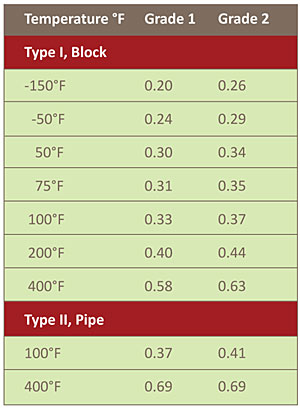
dimensional stability. For comparison purposes, the thermal conductivity of the
Type XIII XPS is a maximum of 0.259 Btu-in/hr-ft²-°F at 75°F.

Key
applications for XPS insulation are on pipe, equipment, tanks, and ducts
operating at temperatures below ambient. These include food and beverage lines,
and refrigeration lines.


Figure 1

The
North American Insulation Manufacturers Association (“NAIMA”) and its
fiberglass member companies have promoted the usefulness and safety of
fiberglass insulation products since the 1930s. Throughout the years, NAIMA has
asserted that “biosoluble” fiber, fiber that readily dissolves in the lungs, is
safe to manufacture, install and use when the proper work processes are
followed.

Man-made vitreous fibers were identified as a possible
carcinogen in 1987 by the International Agency for Research on Cancer (“IARC”).
These claims were later adopted by domestic governmental bodies. However, since
then, scientists, both internationally and domestically, have questioned the
evidence backing the classification of fiberglass as a carcinogen. Medical and
scientific evidence has been collected and analyzed from groups in the United
States, United Kingdom, Canada, The Netherlands, Australia, New Zealand, and
others since the 1930s.

In October 2001, IARC changed the classification of
“insulation glass wool,” moving it from Group 2B (possibly carcinogenic) to
Group 3 (not classifiable as to its carcinogenicity to humans).”1

Recent
Developments in the United States

On
June 10, 2011, the National Toxicology Program (NTP) removed from its list of
“Reasonably Anticipated To Be Carcinogens” biosoluble glass wool fibers used
for home and building insulation, drawing a distinction between biosoluble
glass wool fibers and “certain glass wool fibers (inhalable) [that are]
reasonably anticipated to be human carcinogens” in an explanatory fact sheet.
The fact sheet notes “Not all glass wool fibers cause cancer. Certain refers to
those fibers that can enter the respiratory tract, are more durable, and remain
in the lungs for long periods of time.”2 The NTP action means that a
cancer warning label for biosoluble fiberglass home and building insulation is
no longer required under federal law. Home and building insulation that will no
longer carry a cancer warning label include fiberglass residential, commercial,
and industrial insulation products; specifically, fiberglass pipe and board
products will not carry a cancer warning label. In fact, the United States was
the only remaining jurisdiction in the world where biosoluble fiberglass
insulation was required to carry a cancer warning label.

Also in 2011, the California Office of Environmental Health
Hazard Assessment (OEHHA) published a modification of its Proposition 65
listing to include only “glass wool fibers (inhalable and biopersistent).”3
The OEHHA action means that a cancer warning label for biosoluble fiberglass
home and building insulation is no longer required under California law.

Delisting fiberglass insulation from the NTP’s Report on
Carcinogens (RoC) and California’s Prop. 65 list of carcinogens is consistent
with the findings or conclusions reported by the IARC4 in 2002; the
National Academy of Sciences (NAS)5 in 2000; the Agency for Toxic
Substances and Disease Registry (ATSDR) in 20046; and Health Canada7
in 1993.

What is a
Biosoluble Fiber?

Before any further discussion on these two significant
developments, it is imperative that the reader understand the meaning of
“biosoluble.” A “biosoluble” fiber is one that readily dissolves in the lung.
“Biopersistent” fibers are fibers that remain in the lungs for a longer time.
These more durable fibers are not used for insulation and represent a small
percentage of glass wool fibers produced in the United States; biopersistent fibers
actually constitute less than one percent of the glass wool fibers produced in
the United States. Biopersistent fibers are “used for high-efficiency air
filtration media, acid battery separators and certain fine-diameter glass
fibres.”8

To identify those fibers described by NTP and California as
biosoluble, NAIMA and its members have adopted as a policy the European Union
(EU) criteria to identify which fibers require cancer warning labels under U.S.
and California requirements. The EU provides a scientific classification system
for differentiating and distinguishing between those glass fibers that require
a cancer warning label from those that do not. The EU system relies on
standardized in vivo protocols. For additional details, the reader may consult
the EU Guidelines ECB/TM27 rev. 7.9

The Historical
Backdrop

The
labeling of fiberglass insulation as a possible carcinogen had its genesis in
animal implantation studies. Implantation is a non-physiological route of
exposure. These studies literally injected or surgically implanted large
quantities of fibers directly into the abdomen, pleura (lining of the chest and
lungs), or trachea of the animals, bypassing the animals’ normal respiratory
systems’ protective mechanisms. Some of these studies resulted in tumors.10

Relying upon the studies where tumors occurred in animals
after implantation, IARC, in 1988, classified fiberglass as a possible
carcinogen. California’s OEHHA (Prop. 65) and NTP followed shortly thereafter
with similar listings. These listings were based on the animal implantation
studies, however.11 Over time, most in the scientific community
agreed that these implantation studies were not appropriate for characterizing
human health risk.12 It was the consensus of a World Health
Organization (WHO) panel of fiber toxicologists that these non-physiological
methods of administering fibers to animals were not appropriate substitutes for
inhalation studies for assessing risk of fibers to human health.13

As the legitimacy of implantation studies was called into
question, a series of inhalation studies was conducted at RCC Laboratories in
Geneva, Switzerland. The results of these studies demonstrated that animals
exposed through inhalation to large doses of glass wool fibers did not develop
tumors.14 With this animal data and expanded human epidemiological
data, IARC revisited its earlier decision. In October 2001, a panel of
international experts reviewed the data and concluded that fiberglass and rock
and slag wool fibers used for thermal and acoustical insulation were considered
“not classifiable as to carcinogenicity to humans (Group 3).” IARC noted
specifically:

“Epidemiologic studies published during
the 15 years since the previous IARC Monographs review of these fibres in 1988
provide no evidence of increased risks of lung cancer or of mesothelioma
(cancer of the lining of the body cavities) from occupational exposures during
manufacture of these materials, and inadequate evidence overall of any cancer
risk.”
15

IARC also included a Group 3 classification for continuous
glass filaments and the Group 2B “possible carcinogen” classification for
certain special-purpose glass wools also known as biopersistent fibers.16

Catching Up With
the Rest of the World

After
the IARC decision, the United States was the only jurisdiction in the world
that required a cancer warning label on biosoluble fiberglass insulation. NAIMA
immediately petitioned the NTP seeking a similar delisting from the RoC. In
submitting comments to NTP, NAIMA emphasized that glass wool fibers delisted by
IARC are not classified and labeled as carcinogens outside the United States.
Under this scenario, a company could produce a glass wool fiber product at a
plant in the United States and ship it to Europe, Canada, or anywhere else in
the world without a cancer warning label. If that identical product was
distributed in the United States, it would be required to carry a cancer
warning label.

It is useful to understand that to be listed on the RoC,
certain criteria must be satisfied (published in the Report on Carcinogens,
Twelfth Edition [12th RoC]):

Known To Be Human Carcinogen:

There is sufficient evidence of
carcinogenicity from studies in humans, which indicates a causal relationship
between exposure to the agent, substance, or mixture, and human cancer.

Reasonably Anticipated To Be Human
Carcinogen:

There is limited evidence of
carcinogenicity from studies in humans, which indicates that causal
interpretation is credible, but that alternative explanations, such as chance,
bias, or confounding factors, could not adequately be excluded,

or

there is sufficient evidence of
carcinogenicity from studies in experimental animals, which indicates there is
an increased incidence of malignant and/or a combination of malignant and
benign tumors (1) in multiple species or at multiple tissue sites, or (2) by
multiple routes of exposure, or (3) to an unusual degree with regard to
incidence, site, or type of tumor, or age at onset,

or

there is less than sufficient
evidence of carcinogenicity in humans or laboratory animals; however, the
agent, substance, or mixture belongs to a well-defined, structurally related
class of substances whose members are listed in a previous Report on
Carcinogens as either known to be a human carcinogen or reasonably anticipated
to be a human carcinogen, or there is convincing relevant information that the
agent acts through mechanisms indicating it would likely cause cancer in
humans.

Conclusions regarding carcinogenicity in humans or
experimental animals are based on scientific judgment, with consideration given
to all relevant information. Relevant information includes, but is not limited
to, dose response, route of exposure, chemical structure, metabolism,
pharmacokinetics, sensitive sub-populations, genetic effects, or other data
relating to mechanism of action or factors that may be unique to a given
substance. For example, there may be substances for which there is evidence of
carcinogenicity in laboratory animals, but there are compelling data indicating
that the agent acts through mechanisms that do not operate in humans and would
therefore not reasonably be anticipated to cause cancer in humans.

This evidence can include traditional cancer epidemiology
studies, data from clinical studies, and/or data derived from the study of
tissues or cells from humans exposed to the substance in question, which can be
useful for evaluating whether a relevant cancer mechanism is operating in
humans.

 The 12th RoC profile for certain glass wool fibers
(inhalable) indicated that biosoluble glass wool fibers do not meet the
criteria for listing. Shortly after the NTP action, California’s OEHHA
published a modification to its Prop. 65 listing to include only “Glass wool
fibers (inhalable and biopersistent).”17

Conclusion

IARC,
NTP, and California’s Prop. 65 do not often remove substances from their lists
of carcinogens. NAIMA and its members are not surprised by the recent
development, however, because they are supported by medical and scientific evidence.
NAIMA restates that “Fiberglass insulation products are safe to manufacture,
install and use when recommended work practices are followed.”18

 

References:

  1. The various classifications include Group 1 (carcinogenic
    to humans), Group 2A (probably carcinogenic to humans), Group 2B (possibly
    carcinogenic to humans), Group 3 (not classifiable as to its carcinogenicity to
    humans), and Group 4 (probably not carcinogenic to humans). See http://monographs.iarc.fr/ENG/Monographs/vol81/mono81.pdf.

  2. National Institute of Environmental Health Sciences,
    National Toxicology Program, Fact Sheet, “The Report on Carcinogens,” June
    2011. See http://www.niehs.nih.gov/health/materials/the_report_on_carcinogens_12th_edition.pdf
     

  3. 46-Z California Regulatory Notice Register, p. 1878
    (November 18, 2011). http://www.oal.ca.gov/res/docs/pdf/notice/46z-2011.pdf

  4. International Agency for Research on Cancer, IARC
    Monographs on the Evaluation of Carcinogenic Risks to Humans: Man-Made Vitreous
    Fibres,
    Vol. 81 (Lyon, France: WHO/IARC, 2002).

  5. NRC Subcommittee on Manufactured Vitreous Fibers. 2000.
    Review of the U.S. Navy’s Exposure Standard for Manufactured Vitreous Fibers.
    National Academy of Sciences, National Research Council, Washington, D.C.:
    National Academy Press.

  6. Toxicological Profile for Synthetic Vitreous Fibers
    (U.S. Department of Health and Human Services, Public Health Services, Agency
    for Toxic Substances and Disease Registry), September 2004.

  7. Environment Canada. 1993. Mineral Fibres (Man-Made
    Vitreous Fibres), Priority Substance Assessment Report,
    p. 5.

  8. IARC Monograph 81, p. 52.

  9. http://tsar.jrc.ec.europa.eu/documents/Testing-Methods/mmmfweb.pdf.

  10. Hesterberg, W., et al., “Chronic Inhalation Toxicity
    of Size-Separated Glass Fibers in Fischer 344 Rats,” 20 Fund. & Appl.
    Toxicol. 464-76 (1993); Bunn, W.B., et al., Recent Studies of Man-Made Vitreous
    Fibres ? Chronic Animal Inhalation Studies,” 35 J. Occup. Med. 101 (1993).

  11. International Agency for Research on Cancer, IARC
    Monographs on the Evaluation of Carcinogenic Risks to Human: Man-made Mineral
    Fibres and Radon,
    Vol. 43 (Lyon, France: WHO/IARC, 1988), pp. 148-49, 152.

  12. Environmental Protection Agency, “Health Hazard Assessment
    of Nonasbestos Fibers,” Final Draft (Dec. 30, 1988).

  13. WHO, European Programme For Occupational Health, “Validity
    of Methods for Assessing the Carcinogenicity of Man-Made Fibers,” Executive
    Summary of a WHO Consultation (May 19-20, 1992).

  14. Hesterberg, W., et al., “Chronic Inhalation Toxicity
    of Size-Separated Glass Fibers in Fischer 344 Rats,” 20 Fund. & Appl.
    Toxicol. 464-76 (1993); Bunn, W.B., et al., Recent Studies of Man-Made
    Vitreous Fibres ? Chronic Animal Inhalation Studies,” 35 J. Occup. Med. 101
    (1993).

  15. IARC Press Release, 24 October 2001 (http://www.iarc.fr/en/media-centre/pr/2001/pr137.html).

  16. World Health Organization International Agency for Research
    on Cancer, IARC Monographs on the Evaluation of Carcinogenic Risks to
    Humans: Man-Made Vitreous Fibres,
    Vol. 81 (Lyon, France: WHO/IARC, 2002). http://monographs.iarc.fr/ENG/Monographs/vol81/volume81.pdf

  17. 46-Z California Regulatory Notice
    Register, p. 1878 (November 18, 2011). http://www.oal.ca.gov/res/docs/pdf/notice/46z-2011.pdf

  18. Recommended work practices are designed to reduce temporary
    mechanical irritation. Note that this mechanical irritation does not meet the
    U.S. OSHA HAZCOM definition of irritation as set forth in Appendix A to 29
    C.F.R. § 1910.1200.

Disclaimer: Unless specifically noted at the
beginning of the article, the content, calculations, and opinions expressed by
the author of any article in Insulation Outlook are those of the author and do not
necessarily reflect the views of NIA.