Category Archives: Material Selection

Molded Expanded Perlite
Insulation Products

Molded Expanded Perlite
insulation is defined by ASTM as insulation composed principally of expanded
perlite and silicate binders. It may also contain
reinforcing fibers.

Perlite Pipe and
Block Insulations are covered by ASTM C610. The standard covers the material
for operating temperatures between 80°F and 1200°F.

Perlite pipe
insulation is supplied as a hollow cylinder split into half or
quarter sections, or as curved segments. Pipe insulation sections are typically
supplied in lengths of 36″, and are available in sizes to fit most standard
pipes. Available thicknesses range from 1″ to 4″ in ½” increments. Thicker insulation
is supplied in nested sections.

Perlite block insulation is supplied in lengths of
36″ and 1 meter, widths from 24″ and in thickness from 1½” to 6″ in increments
of ½”. Perlite molded fitting cover insulation is available for a wide variety
of standard elbow and tees.

Scored and V-Groove
sections are also available. Special shapes such as valve or fitting insulation
can be fabricated from standard sections.

Perlite is normally
finished with a metal or fabric jacket for appearance and weather protection.

The specified
maximum thermal conductivity for both block and pipe insulation is 0.48
Btu•in/(h•ft²•°F) at a mean temperature of 100°F.

Perlite insulation
products also comply with the ASTM C610 requirements for flexural (bending)
strength, compressive strength, weight loss by tumbling, moisture content,
linear shrinkage, water absorption after heat aging, surface-burning
characteristics, and hot surface performance. Additionally, it complies with
the standard for use in contact with austenitic stainless steel.

Typical applications include piping and equipment
operating at temperatures above 250°F, tanks, vessels, heat exchangers, steam
piping, valve and fitting
insulation, boilers, vents, and exhaust ducts.
Perlite insulation is often used in insulation systems where water may enter
and cause corrosion or process problems. Examples of this would be wash-down
areas, deluge testing, pipes that cycle in temperature, and stainless steels that
are susceptible to stress corrosion cracking.

Figure 1

The
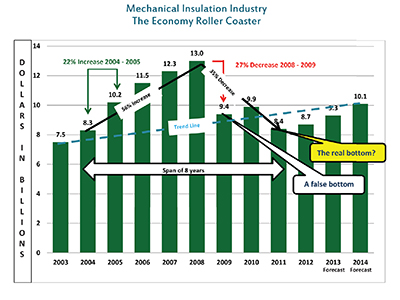
mechanical insulation industry, and the economy as a whole, continues to
rebound from the recent recession. The recovery is slow and varies by region,
market segment, and even within states. The good news is that the industry is
slowly recovering and the signs are there, although fragile, for continued
moderate growth. The industry is moving forward.

After
years of significant growth (2003–2008), the commercial and industrial
mechanical insulation market saw a decline in 2009 of over 27%. The 2010 survey
indicated that the industry had potentially bottomed out and was beginning to
recover. Like many other industries, we soon found that optimism was unfounded
and we had encountered a false bottom. 2011 yielded a 14.7% decline from 2010,
which—for all practical purposes—erased the gains of 2005–2008. Margin erosion
represented a significant portion of the 2011 decline. It does appear, however,
that the bottom has been reached, with 2012 showing 3.5% growth over 2011.

While the growth in 2012 is encouraging, it is
unfortunately beginning from a smaller base, and the general economic recovery
is still tenuous and subject to sudden change. Thus it is not a question of
whether the recovery has begun, but at what pace it will continue. For the
first time, the industry survey asked respondents to provide information
relative to growth expectations for 2013 and 2014. The respondents were
confident about the recovery and indicated they were expecting, on average, a
total of 7% and 8.9% growth, respectively.

The survey was sponsored by the National Insulation
Association (NIA) Foundation for Education, Training, and Industry Advancement
(Foundation). The goal of the survey is to obtain valuable data regarding
sales, market size, and growth for the U.S. commercial and industrial
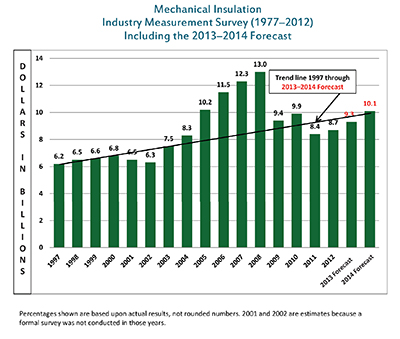
mechanical insulation market. Since the first survey was completed in 1997, the
market has shown a net growth that equates to a 2.4% annual compounded growth
rate. While that compounded growth rate may not seem overly impressive, you
must consider that the recent recession drove an industry decrease of over 35%
from 2009 through 2011. Over the 16-year period in which the survey has been
conducted, the range of growth has varied from over 22% in 2005, to a decrease
of more than 27% in 2009. That is a severe variance in a relatively short
period of time.

While
survey results are always subject to individual interpretation, the following
takeaways have been generated through discussions held both before and after
the tabulation of survey data.

  • The survey is based upon dollars, not units, and a consistent approach
    has been utilized over the 16-year period. Based on the survey methodology, the
    results should reflect conservative numbers. The survey does not include data
    related to metal building insulation; heating, ventilating, and air
    conditioning (HVAC) duct liners; original equipment manufacturer products; building
    insulation; refractory products; other specialty insulations; or insulation
    products or technologies not currently encompassed in NIA’s scope of mechanical
    insulation products. The value added by fabricators and laminators has not been
    accounted for, nor has the potential impact of imported products from outside
    North America.

  • The survey is meant to be a national picture for the respective calendar
    year. Based upon observations and feedback, there are significant geographical
    and product variances in the survey results. This is consistent with any survey
    of such a broad nature.

  • The growth exhibited in 2010 could have been created by a simple spike,
    or by completion of backlog carried over from 2008, which would indicate the
    decline in 2009 was potentially deeper than originally reported.

  • The industry declined from its peak in 2008 ($13.0 billion) by 35.4%, to
    what we assume/hope is the bottom of the recession ($8.4 billion) in 2011.

  • Every channel experienced some degree of margin reduction in the 2009
    and 2010 reporting period. On average, it is estimated that the decline was 1.5
    points. Over 28% of the decline in 2011 is attributable to the margin decline
    in the distributor and contractor segments. The margin decline in the
    manufacturing segment is not known, but it is expected to be in the same range.
    In all likelihood, the decline in 2011 was closer to a 60:40 ratio—60% in units
    with 40% margin erosion. The growth in 2012 appears to be substantially all
    unit growth.

  • Accessory products on a dollar
    comparative basis to core insulation materials declined similarly in 2011 as in
    2010, at 11.2% and 11.9%, respectively, while core insulation product growth in
    2012 over 2011 was significantly higher, at 5.0% versus 0.9%, respectively. The
    breakdown of the 2011 decline is not known, but it is thought to be reasonably
    split between unit decline and margin erosion. The 2012 growth seems to
    indicate that growth in interior mechanical insulation systems, generally used
    in the commercial market, was greater than in the industrial market, which can
    require more extensive finishing systems.

  • Over 78% of the survey respondents provided input to the 2013 and 2014
    growth expectation questions. For 2013, the growth expectations ranged from 3%
    to 15%, with the average being 7%. For 2014, the range was 3% to 17%, with an
    average of 8.9%. If one omits the overly modest and confident respondents, the
    averages are 6.6% and 8.9%. Those expectations seem to be reasonably in line
    with the overall commercial and industrial construction market forecast.
    However, that also begs the question: has the mechanical insulation industry
    forecast taken into consideration the lag time between construction starts and
    mechanical insulation installation requirements? The industry forecast does not
    differentiate growth expectations between new construction, retrofits, or
    maintenance. Historically, forecasts of this nature include a blend of each,
    with new construction being the largest percentage. Regardless, the forecasts
    are optimistic and refreshing after four rollercoaster years.

  • Approximately 50% of respondents
    separated their growth expectations between unit and dollar growth. Based upon
    their responses, it appears that 60% of the growth for 2013 and 2014 will come
    from unit growth, and the balance in dollar growth. In other words, an increase
    in unit cost—or sales price, depending upon your point of view—is expected to
    represent 40% of growth expectations over the 2-year period. The ratio between
    unit and dollar growth is good news, as unit growth is important to sustained
    growth.

  • Unfortunately, the survey methodology does not allow for interpretation
    between the commercial and industrial market segments. As noted in previous
    surveys, the unit increases or decreases were probably led by the commercial
    segment, while the dollar increase may have been somewhat equivalent between
    the two markets. The decline in export product sales created by global economy
    issues would have contributed to the 2011 decline.

  • The survey readership always requests more information by segment,
    region, and a host of other meaningful categories. Obtaining that type of
    information, however, is dependent upon survey respondents choosing to disclose
    it.

The
last several years have been difficult; although signs of recovery were evident
in 2012, it was a challenging year. All
segments—manufacturing, distribution/fabrication, and contracting—responded to
the challenges, as they have in the past (although it is much easier, and more
fun, to respond to the challenges of growth versus decline). Though the economy
has been problematic in the past few years, the future is looking much brighter,
with the potential for sustained growth.

We
should not undervalue the impact the industry’s educational and awareness
initiatives have had. Without those efforts, the bottom may have been deeper
and the recovery even slower. I would like to extend a sincere thank you to
NIA’s Associate (manufacturer) Members who participated in the survey, the
individuals who contributed to the informal survey supporting data, and to all
the contributors to the NIA Foundation for Education, Training, and Industry
Advancement. The Foundation and your support are making a difference in the
industry.

Figure 1
Figure 2

For years, industry has viewed many maintenance activities as a necessary expense or barrier to obtaining profit objectives. This thought process is especially prevalent in a tough economic environment, which has certainly been the case in the United States since the recession began and even during recovery. Management has developed and applied justification methodologies to delay, or even abort, maintenance activities on facilities and processes. It appears that businesses require confidence in a sustained economic recovery before they commit to investing in endeavors such as maintenance of mechanical insulation. Maybe businesses, and/or governing bodies, are looking at mechanical insulation maintenance incorrectly.

Mechanical insulation maintenance is one of the few maintenance activities offering a definitive and attractive return on investment (ROI) that, in terms of short- and long-term energy cost reduction, increases profitability and creates direct, indirect, and induced jobs-the core component to sustained economy recovery. This article explores how increased focus on mechanical insulation maintenance will increase a company’s profitability, create jobs, help our country obtain its energy independence goals, and help stimulate our nation’s economy.

Mechanical insulation is most notably recognized for its inherent energy efficiency attributes, but energy efficiency measures are not always looked upon in a favorable light in troubled economic times. In an October 2012 white paper entitled “Energy Efficiency Job Creation: Real World Experiences,”1 Casey J. Bell, with the American Council for an Energy-Efficient Economy (ACEEE), observes, “The notion of energy efficiency as a driver for widespread,  sustained employment may not be immediately intuitive. Increasing energy efficiency means higher levels of productivity and output achieved through lower levels of energy use. At first glance, it may seem like producing less energy to accomplish the same amount of work would have a negative impact on employment. This view, however, falls short of recognizing the complete economic impact of redistributing saved resources.”

Bell notes that many energy efficiency initiatives take substantial human resources to plan, manage, and implement. Mechanical insulation maintenance, however, does not—nor does it take a significant amount of capital. It can be treated as an expense—an advantage from a tax perspective if potentially a deterrent to short-term profitability—but it provides ROI in many cases in fewer than 6 months. The exact ROI will depend on the application, but seldom is the yield lower than a 25 percent internal rate of return; and on many industrial or manufacturing applications, 200 to 400 percent is not uncommon.

The bottom line is that, as Bell observes, “a company that spends less money on its energy bills likely has more cash on hand to expand and hire.” In turn, that employment can translate into additional job growth in the local economy, which then impacts the regional and national economy.

The United States Bureau of Labor Statistics includes in its definition of “green jobs” those “in which workers’ duties involve making their establishment’s production processes more environmentally friendly or use fewer natural resources.”2 Insulation workers without a doubt perform green jobs. Mechanical insulation maintenance is an excellent example of green job opportunities that can be implemented within weeks or months, versus years. It can put tens of thousands of people to work immediately and retain existing jobs while contributing to the competitiveness of U.S. manufacturing, reducing our country’s dependence on foreign energy sources, improving our environment, and increasing profitability of private and public businesses and facilities.

Equally important, the majority of insulation contractors who install and maintain mechanical insulation systems represent independent small businesses in every state. Mechanical insulation is a proven technology. It does not require research and development, engineering, or design processes. Materials and skilled craft personnel are available now and ready to be deployed, and 95 percent of the materials are made in the United States.

The total number of jobs created by implementing a comprehensive mechanical insulation maintenance program extends well beyond the direct and indirect jobs that are created. The employed workers spend their earnings on a variety of products and services, stimulating growth in other sectors, providing those businesses additional dollars to spend on capital, expansion, or other projects as a result of reduced energy cost. Thus, the cycle of job creation is ongoing.

Using job multipliers derived from MIG’s IMPLAN model3, in the ACEEE white paper, Bell indicated that $1 million spent on energy efficiency in the construction sector supports
approximately 20 jobs. That number is potentially low for mechanical insulation maintenance opportunities because of the magnitude of the ROI. The National Insulation Association (NIA) estimates that implementing a comprehensive mechanical insulation maintenance program in the commercial and industrial market segments and going beyond the minimum standards in new construction, would lead to the following, on an annual basis:

  • Energy savings of 1.22 quads of primary energy, or $4.8 billion
  • ROI ranging from 25 to 100 percent
  • CO2 reductions of 105 million metric tons (MMTCO2)

What do those numbers equate to on a national basis?

Energy savings of 1.22 quads per year equates to:

  • 115 billion kWh of electricity—enough to power 10.8 million households (9.4 percent of  U.S. households) for a year, equivalent to annual output from 26,300 wind turbines
  • 207 million barrels of oil—enough to fill about 103 supertankers
  • 49 million tons of coal—enough tofill 490,000 railcars
  • 1,220,000,000,000,000 Btus (1.22 quadrillion Btus) of primary energy—about 1.2 percent of total U.S. annual consumption, or 4.5 days of energy consumption for the entire United States

105 MMTCO2 of CO2 reduction per year equates to:

  • Adding 4.6 billion mature trees (10.6 million acres of new forest, an area the size of Maryland and Massachusetts combined)
  • Removing 19.2 million cars from the roads, about 7.6 percent of the cars registered in the United States
  • Removing the emissions equivalent of 25 coal-fired power plants, or 3.7 percent of U.S. installed, coal-fired capacity
  • Installing 1.8 billion compact florescent light bulbs, equivalent to 6 light bulbs for every man, woman, and child in the United States

Examining the mechanical insulation maintenance opportunity, and applying the October 2012 ACEEE energy efficiency job creation methodology, approximately 153,000 total jobs would be created—more than double the actual direct and indirect jobs. Achieving these numbers cannot be accomplished overnight, but even with a relatively slow implementation rate, imagine what the numbers would be on a compounded basis over 10 or 20 years.

Some operational and maintenance managers have said that maintaining mechanical insulation is a never-ending process. They are probably correct, because people and/or Mother Nature are the primary causes of damage. Educating personnel as to the real cost of damaging a mechanical insulation system would yield long-term dividends. Most people truly do not understand or appreciate the effects of one small hole in a mechanical insulation system. They walk on the system; lay equipment and tools on it; run into the system with vehicles; hit it for some unknown reason; remove it for substrate inspection or maintenance of adjoining equipment and do not replace it, exposing the remaining insulation, etc. The list of issues is seemingly endless.

Mother Nature is another story. She can do extensive damage in a very short period time. Again, educating personnel as to the value of proper and timely repair of that damage will yield a substantial return.

To management, we can only encourage recognizing the ROI aspect with mechanical insulation maintenance—stop only looking at it as an impediment to the bottom line, and do not accept excuses to delay corrective actions. It is so easy to take insulation systems for granted and talk yourself into believing that delaying action for a few weeks is no big deal. Weeks turn into months, and eventually years, and then you could be facing major problems beyond that of replacing the insulation system. An insulation system failure is normally blamed for corrosion, operational cost increases, underperforming equipment, capital investment required, etc., when in most cases it comes back to taking the insulation systems for granted and delayed corrective action, not the insulation system itself.

While this may sound like common sense, you may or may not be surprised about the lack of respect mechanical insulation systems are given throughout the design, operational, and maintenance processes. Designing, installing, and maintaining a successful mechanical insulation system for below- or above-ambient applications, regardless of geographical location, requires a conscious and continual effort.

Policies, business decisions, and regulatory requirements typically revolve around numbers, so look at the numbers: Increased focus on mechanical insulation maintenance will increase a company’s profitability, create jobs, help our country obtain its energy independence goals, and help stimulate our nation’s economy. Whether you examine the numbers holistically or on a prescriptive basis, the equation does not change: Mechanical Insulation Maintenance = ROI = Job Creation = Energy Efficiency = Economic Recovery.

Sources

  1. www.aceee.org/files/pdf/white-paper/energy-efficiency-job-creation.pdf
  2. www.bls.gov/green/green_definition.htm
  3. “IMPLAN US Model 2009 All Sectors.” Hudson, WI: MIG, Inc.
History

As a part of efforts by the Department of Energy’s Advanced Manufacturing Office to improve the energy efficiency of the U.S. industrial and commercial sectors, the National Insulation Association (NIA) and its alliance partners worked together to design, implement, and execute the Mechanical Insulation Education & Awareness Campaign (MIC).

Calculators

The goal is a program to increase awareness of the energy efficiency, emission reduction, economic stimulus, and other benefits of mechanical insulation in the industrial and commercial markets. An integral component was the development of a series of Insulation Calculators. The calculators provide the user instantaneous information on a variety of mechanical insulation applications in the industrial, manufacturing, and commercial markets. Topics include:

  • Condensation Control for Horizontal Pipe
  • Energy Loss, Emission Reduction, Surface Temperature, and Annual Return (two calculators: one for Equipment, and one for Piping)
  • Financial Returns/Considerations
  • Estimate Time to Freezing for Water in an Insulated Pipe
  • Personnel Protection for Horizontal Piping
  • Temperature Drop for Air in an Insulated Duct or Fluid in an Insulated Pipe

The calculators are online www.insulation.org/calculators. They are fast, free, and functional tools that make it easy to discover energy savings, financial returns, as well as other information used in the design of mechanical insulation systems for above- or below-ambient applications.

This article, including text excerpted from the Design Guide, provides an overview and guide to use of the calculators for energy and condensation control for horizontal piping.

Energy Calculator for Horizontal Piping

As an aid to understanding the relationships between energy, economics, and emissions for insulated systems for horizontal pipe applications, a simple spreadsheet calculator was developed. A similar calculator for equipment, vertical flat surfaces, also was developed.

The algorithms used in the energy calculators are based on the calculation methodologies outlined in ASTM C680-10 – Standard Practice for Estimate of the Heat Gain or Loss and the Surface Temperatures of Insulated Flat, Cylindrical, and Spherical Systems by Use of Computer Programs.

The pipe calculator estimates the heat flows through horizontal piping assuming one-dimensional, steady-state heat transfer. Information concerning a hypothetical insulation system (e.g., the length of run, pipe size, operating temperature, ambient temperature and wind speed, insulation material, and surface emittance of a proposed insulation system) may be input by the user. Calculated results are displayed for a range of insulation types and thicknesses, and include surface temperature, heat flow, annual cost of fuel, installed cost, payback period, annualized rate of return, and annual CO2 emissions.

Other geometries and more complex insulation systems may be analyzed using publicly available software such as the 3E Plus® Insulation Thickness Computer Program. 3E Plus was developed by the North American Insulation Manufacturers Association and is
available at www.3eplus.org.

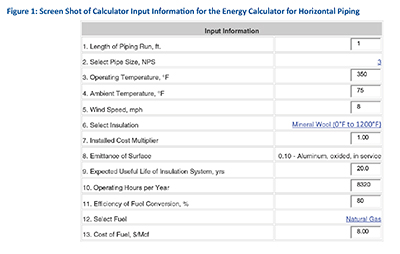
The Energy Calculator for Horizontal Piping requires “Information ” for thirteen variables (see Figure 1). Results are updated as each input variable is entered. Below are instructions and additional information for each input variable. Sample inputs appear in a box, after each instruction.

Figure 1

  • Line 1. Enter the length of the piping run in linear feet    1
  • The default value is 1 linear foot, but you may enter any length of piping run. The initial “Results” section contains installed cost for the default footage (1 linear foot) for the nominal pipe size and material selected in lines 2 and 6, respectively. You may find it helpful to review the cost information for 1 linear foot before completing line 1 and line 7, the cost multiplier.
  • Line 2. Select Nominal Pipe Size, NPS    3
  •  The default value is an NPS of 3″. Using the drop-down box, however, you can select any pipe size from 0.5″ to 14″. Above 14″, we suggest you refer to the 3E Plus program or take another approach.
  • Line 3. Enter average operating (process) temperature for the period of operation 350
  • Enter the average below- or above-ambient operating temperature in degrees Fahrenheit (°F)
  • Line 4. Enter average ambient temperature for the period of operation 75
  • Enter the average ambient temperature in °F
  • Line 5. Enter average wind speed for the period of operation (if unknown, use 1 miles per hour for indoor, 8 mph for outdoor)    8
  • Enter the average wind speed in mph. If unknown, it is suggested you use 1 mph for indoor and 8 mph for outdoor applications.
  • Line 6. Select an insulation material. Note: Calculator does not screen for material temperature limitations­—Use caution.  Mineral Wool (0°F to 1,200°F)
  • The default material is mineral wool; however, you may use the drop-down box to select another insulation material:
    • Calcium Silicate (80°F to 1,200°F)
    • Cellular Glass (-450°F to 800°F)
    • Elastomeric (297°F to 220°F)
    • Fiberglass (0°F to 850°F)
    • Mineral Wool (0°F to 1,200°F)
    • Polyisocyanurate (297°F to 300°F) 

      You will note that each of the material options contains a general operating temperature range. Should you wish to use a material that is not listed, you will need to refer to the 3E Plus program. The simple calculators do not have the capability of utilizing user-supplied thermal curves. Thermal conductivity values for the listed materials are based on ASTM material specification values.


  • Line 7. Enter a cost multiplier to modify the default installed costs (e.g., enter 1.10 to increase costs 10%)    1.00
  • As noted under line 1, the calculator contains default costs for each type of material and pipe size. If you enter 1 linear foot in line 1, select the size pipe in line 2, and the insulation material in line 6, you can review the default cost for a linear foot for various insulation thicknesses in the “Results” section. If “NA” appears for a given insulation thickness, that indicates that the thickness is normally not available for the selected material. You can adjust the cost up or down by simply modifying the multiplier. Enter 1.10 if your cost is 10% higher. Enter .80 if your cost is 20% lower.The installed costs were developed from industry sources and represent single-layer installations. They include aluminum jacketing, but do not include vapor retarders or vapor sealing. They may be viewed as higher than actual, but that view will vary greatly depending upon labor cost, operating conditions, insulation system, and a variety of other factors. Understanding that those variances exist is the reason the multiplier approach was selected.
  • Line 8. Enter the effective emittance of the exterior surface (see Design Data>Table 1 for guidance)    0.10-Aluminum, oxided, in service
  • A definition of emittance is often requested. Technically, emittance is defined as the ratio of the radiant flux emitted by a specimen to that emitted by a blackbody at the same temperature and under the same conditions. In simpler terms: the darker the surface, the more radiant heat is absorbed. The default value is 0.10, which represents aluminum that has oxided in service. However, using the drop-down box, you can select the typical emittance value for eleven of the commonly used insulation jacket finishes.
  • Line 9. Enter the expected life of the insulation system in years    20.0
  • This value is the economic life used for financial return calculations. The default value is 20 years. You can enter any number of years.
  • Line 10. Enter the number of hours per year of system operation (e.g., 8,760 for full year operation)     8320
  • Some systems may not operate 24/7/365. You can input the estimated number of operational hours anticipated.
  • Line 11. Enter the conversion efficiency of the system in percent    80
  • If you do not know the conversion efficiency for the energy source, you can use the following typical conversion efficiencies for various systems:
    • Fossil Fuel Boilers (Non-condensing)     65-85%
    • Fossil Fuel Boilers (Condensing)    80-95%
    • Electric Resistance Boilers    92-96%
    • Electrically Operated Chillers    300-700%
    • Absorption Chillers    60-100%
  • Line 12. Select the fuel used    Natural Gas
  • Using the drop-down box, you can select one of five types of fuel: Natural Gas, Oil, Propane, Coal, or Electricity.
  • Line 13. Enter cost of fuel if known or use default value    8.00
  • A typical default cost for each of the fuel types is provided ($/Mcf). You have the option of simply entering your actual cost, if known, or accepting the default cost.

Based upon the input information you entered, the “Results” section provides detailed information for various insulation thicknesses. An example using the default values for all input variables is shown in Figure 2.

Figure 2

Condensation Control Calculator-Horizontal Pipe

This calculator estimates the thickness of insulation required to avoid condensation on the outer surface of an insulated horizontal steel pipe. Input data includes the operating temperature, the ambient conditions (temperature, relative humidity, and wind speed), and details about the insulation system (material and jacketing).

The insulation materials included in this calculator were selected to be representative of some of the materials commonly used in the industry. The list is not exhaustive, and other materials are available. Also note that some materials are not available in all of the sizes and thicknesses covered by these calculators, and some are available in sizes and thicknesses not listed.

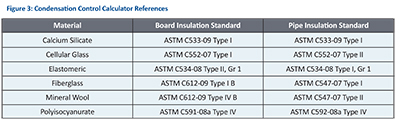
Thermal conductivity data for the materials included in the calculator were taken from the appropriate ASTM material specification. Figure 3 identifies the ASTM specification and the material type and/or grade used in the calculator.

Figure 3

The calculator requires “Input Information” for seven variables. Here are instructions for each data field and additional information for each. As before, sample inputs appear in a box after each step.

  • Line 1. Select Pipe Size, NPS     4
  • The default value is an NPS of 4″, but by using the drop-down box, you can select any pipe size from 0.5″ to 24″.
  • Line 2. Enter average operating (process) temperature, °F    40
  • The default value is 40°F, but other values may be entered.
  • Line 3. Enter average temperature of the air surrounding the pipe    80
  • The default value is 80°F; however, you should enter the average surrounding or ambient operating temperature, in Fahrenheit, for the area in question.
  • Line 4. Enter relative humidity of the ambient air    80
  • The default value is 80%. You should enter the specific design relative humidity for your application, however. From a design perspective, it is better to use a reasonably higher-than-average or worst-case value.
  • Line 5. Enter the wind speed of the ambient air (if unknown, use 0 mph for worst-case conditions)      0
  • As noted, when in doubt, use 0 mph, which represents the worst-case conditions.
  • Line 6. Select an insulation material    Cellular Glass
  • You may use the drop-down box to select one of the insulation materials. Should you wish to use a different material than one of the ones listed, you will need to refer to the 3E Plus program. Thermal conductivity values for the listed materials are based on ASTM material specification values.
  • Line 7. Select the effective emittance of the exterior surface    0.90-All
    Service Jacket
  • As with the energy calculator for horizontal piping, a definition of emittance is often requested. In simple terms, the darker the surface, the more radiant heat is absorbed. The default value is 0.90, which represents All Service Jacket; however, using the drop-down box, you can select the typical emittance value for eleven commonly used insulation jacket finishes.

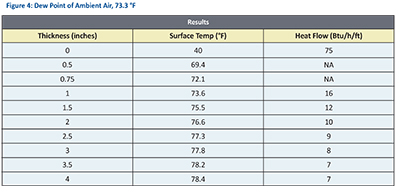
The “Results” section highlights the thickness of insulation required to avoid condensation on the outer surface of the insulation jacket. This thickness yields an average surface temperature that is greater than the dew-point temperature plus a safety factor of ¾°F. It should be noted that for some high-humidity conditions, regardless of the insulation type or thickness, it is impossible to avoid condensation on the outer surface. An example using the default values for all input variables is shown in Figure 4.

Figure 4

Summary

The Simple Calculators are intended to provide the user with online, at-your-fingertips, snapshot information to help answer some the most frequently asked questions about benefits and design considerations of mechanical insulation systems. They do not address every insulation material or application conditions-thus the phrase, Simple Calculators. Other insulation systems and more complex applications may be analyzed using the 3E Plus program.

Whether you need basic insulation information or are designing a complex insulation system, the Design Guide is the best resource for the novice or the experienced user alike, with everything you need to know about the design, selection, specification, installation, and maintenance of mechanical insulation. These tools can be very helpful in designing a mechanical insulation system, allowing the user to easily determine the many benefits and value of mechanical insulation.

Calcium Silicate

Calcium Silicate thermal
insulation is defined by ASTM as insulation composed principally of hydrous
calcium silicate, and which usually contains reinforcing fibers.

Calcium Silicate Block
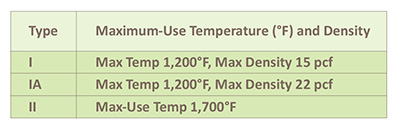
and Pipe Insulation are covered in ASTM C533. The standard contains three
types, classified primarily by maximum-use temperature and density.

The standard limits
the operating temperature between 80° and 1,700°F.

Calcium Silicate
Insulation Products

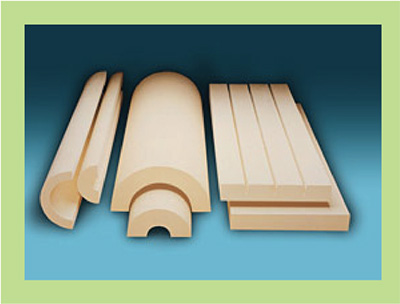
Calcium Silicate pipe
insulation is supplied as hollow cylinder shapes, split in half lengthwise, or
as curved segments. Pipe insulation sections typically are supplied in lengths
of 36″ and are available in sizes to fit most standard pipe sizes. Available
thicknesses range from 1″ to 3″ (in one layer). Thicker insulation is supplied
as nested sections.

Calcium Silicate
block insulation is supplied as flat sections in lengths of 36″; widths of 6″,
12″, and 18″; and thickness from 1″ to 4″. Grooved block is available for
fitting block to large-diameter curved surfaces.

Special shapes, such
as valve or fitting insulation, can be fabricated from standard sections.

Calcium Silicate is
normally finished with a metal or fabric jacket for appearance and weather
protection.

The specified
maximum thermal conductivity for Type I is 0.41 Btu-in/(h?ft²?°F) at a mean
temperature of 100°F. The specified maximum thermal conductivity for Types IA
and Type II is 0.50 Btu-in/(h?ft²?°F) at a mean temperature of 100°F.

The standard also
contains requirements for flexural (bending) strength, compressive strength,
linear shrinkage, surface-burning characteristics, and maximum moisture content
as shipped.

Typical applications
include piping and equipment operating at temperatures above 250°F, tanks,
vessels, heat exchangers, steam piping, valve and fitting insulation,
boilers, vents, and exhaust ducts.

Figure 1
Figure 2

The Mechanical Insulation Design Guide (MIDG) contains extensive information on mechanical insulation materials and their properties, as well as design information. Based on excerpts from the MIDG, here is an overview of design objectives and considerations that should be taken into account for each insulation system.

Most engineers, architects, and end users are familiar with the use of insulation to reduce heating and cooling loads, and to control noise in building envelopes. Insulations used for pipes, ducts, tanks, and equipment are not as familiar; and the installed cost of these materials is usually a small part of the total cost of a project. As a result, mechanical insulation is often overlooked, undervalued, or improperly specified and maintained in commercial and industrial construction projects.

Mechanical insulation is used primarily to limit heat gain or loss from surfaces operating at temperatures above or below ambient temperature. It may be used to satisfy one or more of the following design objectives (answering the question: why insulate?).

  • Condensation control: minimizing condensation and the potential for mold growth by keeping surface temperature above the dew point of the surrounding air
  • Energy conservation: minimizing unwanted heat loss/gain from systems. There are three primary reasons to conserve energy
  • Energy: minimize the use of scarce natural resources
  • Economics: minimize return on investment (ROI) and minimize life-cycle cost
  • Environment: minimize emissions associated with projects’ energy usage
  • Fire safety: protecting critical building elements and slowing the spread of fire in buildings
  • Freeze protection: minimizing energy required for heat tracing systems and/or extending the time to freezing in the event of system failure
  • Personnel protection: controlling surface temperatures to avoid contact burns (hot or cold)
  • Process control: minimizing temperature change in processes where close control is needed
  • Noise control: reducing/controlling noise in mechanical systems

In addition to these objectives, a number of design considerations may require attention when designing a mechanical insulation system.

  • Abuse resistance
  • Corrosion under insulation
  • Indoor air quality
  • Maintainability
  • Regulatory considerations
  • Service and location
  • Service life

Designing insulation systems can be complicated, as they are intended to satisfy a number of design objectives and in some projects, must satisfy multiple design objectives simultaneously. For example, the objective may be to provide the economic thickness of insulation and avoid surface condensation on a chilled water line. The chilled water line may pass through various spaces within the project. Those various spaces may have differing temperature and humidity conditions, so it is likely that different insulation materials, thicknesses, and coverings may be required for a single line. Since projects may involve many lines operating at various service temperatures in various environmental conditions, it is clear that a systematic approach is required for all but the simplest projects.

Design Objectives Condensation Control

For below-ambient systems, condensation control is often the overriding design objective. The design problem is best addressed as two separate issues 1) avoiding surface condensation on the outer surface of the insulation system, and 2) minimizing or managing water vapor intrusion.

Avoiding surface condensation is desirable for a number of reasons (1) it prevents dripping that can wet surfaces below, (2) it minimizes mold growth, and (3) it avoids staining and possible damage to exterior jacketing.

The design goal is to keep the surface temperature above the dew-point temperature of the surrounding air. Calculating surface temperature is relatively simple, but selection of the appropriate design conditions is often confusing. The appropriate design condition is normally the “worst-case” condition expected for the application. For condensation control, however, a design that satisfies the worst-case condition is sometimes impossible.

For outdoor applications (or for unconditioned spaces vented to outdoor air), there are always some hours per year where the ambient air is saturated or nearly saturated. For these times, no amount of insulation will prevent surface condensation. Therefore, for outdoor applications and mechanical rooms vented to outdoor conditions, it is suggested to design for a relative humidity (RH) of 90%. Appropriate water-resistant, vapor-retarder jacketing or mastics then must be specified to protect the system from the inevitable surface condensation. Additional design dew-point data can be found in Chapter 28 of the 2005 ASHRAE Handbook of Fundamentals (www.ashrae.org).

For indoor designs in conditioned spaces, care must still be exercised when selecting the design conditions. Often, the HVAC system will be sized to provide indoor conditions of 75°F/50% RH on a design summer day. However, those  conditions would not represent the worst-case indoor conditions with respect to the insulation design. Part load conditions could result in higher humidity levels, or night and/or weekend shutdown could result in more severe conditions.

Water Vapor

Note that the discussion has focused so far on designing to avoid condensation on the exposed surface. Another important design consideration is minimizing or managing water vapor intrusion. Water vapor intrusion is extremely important for piping and equipment that is operating at below ambient temperatures. Water-related problems include thermal performance loss, health and safety issues, structural degradation, and aesthetic issues. Water entry into an
insulation system may be through diffusion of water vapor, air leakage carrying water vapor, and leakage of surface water.

During those periods when the operating temperature is below the dew point of the surrounding ambient air, there will be a difference in water vapor pressure across the insulation system. This vapor-pressure difference serves as the driving force for diffusion of water vapor from the ambient toward the cold surface. Piping and equipment typically create an absolute barrier to the passage of water vapor, so any vapor-pressure difference imposed across the insulation system results in the potential for condensation either within the insulation or at the cold surface. While these pressure differences seem small, the impact over many operating hours can be significant.

A number of fundamental design principles are applied in managing water vapor intrusion. One method is to reduce the driving force by reducing the moisture content of the surrounding air. While the insulation designer typically will not have control of the location of the piping, ductwork, or equipment to be insulated, there are opportunities for the mechanical engineer to influence the ambient conditions. Certainly, locating cold piping, ductwork, and equipment in unconditioned portions of buildings should be minimized. Consideration should be given to conditioning mechanical rooms, if feasible.

Another fundamental design principle involves the moisture-storage design. In many systems, some condensation can be tolerated, with the amount depending on the water-holding capacity or water tolerance of a particular system. The moisture storage principle permits accumulation of water in the insulation system but at a rate designed to prevent harmful effects. This concept is applicable when 1) unidirectional vapor flow occurs, but accumulations during severe conditions can be adequately expelled during less severe conditions; or 2) reverse-flow conditions regularly occur on a seasonal or diurnal cycle. Design solutions using this principle include 1) periodically flushing the cold side with low dew point air (this procedure requires a supply of conditioned air and a means for distribution), and 2) use of an insulation system supplemented by selected vapor retarders and absorbent materials such that an accumulation of condensation is of little importance. Such a design must ensure  adequate expulsion of the accumulation.

Another common method is the application of moisture-blocking design. The moisture-blocking principle is applied in a design wherein the passage of water vapor is eliminated or minimized to an insignificant level. The design must incorporate: 1) a vapor retarder with suitably low permeance; 2) a joint and seam sealing system that maintains vapor retarding system integrity; and 3) accommodation for future damage repair, joint and seam resealing, and reclosing after maintenance.

A vapor retarder is a material or system that will adequately reduce the transmission of water vapor through the insulation system. The vapor retarder system is seldom intended to resist the entry of surface water,  or to prevent air leakage, but can occasionally be considered the second line of defense for these moisture sources.

Energy Conservation – Financial Considerations

Energy is in short supply, and our dependency on foreign energy sources is at best volatile. Throughout the developed world, the primary source of energy is the burning of fossil fuels. Energy supply and demand plays an increasingly vital role in national security and the economy.

Minimum insulation levels for ductwork and piping often are dictated by these energy standards, which are often adopted by model building code organizations and/or various jurisdictions as building energy codes. Energy codes address energy conservation in buildings, but typically do not address additional design objectives (such as condensation control, personnel protection, or noise control) that may be important on a specific project. The adoption of energy codes varies by state and locality, and the level of enforcement varies. For the current status of statewide energy codes, see www.bcap-energy.org or www.energycodes.gov.

As an aid to understanding the relationships between energy, economics, and emissions for insulated systems, simple spreadsheet calculators have been developed for equipment, vertical flat surfaces, and horizontal pipe applications.

Calculated results are given over a range of insulation types and thicknesses, and include 1) surface temperature, 2) heat flow, 3) annual cost of fuel, 4) payback period, 5) annualized rate of return, and 6) annual CO2 emissions.

The pipe spreadsheet estimates the heat flows through horizontal piping. Information concerning a hypothetical insulation system (e.g., the length of run, pipe size, operating temperature, ambient temperature and wind speed, insulation material, and surface emittance of a proposed insulation system) may be input by the user. Calculated results are given over a range of insulation types and thicknesses, and include 1) surface temperature, 2) heat flow, 3) annual cost of fuel, 4) payback period, 5) annualized rate of return, and 6) annual CO2 emissions.

Economic Considerations – ROI

Insulation systems are frequently designed with the objective of minimizing costs. Properly designed systems can reduce heat loss (or gains) from (or to) mechanical systems by 90-98%. When energy must be purchased to offset these heat flows, insulation systems can quickly pay for themselves in reduced energy costs.

Insulation projects (like many energy conservation projects) generally involve making an initial investment that will result in future cost savings. A number of approaches can be used to measure the financial desirability of an insulation project. All require estimates of the initial investment (the installed cost of the insulation system) and the resulting future savings. Some of these financial measures are simple, like ROI and Simple Payback Period. Others are more complicated and take into account the time value of money, inflation, and taxes.

In today’s economic environment, companies are requiring that investments be subject to review at various levels in the approval process. The Mechanical Insulation Financial Calculator was developed to provide a simple example of specific financial measures related to investments in mechanical insulation. It can be used for an overall mechanical insulation project or a simple, small mechanical insulation investment?such as insulating a valve or replacing a section of insulation. Tax implications of the investment have not been considered in the Financial Calculator. Users should consult a financial advisor for specific and/or tailored financial calculations.

Economic Thickness Considerations

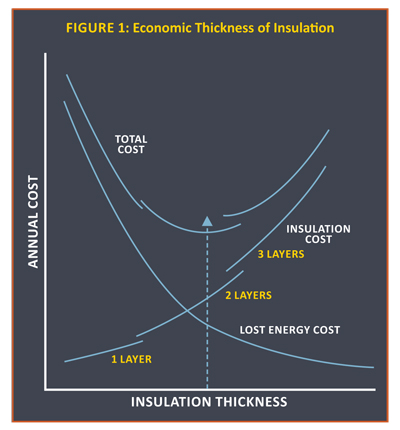
The concept of economic thickness of insulation considers the initial installed cost of the insulation system plus the ongoing value of energy savings over the expected service lifetime. Economic thickness is defined as the thickness that minimizes the total life-cycle cost (see Figure 1). The installed costs (labor and material) of the insulation increase with thickness.

Insulation often is applied in multiple layers (1) because materials are not manufactured in single layers of sufficient thickness, (2) to accommodate expansion and contraction of insulation and system components, and (3) to minimize thermal short circuits at joints. Figure 1 shows initial installed costs for a multilayer application. The curve is discontinuous and increases with the number of layers because labor and material costs increase more rapidly as thickness increases. Figure 1 also shows the present value of the “lost energy” cost over the expected life of the project, which decreases as the insulation thickness is increased. The total cost curve, which is the sum of the installed insulation cost and the present value of the lost energy cost curves, shows a minimum value at point A. This point on the total cost curve corresponds to the economic insulation thickness, which, in this example, is in the double-layer range.

Initially, as insulation is applied, the total life-cycle cost decreases rapidly because the value of incremental energy savings is greater than the incremental cost of insulation. Additional insulation reduces total cost up to a thickness where the change in total cost is equal to zero. At this point, no further reduction can be obtained; beyond it, incremental insulation costs exceed the additional energy savings derived by adding another increment of insulation.

An economic thickness analysis should consider the time value of money, which can be based on a desired rate of return for the insulation investment. Energy costs are volatile, and a fuel cost inflation factor is sometimes included to account for the possibility that fuel costs may increase more quickly than general inflation. Insulation system maintenance costs should also be included, along with any identifiable cost savings associated with the ability to specify lower capacity equipment.

Any economic analysis must, by nature, deal with quantifiable benefits and costs. Some benefits difficult to quantify (e.g., thermal comfort of occupants, increased life of mechanical equipment, reduced dependency on energy imports, and/or reduced emissions). Designers therefore should consider the economic thickness of insulation to be a minimum.

Economic considerations also come into focus during the owner/contractor “value engineering” (VE) process. Efforts by the contractor or owner/developer to reduce the initial cost of a building or structure by applying the principles of value engineering to the building design and construction must be carefully weighed by the architect/engineer-of-record against the best long-term interests of the owner/end-user. This is particularly true with regard to mechanical insulation. In too many instances, the term “value engineering” is used as a euphemism for cost reduction. Design choices of insulation materials, thicknesses, and jacketing systems made by the design professional are arbitrarily considered cost-prohibitive for a project and are eliminated during the VE process. In some cases, the costs associated with correcting problems that result from VE decisions can be significant, and the work highly disruptive. The importance of documenting the criteria used in the design, and highlighting these criteria during the VE process, is emphasized.

Environmental Considerations – Sustainability

Along with the benefits associated with conserving energy resources, insulation contributes to the reduction in emissions associated with using those energy resources. Insulation products are among the few building materials considered to be “carbon negative,” in that reductions in carbon emissions over the life of the materials far exceed the carbon emissions associated with manufacture, transport, and installation of the insulation products.1 In addition, well-insulated mechanical systems often can result in smaller equipment, which also contributes to sustainability.

Fire Safety

Mechanical insulation materials often are used as a component in systems or assemblies designed to protect buildings and equipment from the effects or spread of fire (i.e., fire-resistance assemblies). Specific designs are tested and assigned hourly ratings based on performance in full-scale fire tests. Note that insulation materials alone are not assigned hourly fire-resistance ratings; ratings are assigned to a system or assembly that may include specific insulation products, along with other elements such as framing members, fasteners, wallboard, etc.

Materials used to insulate mechanical equipment generally must meet the requirements of local codes adopted by governmental entities having jurisdiction over the project, so local code authorities should be consulted for specific requirements. In the United States, most local codes incorporate or are patterned after model codes developed and maintained by organizations such as the National Fire Protection Association (NFPA) and the more recent International Code Council (International Codes).

Fire-resistance ratings often are developed using ASTM E119. This test exposes assemblies (walls, partitions, floor or roof assemblies, and through-penetration fire stops) to a standard fire exposure controlled to achieve specified temperatures throughout a specified time period. The time-temperature curve is intended to be representative of building fires where
the primary fuel is solid, and specifies a temperature of 1,000°F at 5 min, 1,700°F at 1 h, and 2,300°F at 8 h.

Most codes related to insulation product fire safety refer to the surface burning characteristics as determined by the Steiner tunnel test (ASTM E84, NFPA 255, UL 723, or CAN/ULC S-102). These similar test methods evaluate the flame spread and smoke developed from samples mounted in a 25 ft long tunnel and subsequently exposed to a controlled flame. Results are given in terms of flame-spread and smoke-developed indices.

For pipe and duct insulation products, samples are prepared and mounted in the tunnel per ASTM E2231, which directs that “the material, system, composite, or assembly tested shall be representative of the completed insulation system used in actual field installations, in terms of the components, including their respective thicknesses.” Samples are constructed to mimic the products, as closely as possible, the products as they will be used?including any facings and adhesives, as appropriate.

Duct insulation generally requires a flame-spread index of not more than 25 and a smoke-developed index of not more than 50, when tested in accordance with ASTM E84. Codes often require factory-made duct insulations (e.g., insulated flexible ducts, rigid fibrous glass ducts) to be listed and labeled per UL 181, Factory-Made Air Ducts and Air Connectors. This standard specifies a number of other fire tests (e.g., flame penetration and low-energy ignition) as part of the listing requirements.

Some building codes require that duct insulations meet the fire-hazard requirements of NFPA 90A or 90B to restrict spread of smoke, heat, and fire through duct systems; and to minimize ignition sources.

For pipe insulation, the requirement is generally a maximum flame-spread index of 25 and a maximum smoke-developed index of 450. For insulation materials exposed within supply and return ducts and plenums, the typical requirement is that the materials be noncombustible or have a maximum flame-spread index of 25 and maximum smoke-developed index of 50.

Freeze Prevention

It is important to recognize that insulation retards heat flow; it does not stop it completely. If the surrounding air temperature remains low enough for an extended period, insulation cannot prevent freezing of still water or water flowing at a rate insufficient for the available heat content to offset heat loss. Clean water in pipes usually supercools several degrees below freezing before any ice is formed, then, upon nucleation, ice forms in the water and the temperature rises to freezing. Ice can be formed from water only by the release of the latent heat of fusion (144 Btu/lb) through the pipe insulation. Well-insulated pipes may greatly retard this release of latent heat. Gordon’s research in 1996 showed that water pipes burst not because of ice crystal growth in the pipe, but because of elevated fluid pressure within a confined pipe section occluded by a growing ice blockage.2 Insulation can prolong the time required for freezing, or
prevent freezing if flow is maintained at a sufficient rate.

Personnel Protection – Safety

In many applications, insulation is provided to protect personnel from burns. In addition, there are safety and comfort concerns related to personnel working in high-temperature, high-radiant exposure locations.

The potential for burns to human skin is a complex function of surface temperature, surface material, and time of contact. See ASTM Standard Guide ASTM C1055 – 03(2009) for a discussion of these factors. ASTM Standard Practice C1057 – 03(2010) provides a mathematical model for “Determination of Skin Contact Temperature from Heated Surfaces….” Standard industry practice is to specify a maximum temperature of 140°F for surfaces that may be contacted by personnel. This temperature would cause no more than first-degree burns for all surfaces for contact times up to about 5 sec. Note that for non-industrial settings (e.g., retail stores) it may be prudent to design for longer contact times (i.e., lower surface temperatures).

When evaluating an insulation system for the potential for burn hazards, select the appropriate worst-case ambient condition. For indoor applications, maximum air temperatures depend on the facility and location, and are typically lower than for outdoor conditions. For outdoor installations, base calculations on summer design ambient temperatures with no wind (i.e., the worst case). Surface temperatures increase because of solar loading, but are usually neglected because of variability in orientation, solar intensity, and many other complicating factors. Engineering judgment must be used in selecting ambient and operating temperatures, and wind conditions, for these calculations.

The choice of jacketing also strongly affects a surface’s relative safety. Higher-emittance jacketing materials (e.g., plastic, painted metals) can be selected to minimize the surface temperature. Jacketing material also affects the relative safety at a given surface temperature. For example, at 175°F, a stainless steel jacket blisters skin more severely than a nonmetallic jacket at equal contact time.

Process Control

Insulation systems often are designed to minimize variation of temperatures in processes. A common example is the use of insulation on tanks or vessels used as chemical reactors, where the yield of the reaction is dependent on the temperature. Insulating the reactor helps to isolate the reaction from variations in ambient temperature and minimizes the capacity of process heating and/or cooling equipment.

Another example is the use of insulation to minimize temperature change (drop or rise) of a fluid from one location to another. Consider the case of a hot fluid flowing down a pipe or duct. Note that, for a cold fluid flowing down a pipe, the temperature drop will have a negative sign, which indicates a temperature rise in the fluid stream.

Noise Control

Noise Radiating from Pipes

Noise from piping can be reduced by adding an absorptive insulation and jacketing material. The expected level of noise reduction in the field can be estimated from knowing knowing the sound insertion loss of insulation and jacketing material combinations. A range of jacket weights and insulation thicknesses can be used to reduce noise. Jackets used to reduce noise are typically referred to as being mass-filled. Some products for outdoor applications use mass-filled vinyl (MFV) in combination with aluminum.

Pipe insertion loss is a measurement (in dB) of the reduction in sound pressure level from a pipe as a result of application of insulation and jacketing. Measured at different frequencies, the noise level from the jacketed pipe is subtracted from that of the bare pipe. The larger the insertion loss number, the larger the amount of noise reduction.

ASTM Standard E1222 describes how to determine insertion loss of pipe jacketing systems.

It is important that sound sources be well identified in industrial settings, otherwise it is possible to treat specfic noise sources effectively and have no significant influence on ambient sound measurement after treatment. All sources of noise above desired levels should receive acoustical treatment, beginning with the largest source.

Noise from Ducts

HVAC ducts act as conduits for mechanical equipment noise and carry office noise between occupied spaces. Additionally, some ducts can create their own noise through duct wall vibrations or expansion and contraction. Lined sheet metal ducts and fibrous glass rigid ducts can greatly reduce transmission of HVAC noise through the duct system. The insulation also reduces cross-talk from one room to another through the ducts.

Attenuation loss is noise absorbed within the duct. In uninsulated ducts, it is a function of duct geometry and dimensions, as well as noise frequency. Internal insulation liners generally are available for most duct geometries. Chapter 47 in the 2007 ASHRAE Handbook?HVAC Applications provides attenuation losses for square, rectangular, and round ducts lined with fibrous glass, and gives guidance on the use of insulation in plenums to absorb duct system noise. Internal linings can be very effective in fittings such as elbows, which can have two to eight times more attenuation than an unlined elbow of the same size. For alternative lining materials, consult individual manufacturers.

Breakout noise is from vibration of the duct wall caused by air pressure fluctuations in the duct. Absorptive insulation can be used in combination with mass-loaded jacketings or mastics on the duct exterior to reduce breakout noise. This technique is only minimally effective on rectangular ducts, which require the insulation and mass composite to be physically separated from the duct wall to be effective. For round ducts, as with pipes, absorptive insulation and mass composite can be effective even when directly applied to the duct surface.

For More Information

Additional information on these topics and more can be foundat www.wbdg.org/midg or www.insulation.org.

References

1.
Gordon, J., 1996. An investigation into freezing and bursting water pipes in
residential construction. Research Report 90-1. University of Illinois Building
Research Council.

2.
Russell, A., 2007, The Basics of Life Cycle Assessment and Insulation, ASTM C
16 Forum. April 2007.

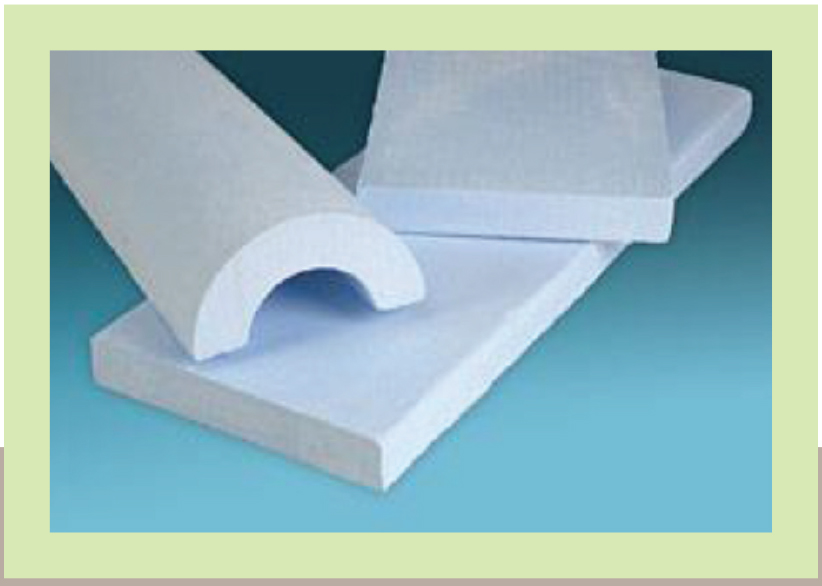
Figure 1

Textile Glass

Textile Glass (e-glass) fibrous thermal insulation is
produced from textile glass fibers (e-glass) and is needled into insulation
felts without the use of binders. The material is used as a thermal insulation
component in the fabrication of insulation systems for use on machinery and
equipment at temperatures up to 1,200°F. These products are covered in ASTM
C1086 and in MIL-I-16411F.

The Standard contains requirements
for thickness, mass per unit area, apparent thermal conductivity, hot surface
performance, tensile strength, and combustibility. For comparison purposes, the
thermal conductivity of the material is a maximum of 0.29 Btu?in/(hr?ft²?°F) at
75°F.

Powerful “super storm”
Hurricane Sandy literally destroyed parts of New York, New Jersey, and other
areas along the East Coast. According to the Construction Claims Advisor,
“Estimates of the economic losses caused by Hurricane Sandy recently reached
$50 billion after experts assessed the costs of severe property damage,
shut-down subways and power outages. Hurricane Sandy’s recent devastation along
much of the East Coast is a reminder of the significant factor weather can
contribute to the planning and execution of a construction project.” Other
estimates put the losses and cost of repairs in just the two states of New York
and New Jersey between $50-$65 billion.

The National Insulation Association (NIA) contacted all of
our manufacturing members to see if they could offer any advice on what to do
with insulation materials in the areas damaged by Hurricane Sandy. As some
members noted, providing a blanket response for the replacement of insulation
is difficult, as these situations are better assessed on a case-by-case basis.
The best advice is to always use caution when handling any construction
materials, and contact the original manufacturer and mechanical insulation
experts to get answers specific to your situation. The damage done by Sandy is
extensive, leaving contaminates in many buildings, facilities, and homes, going
far beyond ruining insulation and building materials. Trying to save money by
salvaging damaged goods may have dire future consequences that are presently
unknown.

NIA would like to thank the
respondents, whose valuable feedback contributed to this article: Allen Dickey
at Pittsburgh Corning; Tony Garone at Polyguard Products, Inc.; Matt Hair at
K-FLEX USA, LLC; Gordon Hart, representing Auburn Manufacturing, Inc.; Betty
Hartman at Evonik Foams, Inc.; and Mike Resetar at Armacell. The following are
some of their responses to our questions.

1. What type of insulation does your company make?

  • Allen Dickey (AD) at Pittsburgh Corning: Closed-cell cellular
    glass

  • Jake Erickson (JE) at Roxul, Inc.: Stone
    wool insulation

  • Tony Garone (TG) at Polyguard Products, Inc.: Adhesives, pipe
    insulation support systems, tapes, jacketing and flexible facings, protective
    coatings, and sealants

  • Matt Hair (MH) at K-FLEX USA: Closed-cell flexible
    elastomeric foam

  • Gordon Hart (GH), representing Auburn Manufacturing, Inc.:
    Insulation blanket; tapes; jacketing and facings; fitting covers and fitting
    insulation; pads and covers; prefabricated insulation panels;
    removable/reusable blankets

  • Betty Hartman (BH) at Evonik Foams, Inc.: Polyimide foam
    product

  • Mike Resetar (MR) at Armacell: Closed-cell flexible
    elastomeric foam

2. What would your advice be to contractors working in the
aftermath of Sandy? How do you suggest handling the mechanical insulation
products?

  • AD: Worker safety is extremely important. Make sure your
    immunizations are up to date and wear protective clothing. Dispose of all
    materials that are contaminated with salt water, and all wet insulation
    materials that cannot be dried out.

  • JE: [When rebuilding,] there is an
    opportunity to build with sustainable materials that add comfort to the
    interior environment. Contractors can differentiate themselves by building
    something special versus just the way it used to be. You can insulate with
    sustainable materials that contribute to LEED credits and improve building
    performance. You can identify products that can contribute to the entire
    mechanical system.

  • MH: Contractors should take safety precautions when working
    in areas affected by Sandy and should contact K-FLEX directly to address
    elastomeric insulation maintenance, repair, or replacement questions.  In
    general, elastomeric insulation can be handled without risk of personnel safety
    concerns and can be disposed of in a landfill.

  • MR: Any insulation that was wet from the storm needs to be
    removed from the piping, the pipe needs to be wiped clean and dry, and new
    insulation must be installed.

3. Can your product be dried out and reused in the insulation
system?

  • AD: In many cases, yes, assuming it is only wet from rain or
    freshwater and not contaminated with salt water or any other contaminants.

  • JE: Most stone wool products can be dried and reused if they
    become saturated with clean water. Due to the dimensional stability and
    rigidity of stone wool, the material does not sag or lose its insulating value
    after exposure to moisture.

  • MH: Given the number of variables in this type of natural
    disaster, (salt water, full product immersion, high winds) contractors should
    contact K-FLEX directly to address insulation replacement on a case-by-case
    basis.

  • GH: Yes, if the product has not been contaminated with salt
    water.

  • BH: Yes, if the water has not been contaminated.

  • MR: No. There is great concern for the sea water and
    contaminates trapped under the insulation, which could damage the pipe long
    after the storm damage is cleared.

4. Does your product need to be replaced with clean, new
product?

  • AD: If the system is breached and the insulation is wet from
    storm surge (salt water) flooding or contaminated with chemicals that may have
    been released as a result of the storm then the insulation must be replaced. If
    the system, upon inspection, is still intact and sealed, then there is no need
    for replacement.

  • JE: It is recommended that you replace the insulation if it
    has been exposed to contaminants or pollutants.

  • TG: Polyguard’s products are typically used on rooftop duct
    work and piping as weather protection for the insulation. If flooding reached
    the rooftop of the building, there’s a good chance the building was totally
    destroyed. Wind-driven rain could have penetrated the system and caused
    insulation to become saturated. If that is the case, the wet insulation should
    be replaced. Since Polyguard’s products adhere directly to the insulation, they
    would need replacement as well.

  • MH: If the insulation system has been damaged or
    contaminated, the product should be replaced and the piping should be cleaned
    before the replacement insulation is installed. [Note that] damage to the
    insulation can also be caused by high wind or flying debris, especially any
    insulation outside or on a roof top, so those areas should be evaluated as
    well.

  • GH: Yes, if the product has been contaminated with salt
    water, it should be replaced.

  • BH: It should be replaced if the product is damaged or
    contaminated.

  • MR: Yes.

5. What are the reasons that the product can stay or needs to
be replaced?

  • AD: Salt or contaminated water intrusion into the insulation
    system can create the potential for corrosion under the insulation. This would
    be the most immediate reason for system replacement.

  • JE: Stone wool can be reused because it is organic and does
    not promote mold growth. It retains its rigidity and performance even after it
    has been exposed to moisture. It is also permeable so vapor can pass through
    the product.

  • MH: The need to replace product would depend on the extent of
    damage, so contractors should contact K-FLEX directly to address insulation
    replacement on a case-by-case basis. For example, damage caused by full and
    extended immersion in water would warrant product replacement. [There also may
    be] damage to insulation that may have been in inventory or on a job site.

  • MR: Concerns about the sea water and other contaminates in
    the water that will be trapped under the insulation [need to be considered].

6. For insulation, do you have any advice or product removal
or installation suggestions?

  • AD: Our MSDS [Material Safety Data Sheet] covers handling and
    disposal. Installation recommendations are application specific and are
    available on request.

  • MH: Contractors should follow the best practices for
    installing elastomeric insulation. Two good sources for this are a
    comprehensive “Installation Guide” available at www.kflexusa.com and
    ASTM C1710, Installation of Flexible Closed Cell Preformed Insulation in
    Tube and Sheet Form
    .

  • GH: There are no special removal instructions, but the pipe,
    which has been contaminated with salt water, should be cleaned off with tap
    water and allowed to dry prior to being re-insulated.

7. Do you have any health and safety advice or suggestions?

  • AD: Consult the MSDS for materials involved and use
    appropriate safety procedures prior to handling any product.

  • MH: Contractors should contact the manufacturer of all
    insulation types for specific health and safety concerns. In general, elastomeric insulation does not pose safety hazards.

8. Has your company appointed a hazard, environmental
engineer, or other contact person for contractors who have related product
questions?

  • AD: Contact our Technical Support Group or me (Allen Dickey)
    at Pittsburgh Corning.

  • MH: Yes, contractors can reach K-FLEX Technical Support at
    800-765-6475.

  • GH: Yes. You can
    contact me at
    gordon.hart@artekengineering.com.

NIA manufacturer members had additional
recommendations, including Allen Dickey’s (Pittsburgh Corning) observation that
consideration of the need for replacement extends to building envelope
insulation, as well as other materials besides insulation. Matt Hair (K-FLEX
USA) added that damage to the insulation jacket would warrant a look at the
insulation even if damage is not readily visible from the outside. If the
jacket is compromised, the insulation probably is also, and needs to be
replaced. Gordon Hart (Auburn Manufacturing, Inc.) commented that he would
assume most “flooded insulation materials have been contaminated by salt
(sodium chloride), a highly corrosive chemical to steel and other metals.” He
“would recommend that all such contaminated insulation materials be removed and
discarded, as soon as possible, and the contaminated pipe and equipment first
sprayed with high pressure fresh water prior to their being reinsulated.”

In the aftermath of the hurricane, it was universally
noted how people came together to help one another. NIA is pleased to provide a
forum for our members to share their expertise and pass along information to
support all who may have been impacted by the storm. Please contact your
mechanical insulation expert for suggestions on product replacements, or visit www.insulation.org.

High-Temperature Fiber

High-temperature fiber insulations are fibrous
insulations, varying
in flexibility, density,
and composition, with or without binders. These insulation products are
available in flat sheets, rolls, boards, or loose fibers. The insulation products
are used as the thermal insulation component in the fabrication of insulation
systems for use at temperatures up to 3,000°F.

This
category of products is composed of Refractory Ceramic Fibers (RCF), including
a recently developed class generally referred to as Alkaline Earth Silicates
(AES). These AES fibers are designed to be bio-soluble (i.e., they have
enhanced in-vitro solubility characteristics that enable these products to meet
European regulatory requirements [Directive 97/69/EC] for man-made vitreous
fibers).

The
RCF products in mat and blanket form are covered in ASTM C892. Products are
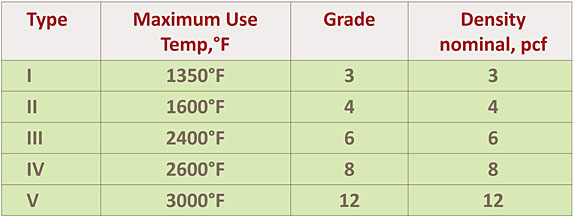
classified into five types (by maximum use temperature) and five grades (by
density).

The
standard contains requirements for thermal conductivity, density, maximum use
temperature, non-fibrous (shot) content, linear shrinkage, and tensile
strength. For comparison purposes, the maximum thermal conductivity of Grade 3
material is 0.66 Btu?in/(hr?ft²?°F) at 400°F. It should be noted that not all
manufacturers of high-temperature fiber products utilize the ASTM C 892
standard for their products.

High-temperature
insulation products are often used as an alternative to fire resistance-rated shaft
enclosures. Applications include kitchen exhaust grease ducts, ventilation
ducts, stairwell pressurization ducts, smoke extraction, chemical fume exhaust
ducts, and refuse and trash chutes. They may be used to cover plastic pipe and
cables to limit flame spread and smoke generation in fire-rated air plenums.
These insulation systems are listed and labeled by nationally recognized
laboratories.

Pneumatically
applied high-temperature fibers are typically used on applications where it
would be difficult to adhere blankets to a surface. These typically are
internal surfaces, such as furnace interiors, or outer surfaces that are
convoluted and/or difficult to access, such as boiler tube walls on a
coal-fired furnace. While they are not yet covered by an industry
specification, an ASTM specification is in development.

The
composition can be described as follows: The basic types of materials are
loose, inorganic fibers (either RCF or AES) combined with a liquid, water-based
chemical binder. The fibers are made from mineral substances such as silica,
alumina, calcium, and magnesium processed from the molten state into fibrous
form. The liquid binder is made from inorganic materials: water, colloidal
silica, and less than 2% of an organic foaming agent.

The
pneumatically applied product is separated into three types based on the
chemistry and upper use temperature use limit: The liquid binder consists of a
mixture of both organic and inorganic (colloidal silica) materials, and is
typically added in sufficient quantity to provide the fibers with necessary
adhesion to the applied surface; cohesion to one another; and the required physical properties
of the installed, dry insulation. Also, this type of fiber insulation is
typically dimensionally stable with exposure to the maximum rate temperature
for the particular type (I, II, or III). When first heated above a temperature of
about 500° F, most or all of the organic binder decomposes, leaving only the
colloidal silica binder.

The surface to which pneumatically applied high-temperature
fiber insulation is applied is typically prepared with weld pins and wire mesh,
the latter being applied a distance off the surface 1 inch less than the
finished thickness. The pins and wire mesh ensure the insulation material is
firmly applied and will resist the effects of vibration and external forces.

Fibrous Insulations

Fibrous insulations are
composed of small-diameter fibers that finely divide the air space. The fibers
may be organic or inorganic and they are normally (but not always) held
together by a binder. Typical inorganic fibers include glass, rock wool, slag
wool, and alumina silica.

Mineral Fiber (Fiberglass
and Mineral Wool)

Mineral fiber insulations
are defined by ASTM as insulations composed principally of fibers manufactured
from rock, slag, or glass, with or without binders.

Fiberglass and
mineral wool products fall in this category. There is some confusion concerning
the nomenclature used for these materials. Fiberglass products (sometimes
called “fibrous glass” or “glass wool”) and mineral wool products (sometimes
called “rock wool” or “slag wool”) are covered by the same ASTM “mineral fiber”
specifications, and sometimes by the same type and grade. Specifiers are
cautioned to call out both the specific material and the ASTM type and grade
when specifying these products. For example “Fiberglass pipe insulation meeting
the requirements of ASTM C547 Type I, Grade A” or “Mineral Wool pipe insulation
meeting the requirements of ASTM C547 Type II, Grade A.” A number of ASTM
material standards cover mineral fiber products.

Mineral Fiber Pipe

Mineral fiber pipe
insulation is covered in ASTM C547. The standard contains five types classified
primarily by maximum use temperature.

The standard further
classifies products by grade. Grade A products may be “slapped on” at the
maximum use temperature indicated, while Grade B products are designed to be
used with a heat-up schedule.

The specified
maximum thermal conductivity for all types is 0.25 Btu
in/(hr ft² °F) at a mean temperature of 100°F.

The standard also
contains requirements for sag resistance, linear shrinkage, water-vapor
sorption, surface-burning characteristics, hot surface performance, and
non-fibrous (shot) content. Further, there is an optional requirement in ASTM
C547 for stress corrosion performance if the product is to be used in contact
with austenitic stainless steel piping.

Fiberglass pipe
insulation products will generally fall into either Type I or Type IV. Mineral
wool products will
comply with the higher temperature requirements for Types II, III, and V.

These pipe
insulation products may be specified with various factory-applied facings, or
they may be jacketed in the field. Mineral fiber pipe insulations systems are
also available with self-drying wicking material that wraps continuously around
pipes, valves, and fittings. These products are intended to keep the insulation
material dry for chilled water piping in high-humidity locations. Mineral fiber
pipe insulation sections are typically supplied in lengths of 36 inches, and
are available for most standard pipe and tubing sizes. Available thicknesses
range from ½” to 6″.

Mineral Fiber Blanket

Mineral fiber blanket
insulation for commercial and industrial applications is covered in ASTM C553.
The standard contains seven types classified by maximum use temperature and thermal
conductivity.

The standard also
contains requirements for flexibility, water-vapor sorption, odor emission, surface-burning
characteristics, corrosiveness, and shot content.

These insulations
are flexible and are normally supplied as batts or rolled blankets. Dimensions
vary, but thicknesses from 1″ to 6″ are typically available. The products may
be specified with various factory-applied facings, or may be ordered unfaced.

Mineral Fiber Block and
Board

Mineral fiber block and
board insulation is covered in ASTM C612. This standard contains five types classified
by maximum use temperature and thermal conductivity.

Each of these types
is further classified by compressive resistance. Category 1 materials have no requirement
for compressive resistance, while Category 2 materials require a minimum
compressive resistance value. Density is not a performance measure and has been
removed as a requirement in ASTM C612.

The standard also
contains requirements for linear shrinkage, water-vapor sorption,
surface-burning characteristics, odor emission, corrosiveness to steel,
rigidity, and shot (non-fibrous) content. Further, there is an optional
requirement in ASTM C612 for stress corrosion performance if the product is to
be used in contact with austenitic stainless steel. Fibrous glass boards will
generally meet Types I, II, or III. Mineral wool products will generally comply
with the higher temperature requirements for Types IVA, IVB.

These
products are supplied in rigid and semi-rigid board form. Dimensions will vary,
but typical available thicknesses range from 1″ to 4″. The products may be
specified with various factory-applied facings, or may be ordered unfaced.

Figure 1
Figure 2
Figure 3
Figure 4
Figure 5